
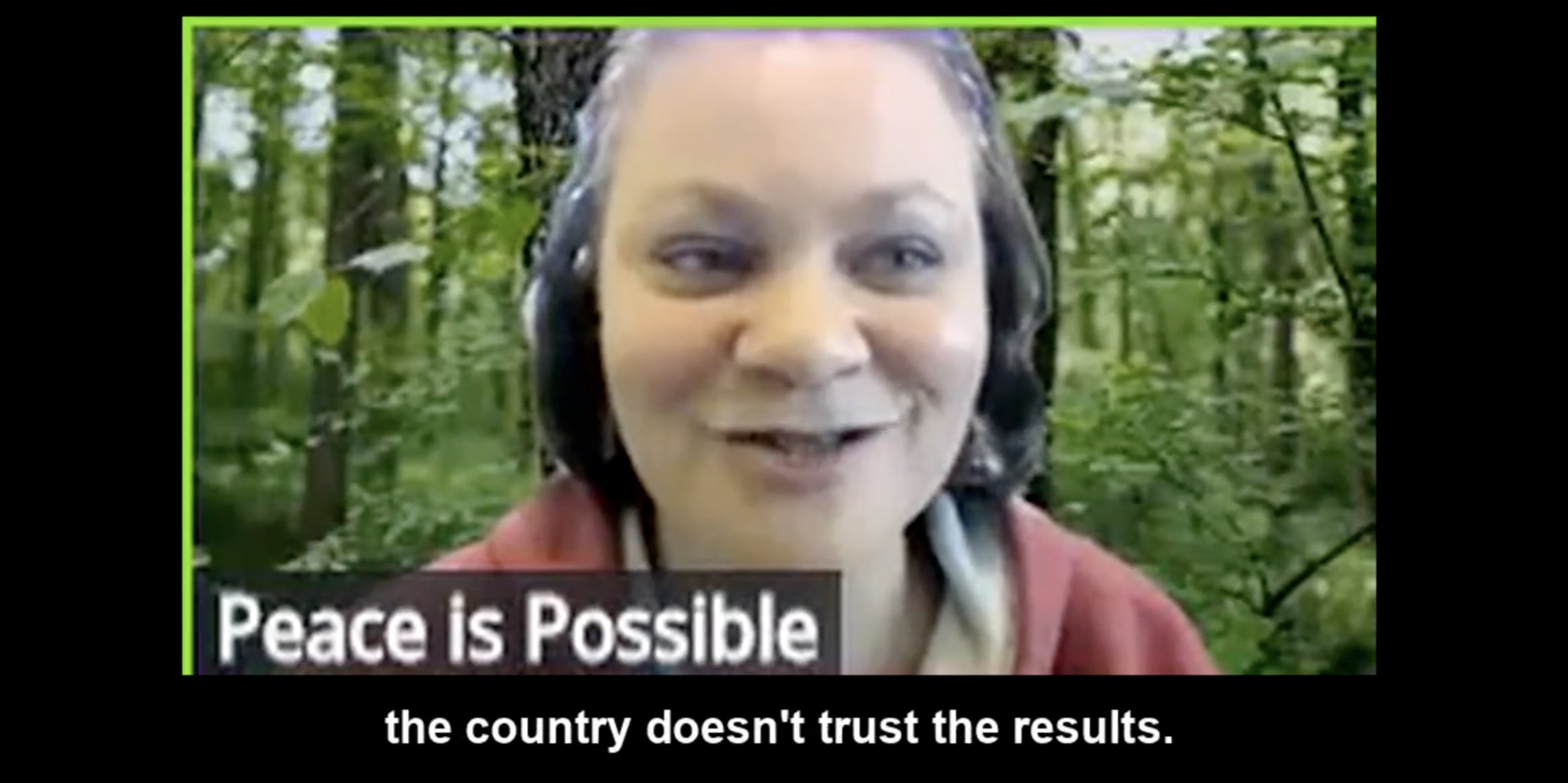
"The research shows that to reverse democratic decline in any one country, international solidarity is key."

A new batch of videos released by DataRepublican has revealed Democrat discussions with foreign operatives on tactics that they could deploy in the US around the midterms, discussing "emergency scenarios" that could affect the 2026 midterms, and how they want to turn a "breakdown into a breakthrough" for implementing "institutional reform."
DataRepublican also obtained video from a July call titled “Lessons from the Frontlines,” in which foreign actors shared their advice for those in the United States. The meeting was hosted by RAD’s International Solidarity Working Group and Renew to Thrive.
In her closing statement from the call, Reiff said, “The research shows that to reverse democratic decline in any one country, international solidarity is key.” She said that “We used to be the ones, you know, with a lot of money and sharing our model and our and our guidance and our support, now we are really grateful for those of you who are stepping up to provide a similar level of guidance and support for us as we traverse a difficult period here in the US.”
Speaking at the meeting was Rast’o Kuzel, a Slovakia-based media and election monitoring expert. He said that “prebunking and inoculation” was needed, “anticipating some of these narratives before they actually dominate the information space, explaining the manipulation techniques, and building trusted channels between citizens and politics, and this is clearly something which could be really done within this type of circles.”
CRTA program director Rasa Nedeljkov of Serbia said that a tool that had proved to be “useful” and was learned “from you guys two decades ago” was that “we need to be present at every polling station. Citizens who are afraid, citizens who do not believe that in the vicinity of the polling stations there are going to be somebody who can help them, who can be the guide for them, who can be some kind of point of contact from them, then it could happen that actually they do not turn out to vote at all.”
“So what we provided was presence of activists around the polling stations, but also we provided hotlines, legal hotlines for citizens, so that they can report and call, and we can provide the legal assistance at the spot.
Edgar Ortiz Romero, a constitutional lawyer from Guatemala, said, “litigation alone was not enough. Mobilization alone is not enough. You need to, you know, fight on different fronts, and in our case, that was the key to success.” He said that judges “are rational people, and they are also looking at the streets and saying, ‘Hey, you know, I cannot ignore this mobilization.’”
DataRepublican noted that “is that all of the foreign actors' recommendations were implemented right here in America,” noting news headlines from the past few months regarding possible election challenges.
In a January 2026 Renew American Democracy (RAD) forum meeting, Danielle Reiff, RAD’s co-coordinator and a retired USAID democracy officer, said, “So the issue that we want to address this month with today's forum is the emergency scenarios in the strategy.”
“So the three emergency scenarios that were identified that could affect us in 2026 were, one, militarization. We already have seen, you know, more military and ICE and, you know, National Guard on the streets than we have certainly during my lifetime, and we know there's a potential for that militarization to become a greater challenge for us,” she said.
“The second scenario is election meltdown, which could happen in any number of ways. We could have a perfectly clean election, and then half the country or 25% of the country doesn't trust the results. And then the final scenario is around sort of an acute constitutional crisis if we experience a moment where there is an attempt to undermine the peaceful transition of power,” she said.
An example she gave of an “election meltdown” was, “if we hold an election and everybody agrees on the results, and we're trying to move forward. And then, for example, newly elected members of Congress are not seated promptly, and then there’s, you know, delays and questions about how Congress can move forward. So that's just one way that that could manifest in 2026.”
One participant in the meeting, Nadine Block, the training director of Beautiful Trouble, said that there was an “immediate crisis” and “we can't wait to actually figure some of this stuff out for the midterms.” She said “there was kind of an understanding that there's not a clear possible transfer of power at the national level from the right to the left, given current circumstances, unless things change dramatically, that's a big deal.”
In an online call that took place on August 5, 2026, Reiff said that there’s a “big tent that’s being organized in the blocking community, so that if there is a red line crossed in terms of a constitutional crisis, like everybody’s already pre-organized. They’ve identified the red lines, and everybody on the street, like, across the entire blocking community.”
Per DataRepublican, the so-called “blocker community” is “the umbrella of countless NGOs that are ready to mobilize against Trump, both on the streets and in lawfare (and, as it seems, in involving local officials). Includes Indivisible, Democracy Funders, etc.”
She had spoken with Mike Smith, a retired rear admiral and founder of National Security Leaders for America, the day prior, “But in the conversation yesterday, we were talking about the NDC and the broader like conception of turning a breakdown into a breakthrough. And if we do enter into a crisis, how do we pivot that to the kind of institutional reform and structural reform that'll actually get us out of this mess.”
She said the blocking community wasn’t just planning for election day or certification day, and that “the research all shows that you know the blocking community can like rid us of a dictator, and the renewal will not happen if there's not a positive vision and a plan for what to do on the day after.”
Powered by The Post Millennial CMS™ Comments
Join and support independent free thinkers!
We’re independent and can’t be cancelled. The establishment media is increasingly dedicated to divisive cancel culture, corporate wokeism, and political correctness, all while covering up corruption from the corridors of power. The need for fact-based journalism and thoughtful analysis has never been greater. When you support The Post Millennial, you support freedom of the press at a time when it's under direct attack. Join the ranks of independent, free thinkers by supporting us today for as little as $1.
Remind me next month
To find out what personal data we collect and how we use it, please visit our Privacy Policy


Comments