
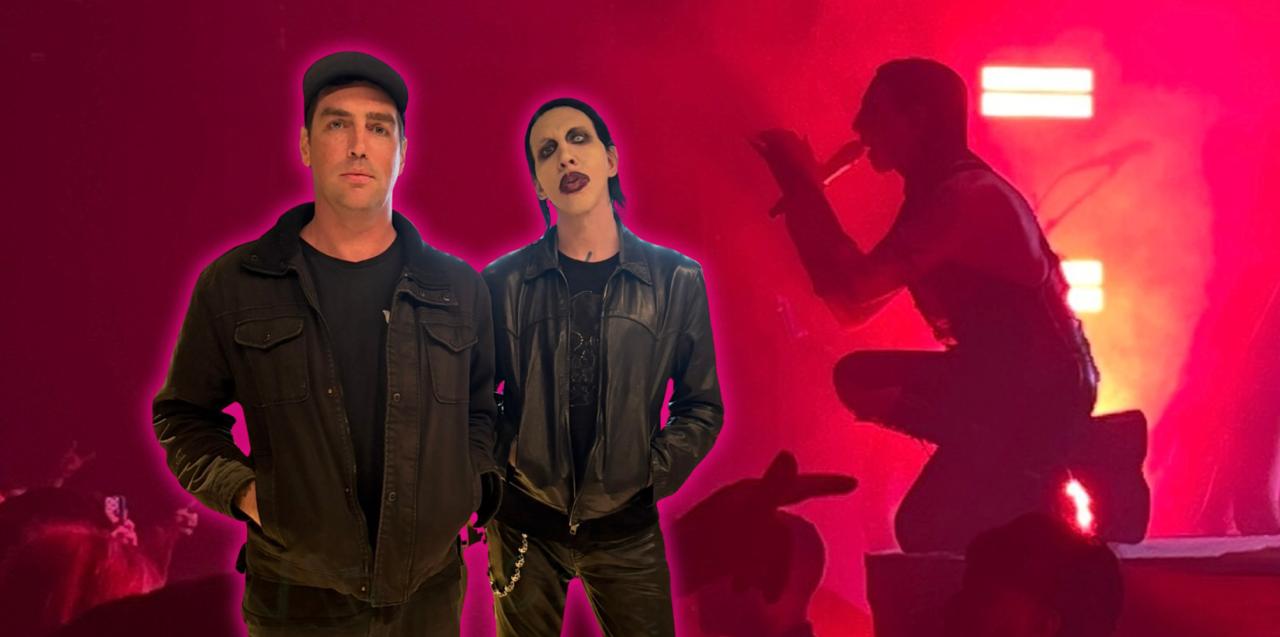
The culture may finally be shifting away from the media’s old habit of turning sensational headlines and flimsy accusations into permanent bogeymen.

The concierge at the Hilton West Palm Beach handed me my room key and asked, apropos of nothing, if I was a fan of Marilyn Manson. She didn’t know I’d come to see the first stop of the Freaks on Parade tour at the iTHINK Financial Amphitheater. She was an older woman, and she seemed excited to tell me—maybe she was telling everyone—that people from the tour were staying at the hotel, too. I was in a white shirt, gray slacks, a hat, and sunglasses.
I don’t think I gave off the look of someone who goes to a Manson show. No black lipstick. No chaps. No mismatched contacts. No fishnet. The amphitheater was thirty minutes away. I thanked her, and thought: five years ago, the concierge might’ve told me of Manson’s proximity as a warning, like do yourself a favor and lock your doors. Tonight it was almost a courtesy.
Her excitement felt like a quiet barometer. The culture may finally be shifting away from the media’s old habit of turning sensational headlines and flimsy accusations into permanent bogeymen. Manson is a veteran of these attacks—he survived the post-Columbine frenzy and has now weathered the latest storm. It feels like a broader signal that people are no longer so easily manipulated by clickbait and coordinated character assassination, though that discernment still ebbs and flows.
I should say that I’ve met Manson before. So take what follows for what it is—not a verdict, but a report from someone who’s watched his career from close range. His return to the stage began a few years earlier. I met him and his wife, the photographer Lindsay Elizabeth Warner backstage at the Fillmore in Silver Springs, MD on August 3, 2024. That night was his first headlining show in five years. The room had sold out in about fifteen minutes. His large platform boots made him taller than me—without them I would have been taller by an inch. I told him that, at the time, it felt like the lead-up to Holy Wood all over again.
Holy Wood, his fourth studio album, released in 2000, was the record that came after the media tried to blame him for Columbine. This time was different. This time, I told him, the accusations went after Brian Warner. Not the character. Those accusations were grave ones—abuse, coercion, cruelty—and when they surfaced in February 2021, they arrived the way these things now do, all at once, a wave. He answered them almost entirely with silence. No press tour, no rehabilitation campaign, no confessional documentary.
The only public words he’s offered came in a single written post and in court. In that post he said, “Obviously, my art and my life have long been magnets for controversy, but these recent claims about me are horrible distortions of reality. My intimate relationships have always been entirely consensual with like-minded partners.” Whatever you make of the allegations—and readers will make different things of them—he didn’t fight the narrative in the press. He let the work answer instead. Art is his weapon. Art is his revenge. And the work delivered.
Chapter One of One Assassination Under God, released November 22, 2024 debuted at No. 32 on the Billboard 200, No. 5 on Top Album Sales, and No. 2 on Hard Rock Albums, moving more than twenty-one thousand copies its first week. He only had to rely on support from his audience. Chapter Two dropped on August 14, 2026. The Freaks on Parade tour with Rob Zombie is selling out arenas. The new videos pull millions of views within days—Exit Wound past three million, Unalive past a million and a half.
You can argue about what he deserves. You can’t argue that the audience abandoned him. The songs carry his trials in them; anyone who watched him go through this will hear the references. But they don’t depend on him. They’re specific to one man’s interior and exterior weather, and somehow that’s what makes them portable. Spiritual, even. On the track “All the Vilest Things,” he sings, “Heaven on my mind.” That line connects directly to the final song on Chapter One, where after being publicly sacrificed—symbolically, with real-world fallout of cancelled tours and lost work—he dies and ascends into Heaven to see his parents–of whom he always spoke about with love and respect and, for their part, his parents always seemed supportive of their son.
“If you die when there’s no one watching and your ratings drop and you’re forgotten… but if they kill you on their TV… you’re a martyr and a Lamb of God.”
That’s from the song “Lamb of God” on the Holy Wood album—and they’re as relevant today as they were then. This is the cyclical nature of fame and media. Sensationalism and character assassination. However, you don’t have to be someone getting fed through the media machine to relate to these songs. Someone nursing an entirely different wound can put the record on and recognize themselves in it. It’s about isolation, alienation, survival, and love. There are also nods to Manson’s past on the album and onstage, but this isn’t a nostalgia act. It is, as the songs imply, a resurrection.
On the opening track of Chapter Two, “Unalive,” he sings of rising from the fake grave the accusers tried to put him in. It is celebratory.
Two albums of war songs, and it ends with a love song. The final track on Chapter Two is called Enantiomorph. The word means a mirror image or opposite form—like a left and right hand. After everything—the accusations, the silence, the years of fighting to stay standing—the record closes not with another battle cry, but with something tender, with the battlefield in the background.
It is a love song for Lindsay, a finale of his own odyssey. Unlike Odysseus, Manson was adrift for years with his wife by his side—an anchor as they fought the headline annihilation machine. Not an easy triumph, but a hard-won one.
He sings on this on the final track of Chapter 2: “We didn’t know to be cut out for this. It would have to be cut into us.” Then, at the end of the song, he addresses his wife, “It’s not for what they did to me, it’s for what they did to you.”
The man made it home, intact, but changed, and still capable of love. After all the accusations and headlines and the symbolic death, Manson gets the final word. And now his fans sing those words with him around the world, a giant choir of triumph. The fans and the artists have chosen the real world over the scripted one.
Manson isn’t alone in this return. Ye is out there too, filling stadiums while the same annihilation machine keeps grinding. The media tried to declare both men finished; their audiences refused. These are not soft comebacks. They are refusals to be erased—by the press, by the courts of public opinion that demand no evidence, by a culture that spent years treating accusations as proof. The men who speak against the machine almost always face the same coordinated response. The fact that their fans are still showing up, still buying the records, still singing the words back at them, is the real story. It is a hard-won insistence that a life cannot be canceled on rumor alone.
Marilyn Manson has always been a reflection of America at its best and worst, fear and violence, peace and war, good and evil, and these new songs are a reflection of anger, suffering, survival, and love as America feels like it’s shaking off some long political spell–to some degree, at least. Six years sober, in a committed marriage, he’s back on stage and in control of the narrative.
In West Palm Beach, I saw fans of all ages singing along. They knew the songs from 1996 and they knew the songs that just came out. There were thousands of goths in the muggy 90 degree Florida heat. The bartenders and the EMTs at the gate sang along. I even saw cops taking selfies as he sang the words “cops and queers” during “The Dope Show”—and it felt like maybe this new and improved version of Manson is a reflection of hope in an increasingly mad world.
Shane Cashman is the author of Good Villains: My Journey to the Frontlines of Fame, Controversy, and the War on Reality.
Powered by The Post Millennial CMS™ Comments
Join and support independent free thinkers!
We’re independent and can’t be cancelled. The establishment media is increasingly dedicated to divisive cancel culture, corporate wokeism, and political correctness, all while covering up corruption from the corridors of power. The need for fact-based journalism and thoughtful analysis has never been greater. When you support The Post Millennial, you support freedom of the press at a time when it's under direct attack. Join the ranks of independent, free thinkers by supporting us today for as little as $1.
Remind me next month
To find out what personal data we collect and how we use it, please visit our Privacy Policy

Comments