
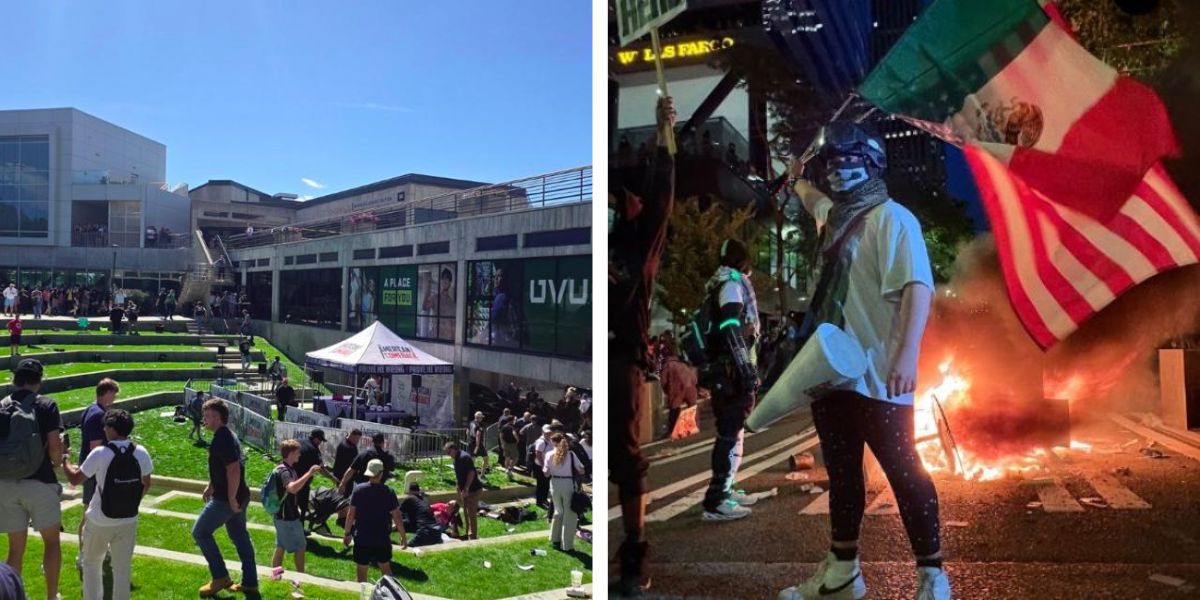
The survey was conducted in the wake of the Sept. 10 murder of conservative commentator Charlie Kirk.

The survey was conducted Sept. 22–28, 2025, in the wake of the Sept. 10 murder of conservative commentator Charlie Kirk and follows recent attacks on Republican and Democratic officials.
“Across the country, and across the political spectrum, Americans see politically motivated violence as on the rise,” Pew researchers Joseph Copeland and Jocelyn Kiley wrote in the report.
While agreement on the trend is nearly universal, Americans are deeply divided about the sources of political violence.
Just over half of US adults view both left-wing extremism (53 percent) and right-wing extremism (52 percent) as major problems, while 47 percent say violence from people with no clear political views is a major concern.
The partisan split is stark: 77 percent of Republicans call left-wing extremism a major problem, compared with 27 percent who say the same of right-wing extremism. 76 percent of Democrats say right-wing extremism is a major problem, while 32 percent point to the left.
Roughly half in each party (49percent of Republicans, 47percent of Democrats) view politically unaffiliated extremists as a significant threat.
Pew wrote, “Large majorities of both Republicans and Democrats see extremism as a problem, but they disagree sharply about where the threat comes from.”
When asked to describe the causes of political violence in their own words, respondents often pointed to rhetoric from the “other side.”
28 percent of Democrats cited the rhetoric or behavior of Donald Trump, Republicans, or the MAGA movement as a reason for violence. 16 percent of Republicans mentioned Democrats, liberals, or the Democratic Party as contributing factors.
Pew noted that “partisans’ most common answers reference the other political side.”
The second most common answer overall was political polarization, cited by 11percent of respondents. 13percent of Democrats and 9percent of Republicans said growing divisions between the two parties fuel violence.
“We have a larger divide between the right and left than ever before, so we don’t see each other as people but as the ‘enemy.’ When you see someone as an enemy, you can justify a lot of awful actions,” said a Republican respondent in their 30s.
An independent who leans Democratic added: “The country has, over time, become politically only two major parties with severely extreme and opposite views.”
Roughly one in ten Americans cited an unwillingness to engage with or understand those with different views as a key factor. 13 percent of Republicans and 9percent of Democrats mentioned this.
A Republican respondent in their 60s said, “No one knows how to discuss and have a conversation with people of opposing values. We don’t have to agree with each other, but we must learn to have adult conversations again.”
A Democrat in their 20s wrote: “The inability to communicate respectfully and come to a solution that supports both sides. There is no compromise.”
About 9 percent of respondents, across party lines, said there has been a normalization or acceptance of violence in the country. “My generation and the one below me think they are getting justice by being violent and even killing people who don’t agree with them,” said a Republican in their 20s.
Another respondent, a Democrat in their 60s, said: “Too many people accept this as normal.”
Another recurring theme was the role of media, both social and traditional.
6 percent cited social media directly, while 6 percent pointed to television or other traditional news outlets.
Republicans (17 percent) were nearly twice as likely as Democrats (9percent) to cite the media overall as a contributor.
“I think a lot of it comes from social media, politicians, and biased news feeding division and extreme rhetoric who paints people who disagree as enemies,” said a Republican in their 20s.
An independent in their 20s who leans Democratic said: “Media often wants you to be angry to drive engagement, which ultimately is what they survive off of.”
The Pew report underscores a paradox: Americans overwhelmingly agree that political violence is worsening but interpret its causes through starkly partisan lenses. “Americans may share the same concern, but they are living in very different narratives about who’s driving it,” the report concludes.
Powered by The Post Millennial CMS™ Comments
Join and support independent free thinkers!
We’re independent and can’t be cancelled. The establishment media is increasingly dedicated to divisive cancel culture, corporate wokeism, and political correctness, all while covering up corruption from the corridors of power. The need for fact-based journalism and thoughtful analysis has never been greater. When you support The Post Millennial, you support freedom of the press at a time when it's under direct attack. Join the ranks of independent, free thinkers by supporting us today for as little as $1.
Remind me next month
To find out what personal data we collect and how we use it, please visit our Privacy Policy


Comments