
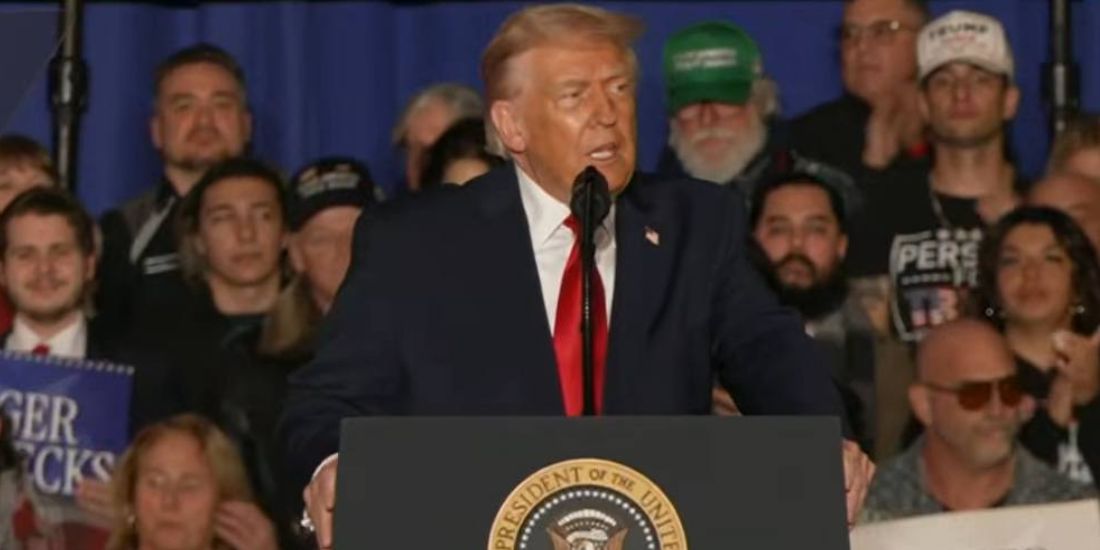
"At this preliminary stage, the Government has failed to identify a source of authority that would allow the military to execute the laws in Illinois."

The Supreme Court has denied a bid from the Trump administration to deploy the National Guard to Illinois. The emergency request from the administration was filed in response to an October ruling by US District Judge April Perry.
The unsigned order stated, "At this preliminary stage, the Government has failed to identify a source of authority that would allow the military to execute the laws in Illinois."
Trump had called 300 members of the Illinois National Guard into active federal service to protect federal property and personnel in Illinois, particularly in the Chicago area, on October 4, and federalized members of the Texas National Guard the following day to send them to Chicago. A US District Court had barred the federalization and deployment of the National Guard in Illinois, while an appeals court permitted the Guard to remain federalized in Illinois, but upheld the bar on their deployment.
"In calling forth the Guard, the President relied on 10 USC §12406(3), which empowers him to federalize members of the Guard if he is 'unable with the regular forces to execute the laws of the United States,’" the order stated.
The order later added, "We conclude that the term 'regular forces' in §12406(3) likely refers to the regular forces of the United States military. This interpretation means that to call the Guard into active federal service under §12406(3), the President must be 'unable' with the regular military 'to execute the laws of the United States.' Because the statute requires an assessment of the military’s ability to execute the laws, it likely applies only where the military could legally execute the laws.
"Such circumstances are exceptional: Under the Posse Comitatus Act, the military is prohibited from 'execut[ing] the laws' 'except in cases and under circumstances expressly authorized by the Constitution or Act of Congress.' 18 USC §1385. So before the President can federalize the Guard under §12406(3), he likely must have statutory or constitutional authority to execute the laws with the regular military and must be 'unable' with those forces to perform that function."
Trump, the court said, "has not invoked a statute that provides an exception to the Posse Comitatus Act. Instead, he relies on inherent constitutional authority that, according to the Government, allows him to use the military to protect federal personnel and property. But the Government also claims—consistent with the longstanding view of the Executive Branch—that performing such protective functions does not constitute “execut[ing] the laws” within the meaning of the Posse Comitatus Act."
In his dissent, Justice Samuel Alito wrote, "In the lower courts, the parties agreed that the phrase 'regular forces' means civilian federal law enforcement officers, not military service members. Respondents explicitly adopted this position in the District Court."
He wrote that the "District Court’s interpretation would lead to even more outlandish results if 'regular forces' means the military. In that case, a President could not call up the National Guard to execute the laws in one locale unless all the Nation’s military forces, if transferred to the area in question, would be incapable of executing the laws."
Powered by The Post Millennial CMS™ Comments
Join and support independent free thinkers!
We’re independent and can’t be cancelled. The establishment media is increasingly dedicated to divisive cancel culture, corporate wokeism, and political correctness, all while covering up corruption from the corridors of power. The need for fact-based journalism and thoughtful analysis has never been greater. When you support The Post Millennial, you support freedom of the press at a time when it's under direct attack. Join the ranks of independent, free thinkers by supporting us today for as little as $1.
Remind me next month
To find out what personal data we collect and how we use it, please visit our Privacy Policy






Comments