
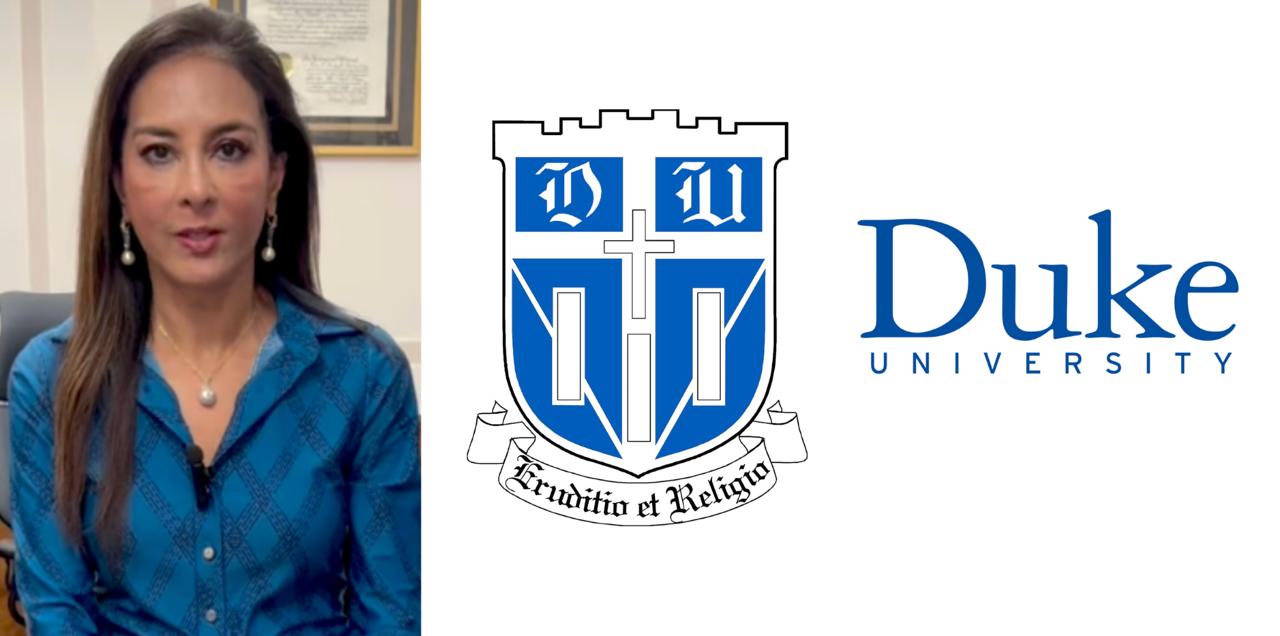
“As a result of these practices, highly qualified white, Asian, and other students were denied admission on the basis of their race.”

The DOJ's Civil Rights Division announced Thursday that Duke Law violated Title VI of the Civil Rights Act of 1964 in admissions for its incoming classes of 2023, 2024 and 2025. The department said the practices also violated the Supreme Court's 2023 ruling in Students for Fair Admissions v. Harvard, which restricted universities' use of race in admissions.
In an Aug. 6 findings letter, the DOJ said investigators reviewed Duke Law's internal documents and admissions data and determined the school continued "intentionally" granting and denying admission based on race following the Supreme Court decision.
“Duke Law School doesn’t get a free pass to discriminate against white and Asian students simply because it thinks it has good intentions,” Assistant Attorney General Harmeet K. Dhillon said. “Using ‘diversity’ essay questions to identify preferred races for admission is still illegal discrimination based on race, and this Department is committed to eliminating it everywhere we find it, including in our nation’s law schools.”
According to investigators, Duke officials were explicitly concerned with maintaining racial diversity following the Supreme Court decision.
Internal communications cited by the DOJ show administrators discussing admissions policies that could give preference to applicants demonstrating particular commitments while “possibly helping our diversity goals.” Duke's application-review guidance prominently incorporated the law school's mission statement, including its commitment to “diversity of perspective and experience.”
Admissions reviewers were also instructed to tag applicants' short-answer responses, including with a “Diversity/Services” designation. Although Duke's published policies stated that reviewers did not see applicants' racial demographic data, the DOJ found that the school elevated characteristics frequently correlated with race, including first-generation and Pell Grant status. Investigators concluded those supposedly race-neutral factors were being used as proxies to advance Duke's racial diversity goals.
Internal communications from 2023 went further. Duke Law officials described DEI as “one of our most important values” and pledged to “work even harder” to admit and recruit “a racially diverse class.” The DOJ said the evidence showed Duke's pre- and post-SFFA admissions strategies were structured to advance racial diversity through “ostensibly race-neutral tools.”
The admissions statistics cited by investigators showed substantial disparities. In 2024, the median LSAT among admitted black applicants was 164, compared with 173 for Asian applicants and 172 for white applicants. In 2025, the median for admitted black applicants was 166, compared with 173 for both Asian and white applicants. More strikingly, the median LSAT scores of rejected Asian and white applicants exceeded those of admitted black applicants in both years.
After accounting for LSAT scores, undergraduate GPAs and race, DOJ investigators said their model found that in 2025 a black applicant had roughly 3.5 times the probability of admission as an Asian applicant with similar academic credentials. The department said racial preferences were even larger in earlier admissions cycles and, although they declined following SFFA, remained statistically and practically significant.
The DOJ ultimately concluded that Duke discriminated against applicants to benefit black and Hispanic candidates. According to the department, Duke's internal policies and communications showed an intent “to discriminate against all racial groups except black and Hispanic applicants, to accept more black and Hispanic applicants.”
“As a result of these practices, highly qualified white, Asian, and other students were denied admission on the basis of their race,” the DOJ findings letter states. The department concluded that Duke violated Title VI in its 2023 through 2025 incoming classes and said, based on its review of the school's documents and data, it believes the discrimination is ongoing.
The DOJ is now seeking a voluntary resolution agreement with Duke University requiring the school to bring its admissions practices into compliance with federal law. If voluntary compliance cannot be reached, federal regulations allow the department to pursue enforcement through the courts.
Duke is not the first major university to face federal action over admissions and DEI policies. The DOJ has undertaken a broader enforcement push targeting alleged race discrimination at federally funded universities. In October 2025, the department reached an agreement with the University of Virginia requiring the school to comply with federal anti-discrimination guidance in admissions, hiring and other university programs. UVA agreed to provide compliance information to the government quarterly through 2028, with its president personally certifying compliance. In exchange, DOJ agreed to pause pending civil-rights investigations and close them if UVA fulfills the agreement.
The following month, the administration reached agreements with Cornell University and Northwestern University. Cornell agreed to pay $30 million to the federal government and provide admissions-related data, while Northwestern agreed to pay $75 million through 2028 and pledged not to give preferences based on race, color or national origin in admissions, scholarships, hiring or promotions. Northwestern's president and board chair are also required to certify compliance quarterly.
The DOJ has separately pursued admissions investigations closely resembling the Duke case. The department found Yale School of Medicine intentionally discriminated based on race and sought a voluntary resolution, while investigators accused UC San Diego School of Medicine of using applicant “hardship” classifications in a manner that helped identify underrepresented minority applicants after SFFA.
Powered by The Post Millennial CMS™ Comments
Join and support independent free thinkers!
We’re independent and can’t be cancelled. The establishment media is increasingly dedicated to divisive cancel culture, corporate wokeism, and political correctness, all while covering up corruption from the corridors of power. The need for fact-based journalism and thoughtful analysis has never been greater. When you support The Post Millennial, you support freedom of the press at a time when it's under direct attack. Join the ranks of independent, free thinkers by supporting us today for as little as $1.
Remind me next month
To find out what personal data we collect and how we use it, please visit our Privacy Policy






Comments