
"One issue will be refunds. Refunds of billions of dollars would have significant consequences for the U.S. Treasury."

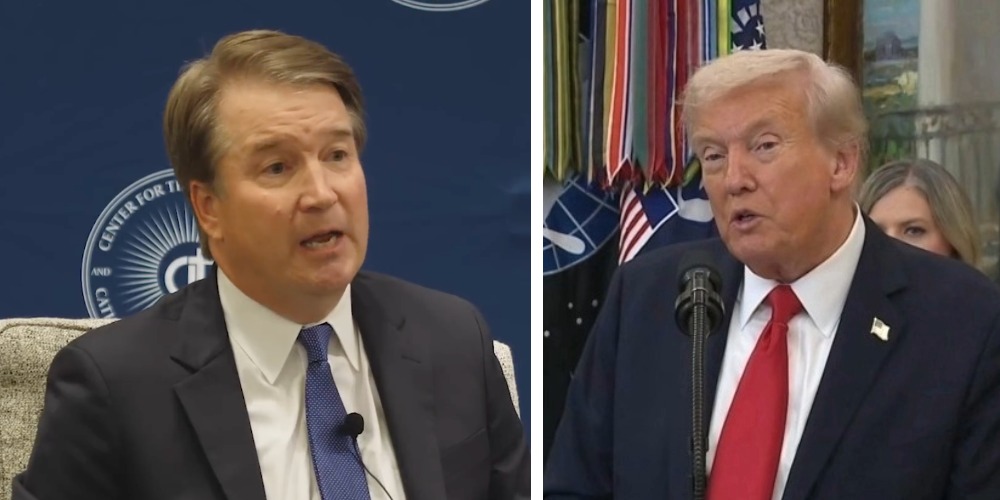
Kavanaugh, who was joined by Justices Clarence Thomas and Samuel Alito, wrote that the court’s decision, in addition to "greatly" restricting Trump’s "tariff authority going forward," is "likely to generate other serious practical consequences in the near term."
"One issue will be refunds. Refunds of billions of dollars would have significant consequences for the U.S. Treasury. The Court says nothing today about whether, and if so how, the Government should go about returning the billions of dollars that it has collected from importers. But that process is likely to be a 'mess,’ as was acknowledged at oral argument," he wrote.
In regard to the fees, Kavanaugh wrote that the US could be required to pay back "billions of dollars to importers who paid IEEPA tariffs, even though some importers may have already passed on costs to consumers or others."
"A second issue is the decision’s effect on the current trade deals. Because IEEPA tariffs have helped facilitate trade deals worth trillions of dollars—including with foreign nations from China to the United Kingdom to Japan, the Court’s decision could generate uncertainty regarding various trade agreements. That process, too, could be difficult."
He said the case "presents one straightforward question of statutory interpretation: Does Congress’s explicit grant of authority in IEEPA for the President to 'regulate … importation' of foreign goods in declared national emergencies authorize the President to impose tariffs? The answer is a clear yes."
He noted that there is a historical precedent for presidents being able to implement tariffs under similar predecessor powers, including under presidents Nixon and Ford, the latter of which was able to "impose money exaction on foreign oil imports" following a ruling in Federal Energy Administration v. Algonquin the year before IEEPA was enacted.
"For both the Nixon tariffs and the Ford tariffs upheld by this Court in Algonquin, the relevant statutory provisions did not specifically refer to 'tariffs' or 'duties,' but instead more broadly authorized the President to 'regulate … importation' or to 'adjust the imports.' Therefore, when IEEPA was enacted in 1977 in the wake of the Nixon and Ford tariffs and the Algonquin decision, Congress and the public plainly would have understood that the power to 'regulate… importation' included tariffs."
"If Congress wanted to exclude tariffs from IEEPA, it surely would not have enacted the same broad 'regulate… importation' language that had just been used to justify major American tariffs on foreign imports."
He said that the plaintiffs in the case and the Supreme Court "acknowledge that IEEPA authorizes the President to impose quotas or embargoes on foreign imports—meaning that a President could completely block some or all imports," however, "they say that IEEPA does not authorize the President to employ the lesser power of tariffs, which simply condition imports on a payment."
"As they interpret the statute, the President could, for example, block all imports from China but cannot order even a $1 tariff on goods imported from China."
He continued, "That approach does not make much sense. Properly read, IEEPA does not draw such an odd distinction between quotas and embargoes on the one hand and tariffs on the other. Rather, it empowers the President to regulate imports during national emergencies with the tools Presidents have traditionally and commonly used, including quotas, embargoes, and tariffs."
SCOTUS rules Trump can't impose tariffs under IEEPA by The Post Millennial
Powered by The Post Millennial CMS™ Comments
Join and support independent free thinkers!
We’re independent and can’t be cancelled. The establishment media is increasingly dedicated to divisive cancel culture, corporate wokeism, and political correctness, all while covering up corruption from the corridors of power. The need for fact-based journalism and thoughtful analysis has never been greater. When you support The Post Millennial, you support freedom of the press at a time when it's under direct attack. Join the ranks of independent, free thinkers by supporting us today for as little as $1.
Remind me next month
To find out what personal data we collect and how we use it, please visit our Privacy Policy






Comments