
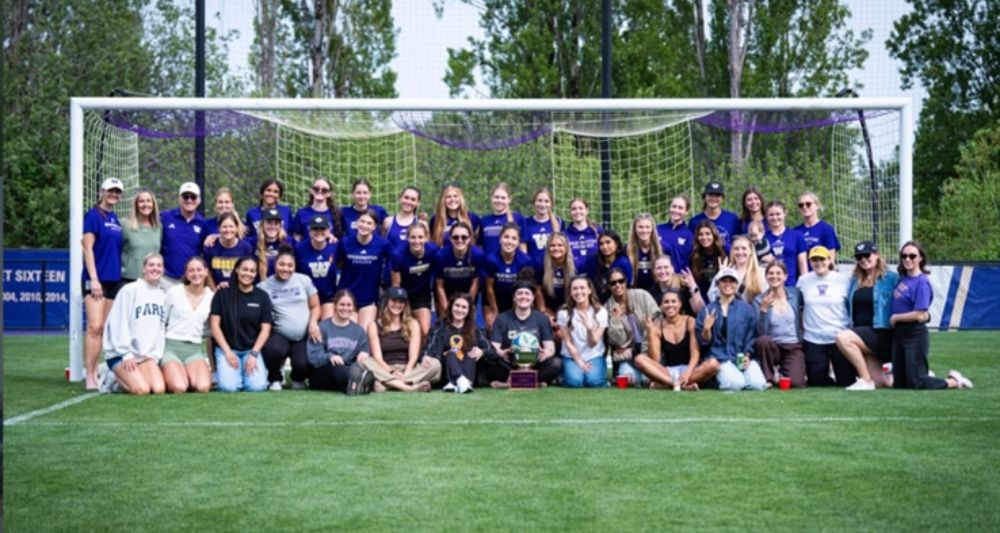
The Washington Huskies women’s Division I soccer program is coming off a Big Ten championship but lost to a boys' team made up of players too young to drive.

The Washington Huskies women’s Division I soccer program is coming off a Big Ten Tournament championship and an Elite Eight appearance last season. Yet despite the program’s success, the women reportedly lost to a boys' team made up of players too young to drive.
The result immediately reignited discussion online over the biological differences between male and female athletes and whether claims that men can fairly compete in women’s sports hold up under real-world conditions.
To longtime observers of the issue, the outcome was hardly surprising. Women’s teams have frequently trained against boys squads for years because the increased speed, strength, and pace of play can sharpen performance ahead of competition against other women. Coaches often view the practice as a way to simulate tougher conditions before matches that are expected to be less physically demanding.
According to Outkick, in 2017, the US Women’s National Team, fresh off a World Cup victory two years earlier, lost 5-2 to the FC Dallas U-15 boys academy team during a scrimmage. The result sparked a similar debate at the time after many Americans learned that elite women’s teams regularly train against teenage boys. The Swiss Women’s National Team also suffered a lopsided 7-1 loss to a U-15 boys side in another widely discussed exhibition.
Supporters of maintaining sex-separated sports say the outcomes provide a direct comparison point in the broader debate surrounding biological males competing in women’s athletics, particularly as states across the country battle over policies involving transgender-identifying athletes. Critics of allowing biological males into female sports argue the issue extends beyond fairness in soccer and into safety concerns in contact and combat sports.
Washington state has become one of the latest battlegrounds in that fight. Earlier this year, Initiative IL26-638 officially qualified for legislative consideration after organizers gathered enough verified signatures. The measure seeks to ban biological boys from participating in girls’ sports. The initiative qualified with an 86 percent signature validity rate.
In a statement at the time the initiative qualified for the ballot, Let’s Go Washington founder Brian Heywood praised female athletes who publicly supported the initiative. “To all the young women who stood up and spoke out about biological boys taking your places on your teams and invading your safe spaces: thank you,” Heywood said. “Thank you for your bravery in the face of harassment, bullying, attacks, and threats of lawsuits.”
Powered by The Post Millennial CMS™ Comments
Join and support independent free thinkers!
We’re independent and can’t be cancelled. The establishment media is increasingly dedicated to divisive cancel culture, corporate wokeism, and political correctness, all while covering up corruption from the corridors of power. The need for fact-based journalism and thoughtful analysis has never been greater. When you support The Post Millennial, you support freedom of the press at a time when it's under direct attack. Join the ranks of independent, free thinkers by supporting us today for as little as $1.
Remind me next month
To find out what personal data we collect and how we use it, please visit our Privacy Policy







Comments