
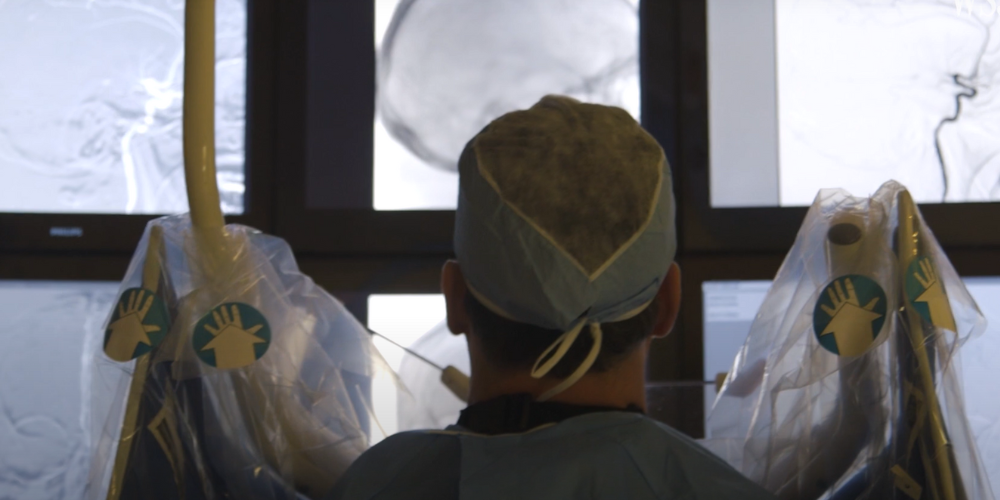
"This is undoubtedly one of the most exciting innovations in stroke intervention in the last decade."

A remote-controlled robot operated by surgeons in Ninewells Hospital in Dundee, Scotland was used to remove a blood clot from a human body that had been donated to medical science in a university facility at a different location in the city, according to the New York Post.
Several hours later and over 4,000 miles away, Dr. Ricardo Hanel, a neurosurgeon in Jacksonville, FL, performed the same procedure on the same body, becoming the first transatlantic surgery, according to BBC News. Hanel said, “Tele neurointervention will allow us to decrease the gap and further our reach to provide one of the most impactful procedures in humankind - the thrombectomy - to more people.”
Iris Grunwald, a professor at the University of Dundee, told the BBC Scotland that, "it felt as if we were witnessing the first glimpse of the future.” Doctors plan to use this procedure for stroke care, which will allow patients to get care quickly, which can be potentially life-saving, even if the patient is hundreds of miles away from the surgeon. This can be especially beneficial for those in remote areas that “have been deprived of access to thrombectomy,” said the chief executive of the Stroke Association charity, Juliet Bouverie.
Doctors believe that this could transform stroke care, because delays in treatment by specialists can decrease recovery chances.
The robotics were developed by Sentante, a Lithuanian company, and clinical trials are hoped for within the next year.
“This is undoubtedly one of the most exciting innovations in stroke intervention in the last decade,” Professor Grunwald said, adding, “What amazed me most was how tactile the experience was. My hands felt exactly as they usually would if I had been doing a conventional thrombectomy.”
Thrombectomy, or removal of a blood clot, is the best treatment for an ischemic stroke. Close to 90 percent of strokes in the US are ischemic, which occurs when the brain is deprived of blood flow. In the US, someone suffers a stroke every 40 seconds.
Additional advancements in robotics aimed at the medical field have been developed in recent years. Elon Musk said that the Tesla Optimus robot will provide "amazing medical care." as well as "eliminate poverty" in a speech this week after his pay package was approved. If Tesla meets its benchmarks over the next 10 years, Musk would receive $1 trillion in Tesla shares. Kaiwa Technology, a Chinese company, is developing a humanoid robot surrogate that could gestate babies and give birth, which is planned for commercial sale next year at a cost of $14,000 for a prototype.
Powered by The Post Millennial CMS™ Comments
Join and support independent free thinkers!
We’re independent and can’t be cancelled. The establishment media is increasingly dedicated to divisive cancel culture, corporate wokeism, and political correctness, all while covering up corruption from the corridors of power. The need for fact-based journalism and thoughtful analysis has never been greater. When you support The Post Millennial, you support freedom of the press at a time when it's under direct attack. Join the ranks of independent, free thinkers by supporting us today for as little as $1.
Remind me next month
To find out what personal data we collect and how we use it, please visit our Privacy Policy







Comments