
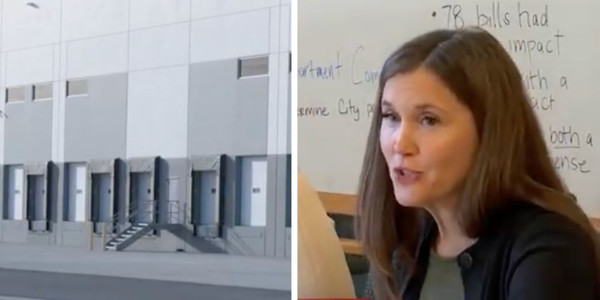
“As Mayor, a primary responsibility I have is to ensure residents have access to clean water, reliable utilities, and safe infrastructure. Put simply, a potential high-occupancy facility interferes with those needs."

Salt Lake City, Utah, Mayor Erin Mendenhall announced plans to restrict water usage that would impact a proposed ICE detention facility in the city. The proposal from Mendenhall was approved unanimously by the Salt Lake City Council on Tuesday night.
In a statement released ahead of a city council meeting on Tuesday, Mendenhall said she had submitted a proposal to update sections of the city code governing water usage for new nonresidential developments. These changes would affect large-scale facilities, including potential facilities operated by ICE.
“Yesterday I transmitted a proposal to the Salt Lake City Council to update Title 17 and Title 21A of the Salt Lake City Code, which pertain to daily water allowances for nonresidential uses,” Mendenhall said. “New large water users are particularly problematic due to Salt Lake City’s worsening drought conditions and water conservation needs, which we are already taking action to address. Just last week, I directed Salt Lake City and our entire service area to move to Stage 2 of our Water Shortage Contingency Plan.”
She argued that a large-scale detention facility could strain the city’s resources, saying, “As Mayor, a primary responsibility I have is to ensure residents have access to clean water, reliable utilities, and safe infrastructure. Put simply, a potential high-occupancy facility interferes with those needs. While we lack direct information from the U.S. Department of Homeland Security, a 7,500-person detention facility on our City’s west side would likely use 1-2 million gallons of water per day. By comparison, the warehouse recently purchased previously used about 5,600 gallons daily.”
“Should they be approved, these water usage updates would enact tighter restrictions on all government entities, ensuring that the amount of water new commercial and industrial developments can use is in line with our City’s capacity,” she added.
The proposal was approved unanimously by the Salt Lake City Council. The amendments apply broadly to new commercial, industrial, and institutional developments, though they include exemptions for certain categories such as agricultural areas, schools, churches, and hospitals. Under the proposal, the city can cap water usage for new nonresidential developments that use over 200,000 gallons of water per day on average.
ICE had purchased a 24.9-acre parcel that contains an 883,000 square-foot warehouse near the Salt Lake City International Airport earlier this month. DHS previously confirmed it planned to build a detention facility in Salt Lake City, according to KSL.
Powered by The Post Millennial CMS™ Comments
Join and support independent free thinkers!
We’re independent and can’t be cancelled. The establishment media is increasingly dedicated to divisive cancel culture, corporate wokeism, and political correctness, all while covering up corruption from the corridors of power. The need for fact-based journalism and thoughtful analysis has never been greater. When you support The Post Millennial, you support freedom of the press at a time when it's under direct attack. Join the ranks of independent, free thinkers by supporting us today for as little as $1.
Remind me next month
To find out what personal data we collect and how we use it, please visit our Privacy Policy





Comments