
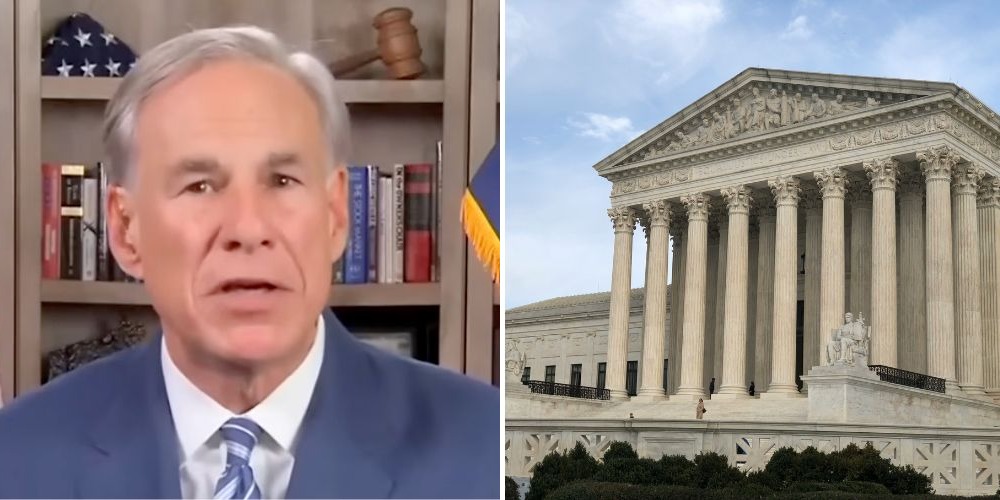
The order stated, "Texas is likely to succeed on the merits of its claim that the District Court committed at least two serious errors."

The Supreme Court has granted an emergency application filed by Texas Governor Greg Abbott, allowing the state to use its new congressional map in next year’s midterm elections.
The unsigned order places a pause on a lower court’s ruling that claimed the map was unlawful because Republican lawmakers had explicitly considered race when drawing up the new districts. The Supreme Court’s ruling allows the use of the map, which creates five new GOP-majority seats, as legal proceedings continue.
The order stated, "Texas is likely to succeed on the merits of its claim that the District Court committed at least two serious errors. First, the District Court failed to honor the presumption of legislative good faith by construing ambiguous direct and circumstantial evidence against the legislature. Second, the District Court failed to draw a dispositive or near-dispositive adverse inference against respondents even though they did not produce a viable alternative map that met the State’s avowedly partisan goals."
The court said that Texas has "also made a strong showing of irreparable harm and that the equities and public interest favor it," adding that the District Court "improperly inserted itself into an active primary campaign, causing much confusion and upsetting the delicate federal-state balance in elections."
Justices Elena Kagan, Sonia Sotomayor, and Ketanji Brown Jackson dissented, with Kagan writing, "Over the course of three months, a three-judge District Court in Texas undertook to resolve the factual dispute at issue in this application: In enacting an electoral map slanted toward Republicans, did Texas predominantly use race to draw its new district lines? Or said otherwise, did Texas accomplish its partisan objectives by means of a racial gerrymander?"
Kagan wrote that the court "held that the answer was clear. Texas largely divided its citizens along racial lines to create its new pro-Republican House map, in violation of the Constitution’s Fourteenth and Fifteenth Amendments. The court issued a 160-page opinion recounting in detail its factual findings."
Kagan wrote that while the Supreme Court is higher than the District Court, "we are not a better one when it comes to making such a fact-based decision. That is why we are supposed to use a clear-error standard of review—why we are supposed to uphold the District Court’s decision that race-based line-drawing occurred (even if we would have ruled differently) so long as it is plausible."
She claimed that the Supreme Court’s order "disrespects the work of a District Court that did everything one could ask to carry out its charge," and "disserves the millions of Texans whom the District Court found were assigned to their new districts based on their race."
In his opinion concurring with the Supreme Court’s order, Justice Samuel Alito wrote that the "clear-error standard of review does not apply here because the 'trial court base[d] its findings upon a mistaken impression of applicable legal principles."
He later added, "Although respondents’ experts could have easily produced such a map if that were possible, they did not, giving rise to a strong inference that the State’s map was indeed based on partisanship, not race. Neither the duration of the District Court’s hearing nor the length of its majority opinion provides an excuse for failing to apply the correct legal standards as set out clearly in our case law."
Powered by The Post Millennial CMS™ Comments
Join and support independent free thinkers!
We’re independent and can’t be cancelled. The establishment media is increasingly dedicated to divisive cancel culture, corporate wokeism, and political correctness, all while covering up corruption from the corridors of power. The need for fact-based journalism and thoughtful analysis has never been greater. When you support The Post Millennial, you support freedom of the press at a time when it's under direct attack. Join the ranks of independent, free thinkers by supporting us today for as little as $1.
Remind me next month
To find out what personal data we collect and how we use it, please visit our Privacy Policy




Comments