
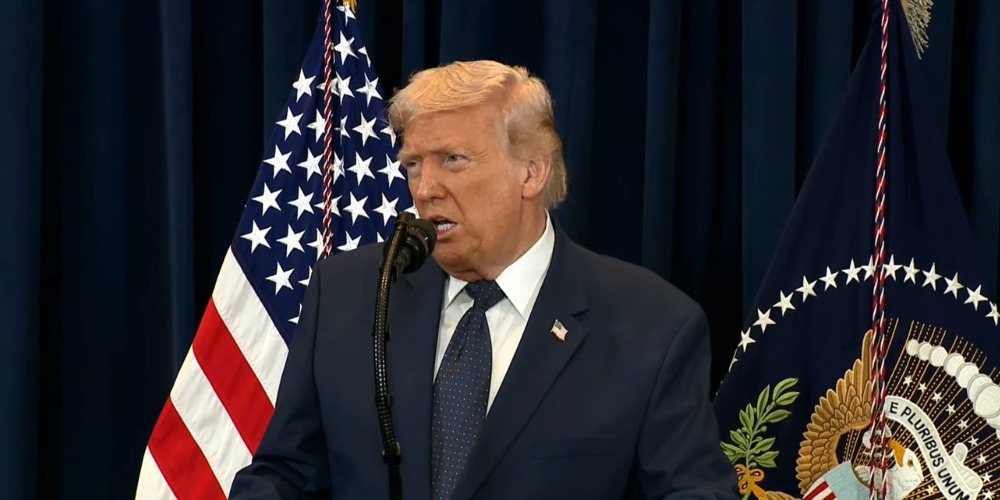
"If the Hormuz Strait is not immediately ‘Open for Business,’ we will conclude our lovely 'stay' in Iran."

President Donald Trump has said that that there has been “great progress” to reach an end to military operations in Iran but warned that if the Strait of Hormuz is not opened up then the US will conduct a bombing campaign in the country and target a number of key infrastructure points.
“The United States of America is in serious discussions with A NEW, AND MORE REASONABLE, REGIME to end our Military Operations in Iran. Great progress has been made but, if for any reason a deal is not shortly reached, which it probably will be, and if the Hormuz Strait is not immediately ‘Open for Business,’ we will conclude our lovely 'stay' in Iran by blowing up and completely obliterating all of their Electric Generating Plants, Oil Wells and Kharg Island (and possibly all desalinization plants!), which we have purposefully not yet ‘touched.’ This will be in retribution for our many soldiers, and others, that Iran has butchered and killed over the old Regime’s 47 year ‘Reign of Terror.’ Thank you for your attention to this matter,” Trump said.
At the same time, President Donald Trump is reportedly considering a military operation to seize nearly 1,000 pounds of enriched uranium from Iran.
According to US officials cited by The Wall Street Journal, the proposed mission would involve deploying American forces inside Iran for days, or potentially longer, to locate, secure, and extract nuclear material. While no final decision has been made, Trump is said to remain open to the option while weighing the risks to US personnel. Any such operation would likely expose American troops to significant danger from Iranian defenses, including surface-to-air missiles and drone attacks.
White House Press Secretary Karoline Leavitt said in a statement that contingency planning does not mean a final decision has been made. “It’s the job of the Pentagon to make preparations in order to give the commander-in-chief maximum optionality,” she said.
Trump has made clear in both public remarks and private conversations that Iran will not be allowed to retain enriched uranium. Trump has also pushed advisers to pressure Iran into surrendering the material voluntarily as part of a negotiated settlement. Intermediaries, including Pakistan, Turkey, and Egypt, have been involved in indirect discussions, though direct US-Iran talks have yet to materialize.
The material, believed to be stored in fortified underground sites such as Isfahan and Natanz, is housed in dozens of specialized cylinders containing highly enriched uranium gas. Securing and transporting it safely would require elite special operations units trained in handling radioactive material.
Ground troops would first need to secure the area, clear potential booby traps and mines, and allow engineers to excavate and locate the material. Transporting the uranium would involve heavy shielding containers and multiple vehicles, potentially requiring the construction of a temporary airstrip for extraction. “This is not a quick in-and-out kind of deal,” retired Gen. Joseph Votel, former head of US Central Command, told the outlet.
Despite the military planning, Trump has continued to signal a preference for a diplomatic resolution. Secretary of State Marco Rubio recently stated that the US can achieve its objectives without deploying ground forces, provided Iran agrees to dismantle its nuclear program. Defense Secretary Pete Hegseth echoed that position. “We have a range of options, up to and including Iran deciding that they will give those up, which of course we would welcome.”
The US has successfully removed enriched uranium from foreign countries in the past, including Kazakhstan in 1994 and Georgia in 1998, both conducted as peaceful transfers.
Trump has reportedly expressed a desire to avoid a prolonged conflict, particularly as domestic political pressures grow ahead of the upcoming midterm elections. Some advisers are urging the president to pivot focus back to domestic priorities.
Still, the administration continues to prepare for multiple contingencies. US forces in the region are being positioned to respond quickly, including Marine units and elements of the Army’s 82nd Airborne Division. Officials have also discussed deploying additional troops to expand operational flexibility.
Powered by The Post Millennial CMS™ Comments
Join and support independent free thinkers!
We’re independent and can’t be cancelled. The establishment media is increasingly dedicated to divisive cancel culture, corporate wokeism, and political correctness, all while covering up corruption from the corridors of power. The need for fact-based journalism and thoughtful analysis has never been greater. When you support The Post Millennial, you support freedom of the press at a time when it's under direct attack. Join the ranks of independent, free thinkers by supporting us today for as little as $1.
Remind me next month
To find out what personal data we collect and how we use it, please visit our Privacy Policy





Comments