
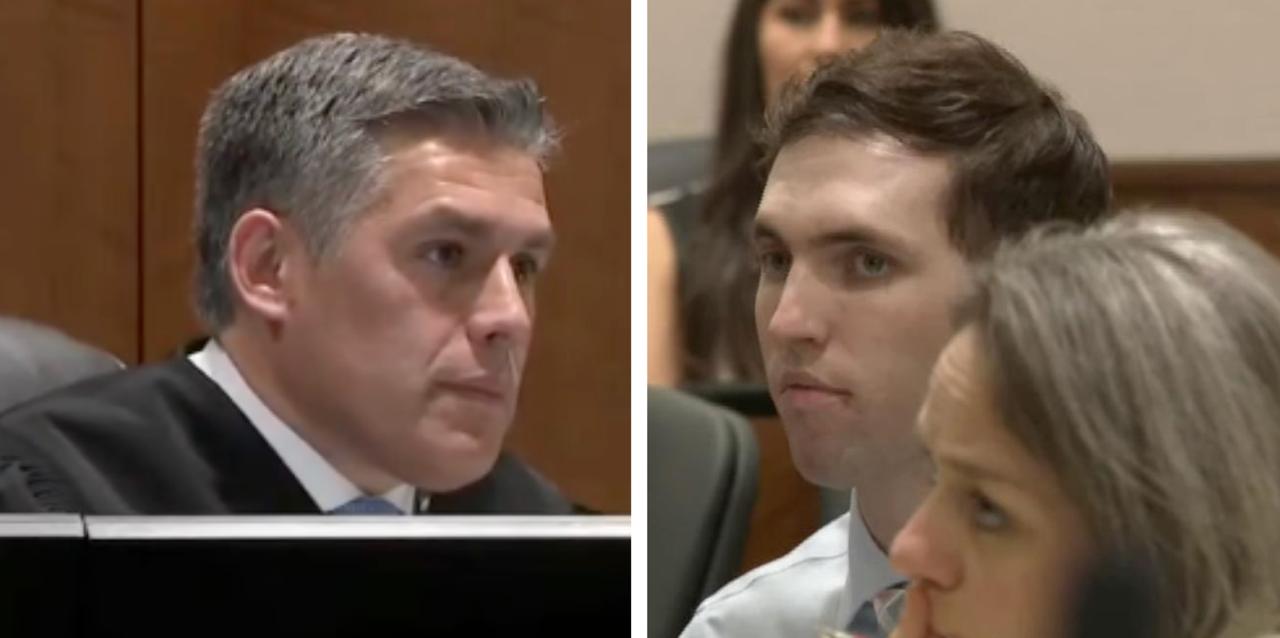
Graf said that the defense had not shown that the proceedings remaining public would "create a realistic likelihood of prejudice to defend its right to a fair trial."

Graf said that the defense had not shown that the proceedings remaining public would "create a realistic likelihood of prejudice to defend its right to a fair trial." He said that the defense and state had come to an agreement ahead of the hearing "that neither the public nor the media should be permitted to inspect or copy exhibits presented at the preliminary hearing, except as published in court as part of the hearing." The preliminary hearing was pushed back in early May to the week of July 6 following a motion from the defense being granted.
"The public and the media enjoy a presumptive right to access court proceedings, including preliminary hearings," Judge Graf said. "A party seeking to close a preliminary hearing must show that adverse publicity traceable to the open hearing poses a realistic likelihood of prejudice to a fair trial to overcome this presumption. The parties seeking closure must also show there are no less restrictive alternative means to ensure the integrity and impartiality of the jury. Public access to judicial proceedings also serve in an important role in maintaining confidence in the fairness and transparency of the judicial process. This court finds these showings have not been made here."
"First, the motion does not identify with sufficient specificity that the evidence, if presented in the public proceeding, would create a realistic likelihood of prejudice to defend its right to a fair trial. Despite receiving notice of the state's witnesses and exhibits for the preliminary hearing, the motion raises generalized concerns regarding hearsay and the expert reports without identifying particular evidence warranting closure."
"Furthermore, much of the evidence the state indicated it intends to offer during the preliminary hearing is already in the public arena and was identified in the information and probable cause statement. The possibility that evidence introduced at the preliminary hearing may later be ruled inadmissible at trial does not, standing alone, bar the public from the courtroom. The court, however, acknowledges defendant’s pending motion in limine to preclude 1102 evidence and reserve ruling on that issue until the matter has been fully briefed and heard.
Even assuming specific evidence has been identified that could present a risk to defendant's constitutional right to a fair trial if publicly disclosed, the motion does not establish that a no less restrictive alternative remains available." Graf said that "several methods remain available to protect the defendant’s right to a fair trial," including expanding the jury pool, using detailed juror questionnaires, and "conducting thorough voir dire." Following Judge Tony Graf striking down the defense's motion for a blanket ban on cameras and other electronic media in the courtroom in May, the defense is seeking to appeal the order to the Utah Supreme Court.
In Monday's hearing, Graf also granted a motion to show cause from the defense requiring prosecutors Jeff Gray and Chris Ballard to appear in court and show cause for why they should not be held in contempt for violating a pretrial publicity order that was issued in September, and amended in December. A hearing will be held on June 12 on the matter.
Powered by The Post Millennial CMS™ Comments
Join and support independent free thinkers!
We’re independent and can’t be cancelled. The establishment media is increasingly dedicated to divisive cancel culture, corporate wokeism, and political correctness, all while covering up corruption from the corridors of power. The need for fact-based journalism and thoughtful analysis has never been greater. When you support The Post Millennial, you support freedom of the press at a time when it's under direct attack. Join the ranks of independent, free thinkers by supporting us today for as little as $1.
Remind me next month
To find out what personal data we collect and how we use it, please visit our Privacy Policy


Comments