
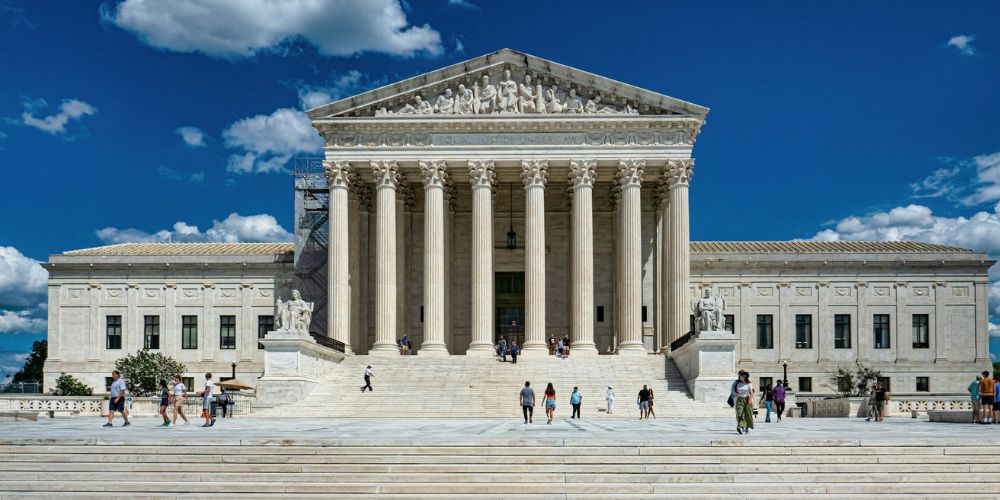
"The election-day statutes say nothing about ballot receipt, and we cannot add to the words Congress chose."

The Supreme Court has ruled that states can count ballots that are sent by Election Day but arrive late. The court was split 5 to 4 in a decision that rejected a challenge from the Republican National Committee to a Mississippi law that allows ballots to be counted even if they arrive after the Election Day deadline.
The decision in Mississippi v. the RNC was authored by Justice Amy Coney Barrett. She was joined by Chief Justice John Roberts as well as the three more liberal justices on the court in the decision.
"The Framers recognized the difficulty of crafting election laws 'applicable to every probable change in the situation of the country.' The Federalist No. 59, at 362. So instead of constitutionalizing election law, they decided that 'a discretionary power over elections' needed to be lodged 'somewhere,'" Barrett wrote. "Suffice it to say, that power was not lodged in this Court. The election-day statutes say nothing about ballot receipt, and we cannot add to the words Congress chose."
A dissent was written by Justice Samuel Alito, who was joined by the Justices Clarence Thomas, Neil Gorsuch, and Brett Kavanaugh. "Today," Alito wrote, "not all voting occurs in person on election day. Both voting by mail and early voting have become popular, and respondents do not dispute the lawfulness of these modern practices. Nor do I. But acceptance of these practices cannot change the fact that under federal law, the electorate’s collective choice must still be authoritatively ex-pressed on election day."
"If ballots received after election day are added to the set of ballots that dictate the election’s outcome, the electorate’s choice does not occur on election day," Alito added in the dissent. "The acceptance of these late-arriving ballots effectively postpones the date on which the electorate’s choice is made."
If the court had ruled that ballots that were received late could not be counted, 14 states would have had to change their election laws ahead of the 2026 midterms.
The new ruling adds another aspect to the election field ahead of the 2026 midterms, as the GOP is looking to keep control of the House and Senate. The ruling is a strike against the Trump administration, which has been pushing for more secure elections as there have been allegations of election fraud after mail-in ballots have shifted election results in the favor of Democrats such as in the LA mayoral primary.
Mississippi is one of 14 states that allow a grace period between when a ballot is sent and when it is received if the ballot is postmarked before Election Day. Many of those states are controlled by Democrats, including California, Illinois, Maryland, Massachusetts, New Jersey, New York, Oregon, Virginia, and Washington.
The RNC received support for the legal challenge against the Mississippi law from the House Republicans' campaign arm, other GOP-controlled states, and other Republican entities.
Powered by The Post Millennial CMS™ Comments
Join and support independent free thinkers!
We’re independent and can’t be cancelled. The establishment media is increasingly dedicated to divisive cancel culture, corporate wokeism, and political correctness, all while covering up corruption from the corridors of power. The need for fact-based journalism and thoughtful analysis has never been greater. When you support The Post Millennial, you support freedom of the press at a time when it's under direct attack. Join the ranks of independent, free thinkers by supporting us today for as little as $1.
Remind me next month
To find out what personal data we collect and how we use it, please visit our Privacy Policy






Comments