
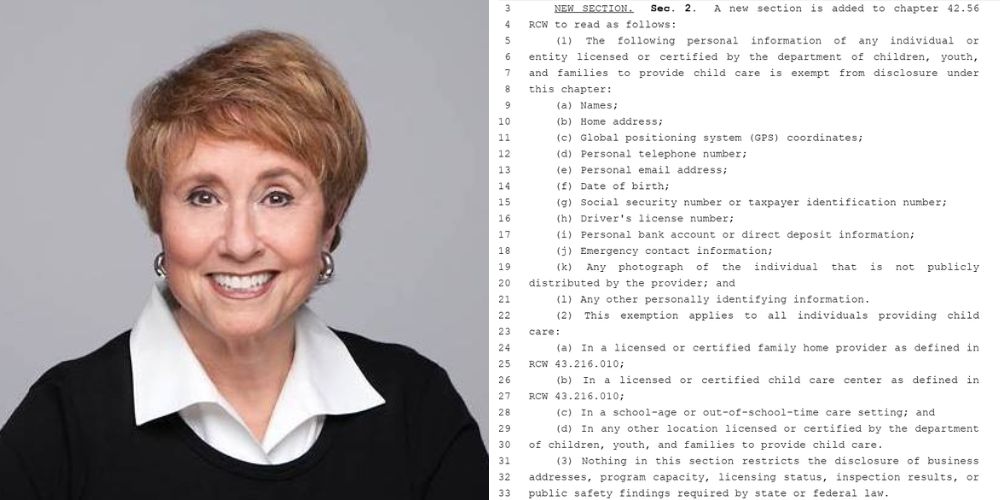
Wellman was one of the primary sponsors of the Keep Washington Working Act, the bill that made Washington a so-called “sanctuary state,” and critics of the bill suggest her new legislation is an attempt to shield illegal immigrants from federal authorities.

The proposal, Senate Bill 5926, was pre-filed on December 22 and expands public records exemptions for childcare providers, shielding a broad range of identifying information from disclosure. Supporters frame the measure as a safety tool designed to protect providers from harassment or threats. Opponents argue it is arriving just as journalists are using public data to uncover suspicious daycare listings tied to large sums of taxpayer funding.
SB 5926 comes as independent journalists, inspired by Nick Shirley's exposure of daycare fraud in Minnesota, have been scouring government websites to find similar fraud across the US. Additionally, Wellman was one of the primary sponsors of the Keep Washington Working Act, the bill that made Washington a so-called “sanctuary state,” and critics of the bill suggest her new legislation is an attempt to shield illegal immigrants from federal authorities.
In the bill’s legislative findings, lawmakers acknowledge that existing confidentiality provisions apply most clearly to licensed family home childcare providers but argue that the same risks now extend to childcare workers in centers and other settings. The bill seeks to widen protections statewide by restricting the disclosure of “personal information” for anyone licensed or certified by the Department of Children, Youth, and Families to provide childcare.
Under the legislation, exempt information would include a wide range of details that could identify a provider or location, such as a person’s name, home address, GPS coordinates, personal phone number, personal email address, date of birth, emergency contact information, and other personally identifying information. It also covers sensitive identifiers like Social Security and taxpayer identification numbers, driver’s license numbers, and financial information such as bank account and direct deposit details. The bill does not limit these protections to home daycare operators; instead, it extends them to licensed family home providers, licensed childcare centers, school-age or out-of-school-time programs, and essentially any location licensed or certified through DCYF.
The bill contains language specifying that certain program-level information must remain public, such as business addresses, program capacity, licensing status, inspection results, and public safety findings required by state or federal law. Yet critics say this limitation provides little comfort, because the current dispute centers on whether state records and publicly available listings are reliable enough to begin with. Watchdogs argue that if the government database contains discrepancies, missing location details, or inconsistent licensing information, the only way for journalists and taxpayers to validate the entries is through independent verification, and restricting identifying information could make those efforts far more difficult.
The bill is also landing amid an intensifying political confrontation between Washington officials and independent journalists who say they are uncovering early warning signs of a subsidy scandal similar to one previously exposed in Minnesota. This week, Washington Attorney General Nick Brown issued a warning aimed squarely at independent journalists, accusing them of harassing daycare providers and engaging in unsafe conduct. Brown said his office had received outreach from members of the Somali community after reports of home-based daycare providers being “harassed and accused of fraud with little to no fact-checking.” He said his office is coordinating with DCYF to evaluate the fraud claims circulating online as well as the reported harassment, and urged anyone contacted by journalists to contact local law enforcement or report incidents to state hotlines and reporting websites.
Brown also pointed people toward DCYF resources, stating that if fraud is suspected, there are appropriate measures to report it, and if fraud is substantiated, accountability should follow. But critics argue the Attorney General’s response sidesteps the reason these investigations gained traction in the first place: growing doubts about whether DCYF has adequately monitored the subsidy system. Some have noted that DCYF’s own website and public records have included missing addresses, incomplete licensing details, and other discrepancies, while some of the listed providers continued to receive substantial sums in taxpayer funding. Journalists say those inconsistencies are precisely what they are investigating.
Journalists Cam Higby and Jonathan Choe reported visiting the address associated with the Dhagash Childcare, where a resident allegedly told them that no childcare business had ever operated there. The woman inside the home repeatedly denied that any daycare existed at the location, responding “No” when asked whether the home was Dhagash Family Childcare and again denying that any childcare operation had ever been run there. Despite those denials, investigators said Washington records list the address as licensed and receiving taxpayer funds, and the business appeared as a daycare on Google as well.
The report claimed the daycare received more than $210,000 in taxpayer funds in 2025 alone and was licensed to hold up to nine children. It also cited inspections in September that allegedly identified “multiple long-term, short-term, serious, and immediate risks to children,” even as the daycare received $22,000 that same month.
Investigative reporter Carleen Johnson of The Center Square said she visited multiple Somali-run daycare homes in Federal Way that receive taxpayer subsidies and found no children and no clear evidence of operating childcare. She said she was threatened with police involvement when she attempted to ask questions, writing that the locations did not appear to resemble legitimate childcare centers receiving taxpayer dollars.
Kristen Mag, who assisted Choe and Higby, raised broader questions about systemic blind spots and transparency gaps, pointing to the number of childcare centers listing Somali as the primary language and claiming many do not provide a street address.
Meanwhile, political fallout has grown as officials such as Governor Bob Ferguson and Socialist Seattle Mayor-elect Katie Wilson publicly reaffirmed support for the Somali community rather than publicly addressing the specific fraud allegations and calling for aggressive oversight.
Powered by The Post Millennial CMS™ Comments
Join and support independent free thinkers!
We’re independent and can’t be cancelled. The establishment media is increasingly dedicated to divisive cancel culture, corporate wokeism, and political correctness, all while covering up corruption from the corridors of power. The need for fact-based journalism and thoughtful analysis has never been greater. When you support The Post Millennial, you support freedom of the press at a time when it's under direct attack. Join the ranks of independent, free thinkers by supporting us today for as little as $1.
Remind me next month
To find out what personal data we collect and how we use it, please visit our Privacy Policy



Comments