
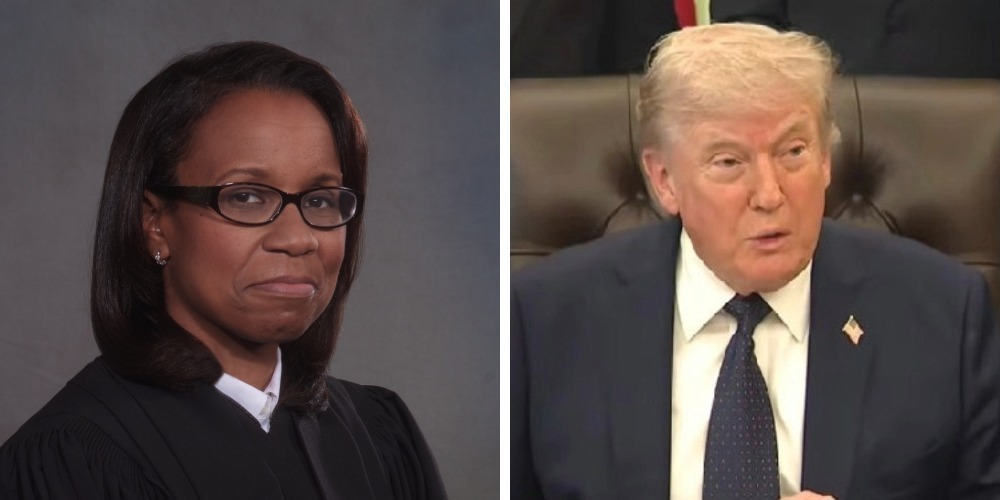
Caspter wrote that the Constitution "does not grant the President any specific powers over elections."

A federal judge in Massachusetts issued an order on Wednesday permanently blocking the Trump administration from carrying out most of the president’s first executive order on elections, including requiring proof of citizenship for voting. It is illegal for non-citizens to vote in federal elections but voter registration in many states is essentially done on the honor system.
Judge Denise Casper of the US District Court for the District of Massachusetts ruled that multiple sections of Executive Order 14248, titled "Preserving and Protecting the Integrity of American Elections," were unconstitutional or inconsistent with the National Voter Registration Act (NVRA). She permanently blocked the sections from being implemented or enforced.
Those sections were 2(a), 3(d), 4(a), 7(a) and 7(b). The first of the sections required "documentary proof of United States citizenship," 3(d) required the Secretary of Defense to update the Federal Post Card Application for registering to vote, 4(a) required that the Election Assistance Commission take action to cease federal funds going to states that don’t require proof of citizenship, 7(a) required that the Attorney General take action against states that count mail-in ballots received after election day, as California and other states do, and 7(b) required that the Election Assistance Commission place conditions on federal funding for states including not counting ballots received after election day.
Sections 2(a), 3(d), 4(a), 7(a) and 7(b) were found to be "unconstitutional and void" and violate the separation of powers, with 2(a) being found inconsistent with the NVRA and 3(d) being found to be inconsistent with the Uniformed and Overseas Citizens Absentee Voting Act. Her ruling effectively converts a preliminary injunction she issued around a year ago into a permanent ban.
Caspter wrote that the Constitution "does not grant the President any specific powers over elections," and as a result, "the President 'plays no direct role in the process’ of appointing electors, 'nor does he have authority to control the state officials who do.’"
Attorney Generals from California, Nevada, Massachusetts, Arizona, Colorado, Connecticut, Delaware, Hawaii, Illinois, Maine, Maryland, Michigan, Minnesota, New Jersey, New Mexico, New York, Rhode Island, Vermont and Wisconsin filed the lawsuit against Trump’s executive order last April.
The ruling comes as Trump canceled a signing that was set for Wednesday on a housing bill, saying, "Today’s Housing News Conference and Signing is hereby cancelled until such time as we pass the desperately needed SAVE AMERICA ACT, which I consider to be a National Emergency." The SAVE Act would require proof of citizenship to vote.
Powered by The Post Millennial CMS™ Comments
Join and support independent free thinkers!
We’re independent and can’t be cancelled. The establishment media is increasingly dedicated to divisive cancel culture, corporate wokeism, and political correctness, all while covering up corruption from the corridors of power. The need for fact-based journalism and thoughtful analysis has never been greater. When you support The Post Millennial, you support freedom of the press at a time when it's under direct attack. Join the ranks of independent, free thinkers by supporting us today for as little as $1.
Remind me next month
To find out what personal data we collect and how we use it, please visit our Privacy Policy


Comments