
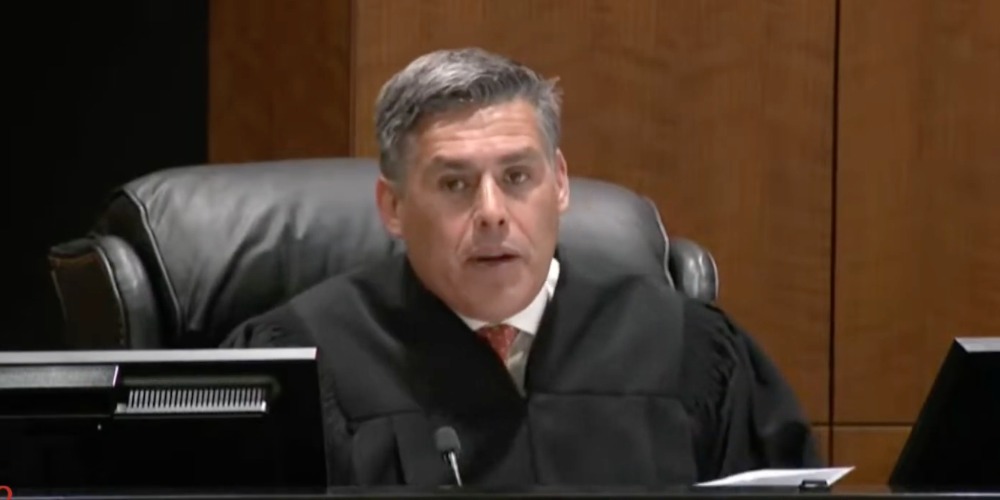
Judge Graf ultimately ruled that around 17 minutes of the interview’s audio could not be played in the courtroom.

On the third day of the preliminary hearing of Tyler Robinson, the man charged with killing Charlie Kirk, on Wednesday afternoon kicked off with never-before-seen video of Robinson after he turned himself in to authorities following the fatal shooting, with the majority of the afternoon hearing being focused on arguments over the admission of a video interview the state conducted with Lance Twiggs, Robinson’s transgender lover. The video of Robinson came form the Washington County sheriff's office. Graf ultimately ruled that only the audio of the Twiggs video will be allowed to be caputured by cameras, and that large portions of the audio must be redacted.
Agent Brian Davis
Brian Davis, a Utah State Bureau of Investigation agent, was the only witness to testify on Wednesday afternoon. He spoke about Robinson turning himself in to the authorities in Washington County on the evening of September 11, the day after Kirk was killed. Robinson was accompanied by his parents.
Davis, who said he was assigned to be a case agent in the Charlie Kirk killing, said he received a call at around 8:30 pm on September 11, 2025 requesting that he travel to St George because a person was turning himself in regarding his involvement with the shooting. He said he and other authorities landed in St George at around 11:30 pm. The shooting took place at Utah Valley University in Orem, Utah.
He said that when he arrived at the sheriff’s office, the individual later identified as Robinson was sitting in one of the "soft interview rooms," with Davis observing Robinson through a camera feed. He said Robinson had arrived at the sheriff’s office at around 9 pm with his parents and a family friend.
Davis said he spoke with Robinson, who provided his name. The agent said Robinson's parents and the family friend were interviewed by authorities, with Davis taking part in the interview of Robinson’s mother. Robinson was formally arrested at around 4 am on September 12 after the interviews were conducted, he said.
He later said that the family friend, Mike Mitchell, "helped facilitate working times with the sheriff’s department for Tyler to turn himself in." He said a second interview was conducted with Mitchell in March.
During questions about Robinson turning himself in, a short clip of Robinson in an interview room was shown to the courtroom. The clip had no audio.
Davis said Robinson was then transported to Utah County Jail, prior to which Robinson’s cell phone was seized. After a search warrant was granted, Robinson’s clothing was recovered, a DNA test was conducted with a buccal swab, and he was fingerprinted. He was formally booked at 8 am on September 12. Davis also spoke on additional search warrants that were carried out at Robinson’s residence and his parents’ house on September 12.
Davis also testified on the interview of Lance Twiggs, saying that he was first interviewed on September 12, and again on April 20, which was interviewed, and that both interviews were recorded. He said that Twiggs voluntarily provided his phone to the FBI during the first interview.
Lance Twiggs Interview Video
The defense seeking to admit an exhibit, the video interview of Lance Twiggs, launched arguments that took up the remainder of the afternoon, centering around whether it should be admitted into evidence, and how much, if any, should be played in the courtroom. Judge Graf ultimately ruled that around 17 minutes of the interview’s audio would not be played in the courtroom.
The state noted that the defense sent a proposed transcript with redactions at the beginning of the week, at the start of the preliminary hearings. The prosecutor said that the state had provided the video of the interview with Twiggs to the defense back in April and that the state was taken "essentially by surprise," saying that the defense had been aware since April that the video was going to be shown at the preliminary hearing. She said making the suggested last-minute redactions would take time and would interfere with the proceedings.
The prosecutions said the state was in agreement that the media should not be able to capture the video’s image but that the audio should be played within the courtroom.
Richard Novak said for the defense that "many, many weeks ago, the state lodged their anticipated exhibits with the court, and then the court said, I’m not going to review them, in fact … the court is returning the exhibits to the state. So there is no moment to make objections to an exhibit, is not inclined to entertain until the moment, as the court has said many times, until the exhibit is presented."
He said playing the video so that audio is captured by the media is a "problem," stating that the "vast majority of this video is Mr. McBride testifying, and Mr. Twiggs agreeing." Ryan McBride is a prosecutor with the Utah County Attorney’s Office. "If we were in a courtroom, it would be a leading examination, virtually from the start. I want to say that every single statement by Mr. Twiggs is just an affirmation of what Mr. McBride says."
Novak said that the "vast majority" of the video’s content is McBride "basically testifying as to what other exhibits that this court will see say," noting text messages and a group chat that have not yet been admitted. Novak said there are also portions of the video that are irrelevant "and really implicate Mr. Twiggs’ privacy rights."
Responding to Novak, Judge Graf said that the court’s position of not looking at exhibits ahead of time "doesn’t preclude any party from filing a motion in limine, which is anticipated before anything is moved into evidence." He said the court’s position "is far different from what the parties choose to do and file in regards to a motion in limine."
The defense said it would like to go into a "very brief closed hearing" during which they could lodge another objection to the video being published.
Speaking for media parties, Michael Judd said that a request to close a court proceeding "requires that the court engage in some sort of hearing about that closure that is open to the public. Can’t be done in a whisper, that can’t be done with cameras off."
He said that the parties are in agreement that the interview is a "very important" exhibit, which "makes people want to invoke protections, invoke closures from the media’s perspective, from the public’s perspective."
He said that the video "appears likely to be one of those pillars on which the state intends to base its case and on which the court's ultimate decision will likely rest." He said that council is in favor of access, in favor of publication, in favor of allowing the public to see the work that the court is doing and why it's doing it.
"So this interview appears to be such a critical piece of the case being presented here in this courtroom today. The media's position is that it should be shown on the screen, and that the public should be allowed to see it as well," he said, adding that if there’s any sort of compromise on the video’s viewing, he sides with the state’s version of allowing the audio to be captured.
Graf overruled the defense’s hearsay objection despite agreeing on the point, saying he would consider McBride’s statements in the recording to provide context for what Twiggs says. He also said regarding the defense’s relevance objection that he would only consider the relevant factors when considering it and that the ruling was reserved. He also overruled the defense’s prejudice objection.
Graf asked if any party needed to make arguments that would require going into a closed hearing. Novak said it was needed, and that publishing the video in the court would violate Robinson’s due process rights. Citing the Supreme Court case Estes v Texas, Novak said that the court had previously "constructed a rule that the televising of a defendant in the act of confessing to a crime was inherently invalid under the due process clause of the 14th Amendment, even without a showing of prejudice or a demonstration of the nexus between the televised confession and the trial."
"I am not calling the statements of Mr. Robinson confessions, but that is what the state will call them, and so there are portions of this exhibit and other exhibits … which implicate Mr. Robinson’s right not to have what the state calls a confession televised."
The state said the two exhibits the defense is anticipating, text messages and a group chat, will be presented, as well as a note Twiggs referenced in his interview. She said the text messages had not been released in their entirety before, with only portions being placed in the charging document. The state intends to release more messages.
The prosecutor said that the tone and context of Twiggs' speaking through the referenced exhibits and talking through his experience "is a meaningful way of presenting our evidence."
Speaking on behalf of the Kirk family and Charlie Kirk was Jeffrey Neiman, who urged open access to unredacted exhibits.
"The Kirk family believes strongly that if the evidence is being admitted in this preliminary hearing, it should be made public for the world to see. No redactions. This court has tools at its disposal to make sure the defendant receives a fair trial," he said.
"To not be transparent here, to not be open, to not let the world see what happened, will create doubt and distrust in the judicial system. And that’s not what anybody wants, that's not what any of us believe should happen here, and we'd ask the court to consider the position of the family in making its ultimate decision."
The state said it would take the night to make the ordered adjustments to the video and return on Thursday to play it.
Powered by The Post Millennial CMS™ Comments
Join and support independent free thinkers!
We’re independent and can’t be cancelled. The establishment media is increasingly dedicated to divisive cancel culture, corporate wokeism, and political correctness, all while covering up corruption from the corridors of power. The need for fact-based journalism and thoughtful analysis has never been greater. When you support The Post Millennial, you support freedom of the press at a time when it's under direct attack. Join the ranks of independent, free thinkers by supporting us today for as little as $1.
Remind me next month
To find out what personal data we collect and how we use it, please visit our Privacy Policy

Comments