
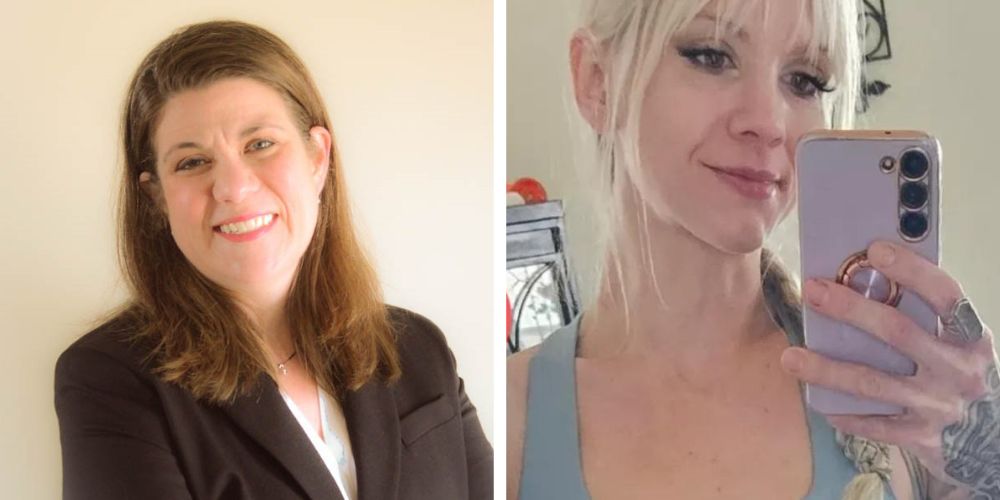
Defense attorney Brian Karalus said he felt like he was "fighting the prosecutor and the judge" during the trial and called the process of the trial "bizarre."

Assistant Chief District Court Judge Christa M. Daily disclosed the jury instruction and oversaw the case in which Hendrix was found guilty of one count of disorderly conduct after saying the n-word to Sharmake Omar, the man who was filmed the interaction that went viral across social media in May 2025 following the April incident. He filmed her and told her, repeatedly, to say the word, and said that he was filming her with the intent of posting the video online. His demeanor was calm but confrontational.
Hendrix was found guilty of disorderly conduct for using what the judge called "fighting words" against Omar, but the count of disorderly conduct against a child who she said stole a snack from her 18-month-old son's diaper bag was dropped. She was alleged to have called him the n-word, which is what prompted Omar to confront her with his cellphone.
However, Daily's jury instruction did not directly mention First Amendment protections other than to say it's not illegal to say something racist. The documents also asked jurors to examine their own "implicit bias," and suggested that the use of racial slur could "provoke a violent reaction" from Omar.
A few days before official jury instruction was given out by Daily to the jury, Hendrix's defense attorney Brian Karalus submitted proposed jury instruction to the judge which addressed First Amendment protections multiple times.
"Whoever, in a public or private place, knows, or has reasonable grounds to know, that his or her conduct will, or will tend to, alarm, anger, or disturb others, or provoke an assault or breach of the peace, is guilty of disorderly conduct," Karalus' proposed instructions read. "However, because this case is based upon alleged speech, the First Amendment to the United States Constitution limits what speech may constitutionally be punished. Speech alone cannot constitute disorderly conduct unless the State proves beyond a reasonable doubt that the words used were fighting words."
The proposed instruction mentioned the First Amendment twice in three pages of instruction. Daily’s instruction—11 pages in length—did not mention the First Amendment once.
The instructions given by Daily said that the jury must determine if the language from Hendrix was obscene and if they also constituted "fighting words" in order to find her guilty of disorderly conduct. Daily asked jurors to determine if "the defendant engaged in offensive, obscene, abusive, boisterous, or noisy conduct, or in offensive, obscene, or abusive language tending reasonably to arouse alarm, anger, or resentment in others."
"If you find that the defendant's conduct consisted only of offensive, obscene, or abusive language, you must also find that the words used were 'fighting words.' Speech is not 'fighting words' merely because it is racist. 'Fighting words' are words that constitute personally offensive epithets that, when spoken to the ordinary person, under the particular circumstances of the case, are, as a matter of common knowledge, inherently likely to provoke a violent reaction or incite an immediate breach of the peace by those to whom such words are addressed. The offense may be based upon the utterance of fighting words alone, without resulting in actual violence. The focus is upon the nature of the words and the circumstances in which they were spoken, rather than upon the actual response," the judge went on in the instructions.
Omar did not respond violently after Hendrix obliged, saying the n-word at his insistent urging.
In the proposed instruction, Karalus had defined fighting words as "words that, by their very utterance, are inherently likely to provoke an immediate violent reaction from the ordinary person to whom the words are directed" as well as "personally abusive," directed at a specific individual," "likely to provoke an immediate violent response," and "more than merely offensive, insulting, rude, vulgar, or hateful."
The proposed instruction from Karalus then mentioned that "the Constitution protects speech that many people find offensive or hateful." The context of the First Amendment, submitted to the judge with the proposed instruction, was not at all mentioned in the official jury instruction.
In addition to suggesting that the n-word—which Omar was also saying repeatedly at the time—could provoke a violent response, the official jury instruction from Daily also said that they had to examine their “implicit biases” as they made their decision.
“At the opening of this case, I instructed you regarding implicit bias. I trust you have kept that instruction in mind as we have conducted this trial. I would like to take this opportunity now to remind you of that instruction: We all have feelings, assumptions, perceptions, fears, and stereotypes about others. Some biases we are aware of and others we might not be fully aware of, which is why they are called 'implicit' or 'unconscious biases.' No matter how unbiased we think we are, our brains are 10 hardwired to make unconscious decisions. We look at others, and filter what they say, through the lens of our own personal experience and background. Because we all do this, we often see life — and evaluate evidence — in a way that tends to favor people who are like ourselves or who have had life experiences like our own. We can also have biases about people like ourselves,” Daily said in the jury instruction.
She went onto say in the instruction, “Reconsider your first impressions of the people and the evidence in this case. If the people involved in this case were from different backgrounds, for example, richer or poorer, more or less educated, older or younger, or of a different gender, gender identity, race, religion, or sexual orientation, would you still view them, and the evidence, the same way?”
After the instructions were given to the jury, they found that Hendrix was guilty of disorderly conduct against Omar but not against the child in the case.
Karalus, who had suggested to the judge to include the language of First Amendment protections with his proposed jury instruction, said that the in court he was "fighting the prosecutor and the judge" during the trial and called the process of the trial "bizarre." He vowed to appeal the verdict.
Powered by The Post Millennial CMS™ Comments
Join and support independent free thinkers!
We’re independent and can’t be cancelled. The establishment media is increasingly dedicated to divisive cancel culture, corporate wokeism, and political correctness, all while covering up corruption from the corridors of power. The need for fact-based journalism and thoughtful analysis has never been greater. When you support The Post Millennial, you support freedom of the press at a time when it's under direct attack. Join the ranks of independent, free thinkers by supporting us today for as little as $1.
Remind me next month
To find out what personal data we collect and how we use it, please visit our Privacy Policy


Comments