
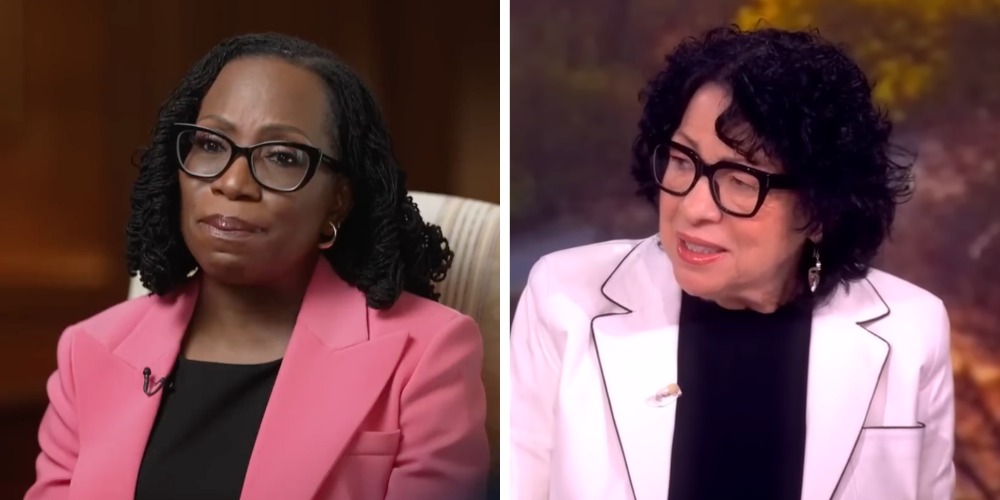
Jackson wrote that the majority is "wrong to suggest that the term 'sex' in Title IX cannot plausibly be interpreted to refer to anything other than biological sex."

Sotomayor said that while she agreed that the Title IX claim from defendant BPJ, a trans-identified male student who wanted to play on a female sports team, fails, it's on a "narrower basis than that on which the majority relies. As for BPJ’s equal protection claim, however, the majority, at this stage of litigation, gets the answer wrong."
She wrote that there are "unresolved factual questions" that prevent the court from assessing BPJ’s equal protection claim, saying that the Supreme Court should allow the District Court to address those factual questions. "Yet in an opinion unencumbered by fact or law, the majority today cuts off that process prematurely, deciding instead that B. P. J.’s case must end now."
She said she shares the sympathy the majority extended to young girls and women who play sports, but "because the majority, however, inflicts a hardship on those it disfavors without giving them the fair and full opportunity the Constitution requires to litigate their contentions, I respectfully dissent."
She said the majority had a "contorted logic" by giving credit to the West Virginia Legislature’s "concern that a class consisting of transgender girls like B. P. J. is large enough to pose an existential threat to girls’ sports, but at the same time holds that this class is too small to be protected by the Equal Protection Clause. In other words, this potentially overbroad generalization is both necessary to furthering substantially the State’s interests in girls’ sports and effectively irrelevant to assessing the classification’s lawfulness."
Her dissent centers around the "factual dispute" of whether allowing BPJ to compete in girls’ sports at school "would compromise the State’s interests in competitive fairness or safety." She said the "outstanding factual dispute should have prevented the Court’s resolution of BPJ’s claim."
"Far from being wholly irrelevant, that factual dispute is potentially outcome-determinative. In concluding otherwise, the majority adopts the position that the Equal Protection Clause allows state actors to deploy sex classifications that impose significant burdens on subclasses within them, even when the State’s interests are not furthered by their inclusion and even when those interests would not be jeopardized by exempting them."
She said this "diminished view of equal protection" was applied by the majority "to the sports context today, relying on the parties’ concessions that the State’s asserted interests will be furthered in most applications, given the particularly close relationship between sex, sports, and those interests. One can only hope that the same misguided approach does not and will not extend to other contexts tomorrow, when any of these considerations are missing."
In writing for the majority, Justice Brett Kavanaugh took issue with Sotomayor’s conclusions, writing that "the dissent directs various rhetoric against the Court’s opinion—employing phrases such as 'contorted logic' and 'misguided approach' and 'diminished view of equal protection' and 'unencumbered by fact or law.'"
"With respect, that rhetoric is misdirected. The Court’s holding today is straightforward. The Equal Protection Clause allows schools to maintain separate teams for female and male athletes. Schools may determine eligibility for women’s and girls’ teams based on biological sex. That policy is constitutionally justified by the vitally important interests in safety and competitive fairness so as to provide equal opportunities for women and girls to participate in sports. And when a sex-based classification is justified as a constitutional matter, as it is here, States need not make case-by-case exceptions—for example, schools need not make individual exceptions to allow certain biological males to compete in women’s and girls’ sports," he wrote.
He continued, "Second, we do not accept the dissent’s assumed monopoly on understanding the effects on individuals involved in disputes over transgender athletes. We are acutely aware of the difficulties sometimes faced by boys who identify as girls (and by girls who identify as boys) in middle school, high school, and beyond. And we greatly admire the desire of all students, including transgender students such as B. P. J., who want to participate in sports. But in conducting the equal protection inquiry, we must also account for the effects on girls who are forced to compete against biological males in sports."
Also dissenting in part was Justice Ketanji Brown Jackson, who wrote that "there is reason to doubt the soundness of the concession that Title IX’s reference to 'sex' means only sex assigned at birth." She noted Congress’s antidiscrimination statutes that "intended to strike at the entire spectrum of disparate treatment of men and women resulting from sex stereotypes."
"The prohibition against stereotyping is difficult to explain fully by reference to sex assigned at birth. A sex stereotype often will but need not have anything to do with an individual’s sex assigned at birth. A transgender woman penalized for being perceived as aggressive has experienced discrimination “on the basis of sex” just as much as a cisgender woman has, no matter that the transgender woman’s behavior matches expectations of her sex assigned at birth. Either way, the institution has imposed its gender-based expectations upon her. And either way, the institution may have violated Title IX."
She wrote that the majority is "wrong to suggest that the term 'sex' in Title IX cannot plausibly be interpreted to refer to anything other than biological sex." She added, "Title IX makes room for individuals to live in the gender they choose; it cares not just about sex assigned at birth but also about individuals’ ability to match (or not) their gender presentation to their gender identity. Because West Virginia’s law forces B. P. J. to live—in this case, to play—as a boy though she is a girl, it might well run afoul of Title IX properly construed."
SCOTUS rules states can keep men out of women's sports by The Post Millennial
Powered by The Post Millennial CMS™ Comments
Join and support independent free thinkers!
We’re independent and can’t be cancelled. The establishment media is increasingly dedicated to divisive cancel culture, corporate wokeism, and political correctness, all while covering up corruption from the corridors of power. The need for fact-based journalism and thoughtful analysis has never been greater. When you support The Post Millennial, you support freedom of the press at a time when it's under direct attack. Join the ranks of independent, free thinkers by supporting us today for as little as $1.
Remind me next month
To find out what personal data we collect and how we use it, please visit our Privacy Policy







Comments