
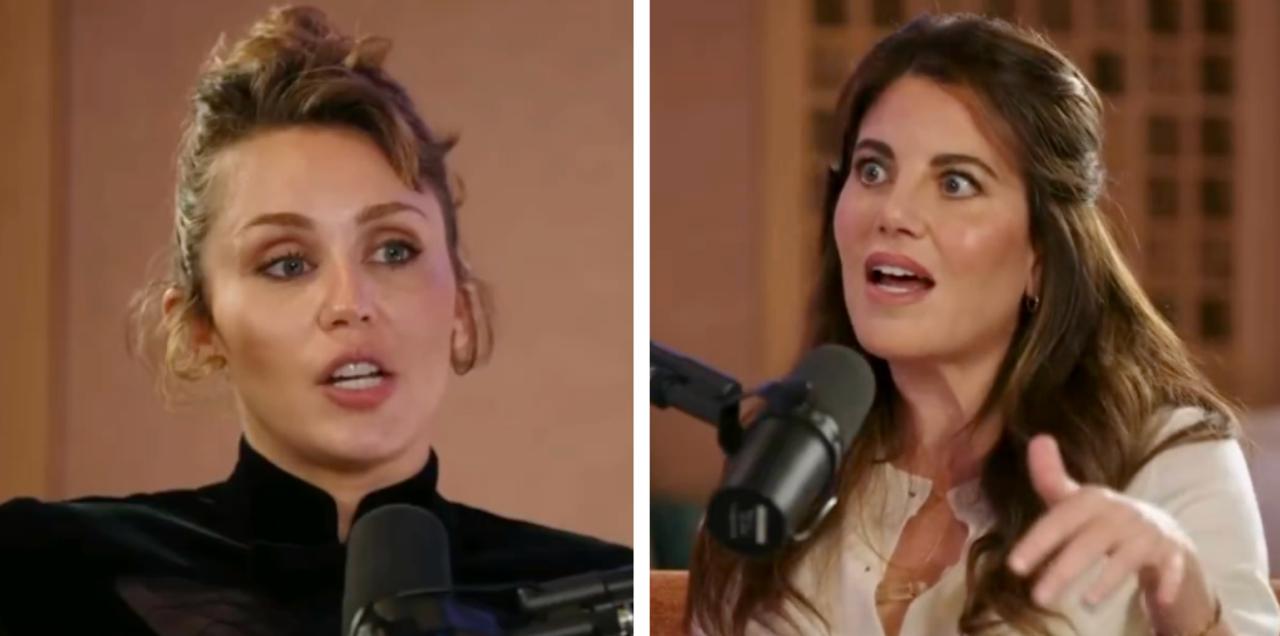
"No one wanted to date me because they didn't want to be with a woman, that sexual expression part was not for them, it was like shared with the world."

Pop singer Miley Cyrus spoke to Monica Lewinsky on her podcast Reclaiming about her emergence from Disney kid stardom and coming into her own. Lewinsky, of course, was the intern with whom President Bill Clinton had an affair, over which he was almost kicked out of the White House. Lewinsky, like Cyrus, had to rebuild, albeit after a different kind of scandal.
The two discuss how their public sexuality made them feel shame, in Cyrus' case intentionally and in the pop entertainment context, and for Lewinsky when the affair she was having as an intern under President Clinton, were cast under scrutiny. While they both undertook their actions of their own volition, both of them felt guilt and shame following those actions, specifically when facing the men in their own families.
It was in 2013 that Cyrus cast off her Hannah Montana character and released Wrecking Ball. She also stepped out onto the stage flaunting her sexuality publicly, for which she received a great deal of backlash from people who associated her with Hannah forever.
"It was really hard for me in 2013," she told Lewinsky, "and I lost everything during that time in my personal life because of the choices I was making professionally. Y'know, if I kept dressing or acting a certain way, my relationships fell apart. No one wanted to date me because they didn't want to be with a woman, that sexual expression part was not for them, it was like shared with the world."
"So like, guys, when I would try to date when I was dating, or who I was engaged to at the time, that didn't work out because I was sharing a part of myself that men wanted saved for them only, and the fact that I would, you know, pose nude or dance in very little clothes, or show my body was making them feel like I was taking something away that was meant to be for them," she went on.
"So I would have really hard times dating, and it was just, it was really hard. It was really hard for me to go home and see my dad and like look him in the eyes and not feel super embarrassed."
Lewinsky said she felt ashamed, too, when the Starr Report came out detailing her sexual activities with President Clinton. It was hard for her to face the men in her family, saying "...my dad and my brother and my stepdad of you know just that all these things were out there, and my dad's a doctor, and he still went to work every day. My brother was in college." She said she still feels guilt over it. Cyrus said she's worked through the guilt and shame she felt.
There is something deep and primal in this. For the most part, men want the women they feel charged with protecting, mothers, sisters, daughters, wives, to not appear sexually available to society at large. Women know this and so when they make themselves appear sexually available in that way, they feel shame about it. One can make the argument that this is instinctive. In Islamic cultures, it is this view that leads to honor killings.
In western cultures, specifically in American culture, women have broken down barriers as regards the presentation of women in public. In practice, this means that it's not at all uncommon for women to publicly behave as Cyrus did, in entertainment or otherwise. It's not uncommon for women to have affairs with their superiors, either, or for those to be made public.
However, none of that absolves women of the shame they feel for their behavior, especially when it comes to the men they care about knowing about it. Men (not all men, caveat, etc.) want to see women a specific way and women, despite the haranguing over liberation, want to be seen that way. While men are pretty clear on that view, just listen to the Weezer song "No One Else," women don't want to believe that they want to be seen as, for lack of a better word, pure and unblemished.
It is this feeling that Cyrus and Lewinsky both tapped into during this conversation, though it's unlikely they would frame it that way. Under the progressive, feminist model, the liberated woman in America is not supposed to feel shame for the public expose of her own desires and sexuality—but she does anyway.
One thing the Me Too era showed was that even when women engage consensually in sexual encounters they then can feel ashamed of it. This shame causes them to feel the need to reframe the incident in a way that protects their purity so that they, and the men around them, continue to see them as sexually innocent. This is how consensual casual sex can be mentally reimagined as rape. Lewinsky praised the Me Too movement in 2018 and said her relationship with the president was "constituted a gross abuse of power" on his part. She was just 22.
She has tried to understand it and reframe it, saying in 2018 that the relationship was "very, very complicated," and dissecting the definition of consent in relation to "the power dynamics, his position, my age." She went on to say "He was my boss. He was the most powerful man on the planet. He was 27 years my senior, with enough life experience to know better. He was, at the time, at the pinnacle of his career, while I was in my first job out of college."
Still, she said that "none of the above excuses me for my responsibility for what happened. I meet regret every day." Cyrus understands the impact her public sexuality had on her relationships, but she sees it more as a public perception disconnect between who she was, Disney star Hannah Montana, and who she was becoming, a singer and musician, an adult artist in her own right.
Women want to be able to flaunt it and shake it without being called slutty and men want to watch it and ogle it without bringing a woman who behaves like that into their heart or homes. No matter how one feels things should be, Cyrus and Lewinsky, two outspoken women who have been through it all, reveal that this is how things are.
This first appeared in Libby Emmons' newsletter. You can subscribe here.
Powered by The Post Millennial CMS™ Comments
Join and support independent free thinkers!
We’re independent and can’t be cancelled. The establishment media is increasingly dedicated to divisive cancel culture, corporate wokeism, and political correctness, all while covering up corruption from the corridors of power. The need for fact-based journalism and thoughtful analysis has never been greater. When you support The Post Millennial, you support freedom of the press at a time when it's under direct attack. Join the ranks of independent, free thinkers by supporting us today for as little as $1.
Remind me next month
To find out what personal data we collect and how we use it, please visit our Privacy Policy
Comments