
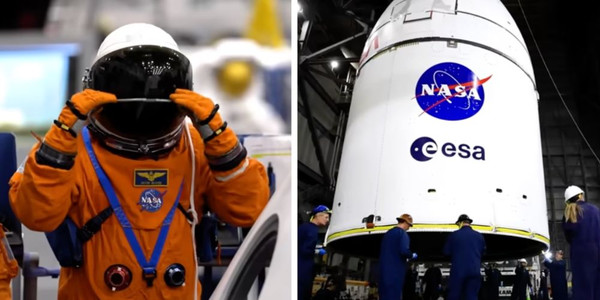
The mission is scheduled for 6:24 pm ET and marks the first time astronauts will travel near the moon since the Apoll porgam ended over 50 years ago.

NASA’s Artemis II mission is expected to take place on Wednesday, as four astronauts prepare to lift off from Kennedy Space Center as part of the agency’s effort to return mankind to the moon.
The mission is scheduled for 6:24 pm ET and marks the first time astronauts will travel near the moon since the Apollo program ended over 50 years ago. The crew includes NASA’s Reid Wiseman, Victor Glover, and Christina Koch, along with Canadian Space Agency astronaut Jeremy Hansen. The mission could break the distance record set during the Apollo program, sending humans further from Earth than ever before.
The launch was initially planned to take place in February, but technical issues with the rocket, including hydrogen leaks, caused it to be delayed.
The mission has been characterized as a “stepping stone” toward eventually sending astronauts to Mars. While NASA does not currently have concrete plans for a Mars mission, Artemis II will help collect data for future deep space exploration. The mission will also test the Orion spacecraft, including how its heat shield performs when reentering Earth’s atmosphere at speeds of about seven miles per second.
“Since the Moon is more accessible to us than Mars, scientists can use it to gain important scientific knowledge about the effects of the harsh conditions of deep space on living systems,” NASA said. “Altered gravity, high energy radiation exposure, and different atmospheric composition are just a few of the unique stressors that can affect our ability to sustain life off-Earth.”
Artemis I launched in November 2022 as a 25.5-day uncrewed mission. Cameras aboard the spacecraft captured images of Earth as the Orion capsule travelled nearly 270,000 miles from Earth. While Artemis II will be a crewed mission, it will not land on the moon. According to CNN, Patty Casas Horn, deputy lead for mission analysis and integrated assessments at NASA, said the spacecraft being used is not designed for landing.
“This is not a lunar lander,” Horn said. “Throughout the history of NASA, everything that we do is a bit risky, and so we want to make sure that that risk makes sense, and only accept the risk that we have to accept, within reason. So we build out a capability, then we test it out, then we build out a capability, then we test it out — and we will get to landing on the moon, but Artemis II is really about the crew.”
NASA appears to be undergoing a staged testing approach before committing to another moon landing. The agency also said that Artemis II will “pave the way for lunar surface missions, establishing long-term lunar science and exploration capabilities and inspire the next generation of explorers.”
The Artemis program has cost taxpayers about $100 billion since its inception and will continue to require significant funding. NASA’s human spaceflight program, which includes Artemis, accounts for nearly half of the agency’s $24.4 billion budget.
The renewed spirit for space exploration has also drawn support from lawmakers. In December, President Donald Trump signed an executive order calling for Americans to return to the moon by 2028 and eventually establish a permanent lunar outpost. Last September, Ted Cruz, chairman of the Senate Committee on Commerce, Science and Transportation, said during a hearing that the United States is “in a new space race with China,” adding that “if we fail, there will be a bad moon on the rise.”
A 2023 survey by Pew Research Center of more than 10,000 Americans found that the public generally holds a favorable view of NASA. However, sending astronauts to explore the moon ranked near the bottom in perceived importance. Similar attitudes were seen even during the 1960s and 1970s, when a majority of Americans thought the Apollo program was generally not worth the cost. It was only in July 1969, when Neil Armstrong and Buzz Aldrin walked on the moon, that 53 percent of Americans said the effort was worth the cost.
A live broadcast for the Artemis II launch is available on NASA’s YouTube Channel. Should the scheduled launch be delayed, the next opportunity would be on Thursday.
Powered by The Post Millennial CMS™ Comments
Join and support independent free thinkers!
We’re independent and can’t be cancelled. The establishment media is increasingly dedicated to divisive cancel culture, corporate wokeism, and political correctness, all while covering up corruption from the corridors of power. The need for fact-based journalism and thoughtful analysis has never been greater. When you support The Post Millennial, you support freedom of the press at a time when it's under direct attack. Join the ranks of independent, free thinkers by supporting us today for as little as $1.
Remind me next month
To find out what personal data we collect and how we use it, please visit our Privacy Policy







Comments
2026-04-01T19:03-0400 | Comment by: Jeffrey
Apparently going to the moon isn't worth the cost but bombing Iran is. How much has the Israeli-American genocide of Gaza cost US taxpayers?