
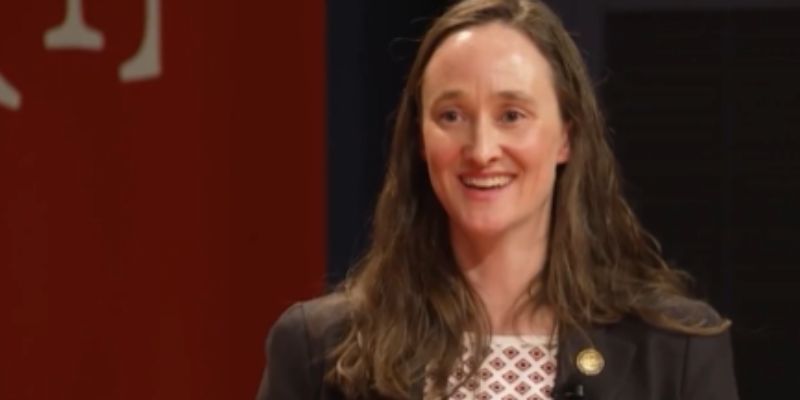
Petitioners are accusing the socialist mayor of being “derelict in her duties for public safety.”

King County Superior Court Judge Patrick Oishi has been assigned the case and will hold a hearing at 9 am on Aug. 31 to determine whether the allegations meet Washington's legal requirements for a recall and whether the proposed ballot synopsis is adequate.
Seattle voters Melinda E. Jacobson and Dale L. Osterud filed the recall charge on Aug. 11, alleging that Wilson “is derelict in her duties for public safety of the city of Seattle.”
Among the allegations is Wilson's handling of the Seattle Police Department following the July 26 Bite of Seattle shooting, which left three people dead and several others injured. The petitioners cite Wilson's removal of Seattle Police Chief Sean Barnes, alleging that she hastily forced Barnes to resign while the murder investigation was ongoing. They contend that Barnes had helped stabilize the department and improve recruiting and community engagement, and allege his removal created turmoil, damaged public trust, and was fiscally irresponsible amid Seattle's budget problems.
The deadly shooting had already triggered scrutiny at City Hall over Seattle's public-safety preparedness and response. On Aug. 10, one day before the recall charge was filed, Seattle City Councilmember Robert Kettle sent Wilson a letter saying the Bite of Seattle tragedy required a review extending beyond the city's expected after-action report. “The tragedy that recently unfolded during the Bite of Seattle at Seattle Center on July 26 has underscored the need for a procedural review— beyond the expected ‘After-Action Report,’” Kettle wrote, noting the three fatalities and multiple injuries.
Kettle said city officials needed to examine the security of major Seattle venues and events as well as how staffing shortages, outside mutual aid, camera technology, and communications affected operational coordination and the government's response. He also called attention to the successful use of Seattle's CCTV program and Real Time Crime Center in the Stadium District and Pioneer Square.
The recall petition raises surveillance cameras as a separate public-safety issue. The petitioners contend CCTV cameras were successfully used during the World Cup but were later turned off. They also allege cameras installed in crime hotspots remained inactive despite being budgeted, partially funded through a federal grant, and requested by residents and businesses.
The petitioners also point to deteriorating conditions in several Seattle neighborhoods.
In North Aurora, they allege residents repeatedly contacted Wilson's administration about gunfire, bullets striking homes and businesses, prostitution, and sex trafficking but received no meaningful response. In the Chinatown-International District, the petition cites complaints from residents and businesses over the open-air drug market, drug use, and violent crime around 12th Avenue and Jackson Street, including shootings and stabbings.
The filing also targets Wilson's handling of Belltown and Third Avenue, alleging areas were cleaned up for the World Cup before conditions deteriorated again afterward.
The King County Prosecuting Attorney's Office emphasized in a statement to The Ari Hoffman Show on Talk Radio 570 KVI that the allegations come from the petitioners and are not criminal charges brought by prosecutors. Its Civil Division conducted the technical review required under state law, examining whether the petitioners were registered Seattle voters, provided a concise summary of their allegations, and properly signed the filing.
The Aug. 31 hearing will determine whether the alleged acts meet the statutory standard necessary for the recall effort to continue. Neither the Prosecuting Attorney's Office nor King County Elections will participate as a party. Wilson and the petitioners may appear, though they are not required to do so.
If the petition survives the legal hurdle, proponents would move to the signature-gathering stage. According to information previously provided by King County Elections, petitioners would have 180 days to gather the required signatures, which would then be submitted to election officials for verification before a recall election could be scheduled.
A Seattle mayoral recall has not reached voters since 1975, when Mayor Wes Uhlman survived an effort to remove him from office. Seattle Mayor Frank Edwards was recalled in 1931, while Mayor Hiram Gill was recalled in 1911.
Powered by The Post Millennial CMS™ Comments
Join and support independent free thinkers!
We’re independent and can’t be cancelled. The establishment media is increasingly dedicated to divisive cancel culture, corporate wokeism, and political correctness, all while covering up corruption from the corridors of power. The need for fact-based journalism and thoughtful analysis has never been greater. When you support The Post Millennial, you support freedom of the press at a time when it's under direct attack. Join the ranks of independent, free thinkers by supporting us today for as little as $1.
Remind me next month
To find out what personal data we collect and how we use it, please visit our Privacy Policy

Comments