
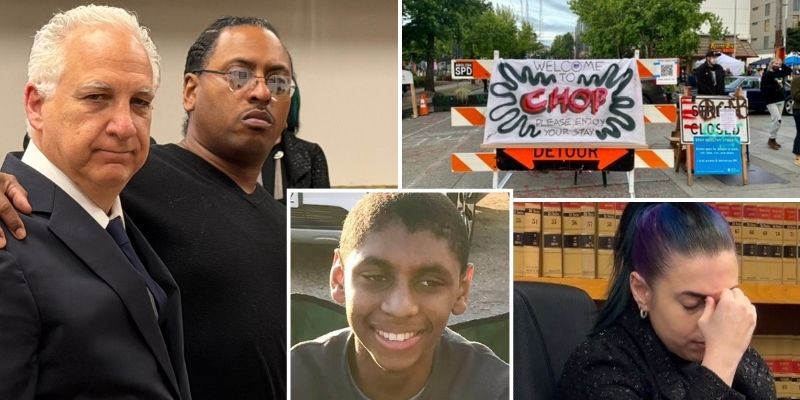
"The City hopes to evade responsibility by attacking this Court’s legal determinations, plaintiff’s counsel, and the jury’s decision."

The move comes after a King County jury in January found the city negligent in its emergency response to the early-morning June 29, 2020, shooting inside the occupied zone, concluding that those failures resulted in Mays’ death. Now, city attorneys are arguing the verdict was flawed from the start. “The trial contained multiple errors affecting the substantial rights of the City,” the Seattle City Attorney’s Office wrote in its motion. “These errors led to an award of excessive damages.”
In its request for a new trial, Seattle claims there was at least a 90 percent chance Mays would have died regardless of any delay in medical care, directly challenging one of the central conclusions presented at trial, that faster emergency response could have saved his life.
That argument cuts against testimony from the Mays family’s medical expert, who told jurors the teen likely would have survived if his airway had been cleared sooner after the shooting. City attorneys also argue the jury was improperly instructed and should have been required to divide fault between the city and the unknown shooters who opened fire.
“Mays lost, at most, a 5–10% chance of survival,” the city wrote, claiming that makes it “mathematically incompatible” to conclude the city caused his death. The city is further arguing that jurors should have been told to assign percentages of fault between Seattle and the still-unidentified gunmen, who witnesses described as armed “CHOP security.”
No one has been arrested or charged in the killing, which remains unsolved nearly six years later despite numerous witnesses and livestream footage from the night of the shooting.
By not apportioning blame, the city claims, the jury improperly placed full financial responsibility on Seattle, leading to what it calls an inflated damages award. Seattle is also targeting the conduct of the Mays family’s legal team, accusing attorney Evan Oshan of improperly influencing the jury by urging them to consider “deterrence,” sending a message to prevent similar incidents, when calculating damages.
The city further claims it was denied the opportunity to cross-examine Robert West, the surviving teen who was in the vehicle with Mays when both were shot. West did not testify live at trial; instead, portions of his prior deposition were played for the jurors.
After the verdict, Oshan refiled a separate lawsuit against the city on West’s behalf. Oshan and his co-counsel sharply rejected the city’s arguments, calling the motion a last-ditch attempt to escape accountability. “The City hopes to evade responsibility by attacking this Court’s legal determinations, plaintiff’s counsel, and the jury’s decision,” Oshan and co-counsel Phillip Talmadge wrote in a filing. “This Court and the jury got it right.”
Oshan also pushed back on the claim that the damages were excessive, telling The Ari Hoffman Show on Talk Radio 570 KVI: “We asked for $100 million. The jury deliberated for twelve days and returned a verdict of $30.5 million, a reduction of nearly 70 percent. The record does not support a characterization of this as an excessive verdict.”
He further noted that the issue of apportioning blame was already addressed during the trial. “Instruction No. 16a expressly directed the jury to segregate any damages caused solely by the unknown shooter and exclude them from any award against the City,” Oshan said. “The jury followed that instruction through twelve days of deliberation. The apportionment issue the City now raises was directly addressed by the court before deliberations began.”
Oshan added that the city declined to resolve the case before trial. “The City made no settlement offer at any point in this litigation. The jury heard the evidence, followed the instructions, and rendered its verdict. We are confident the record will speak for itself.”
The jury instruction referenced by Oshan directed jurors that they “must not include any damages that were caused by acts of the unknown assailant(s)” and that any such damages “must be segregated from and not made a part of any damage award against the City.”
The request for a new trial now goes back to King County Superior Court Judge Sean O’Donnell, who presided over the case. Legal standards heavily favor upholding jury verdicts, meaning O’Donnell must view the evidence in the light most favorable to the Mays family and can only grant a new trial if no reasonable jury could have reached the same conclusion. If denied, the city has already indicated it will appeal to the Washington State Court of Appeals.
The civil trial marked the first full public accounting of the deadly shooting inside CHAZ, which formed after city officials abandoned the Seattle Police Department’s East Precinct and restricted emergency access, allowing Antifa and BLM activists full control of 6 blocks of the city.
Jurors deliberated for 12 days before concluding that Seattle failed to follow its own emergency protocols, pointing in part to a chaotic 911 response in which dispatchers did not clearly direct where volunteers should take the wounded teen.
For the Mays family, the verdict represented a measure of accountability after years without answers.
Powered by The Post Millennial CMS™ Comments
Join and support independent free thinkers!
We’re independent and can’t be cancelled. The establishment media is increasingly dedicated to divisive cancel culture, corporate wokeism, and political correctness, all while covering up corruption from the corridors of power. The need for fact-based journalism and thoughtful analysis has never been greater. When you support The Post Millennial, you support freedom of the press at a time when it's under direct attack. Join the ranks of independent, free thinkers by supporting us today for as little as $1.
Remind me next month
To find out what personal data we collect and how we use it, please visit our Privacy Policy

Comments