
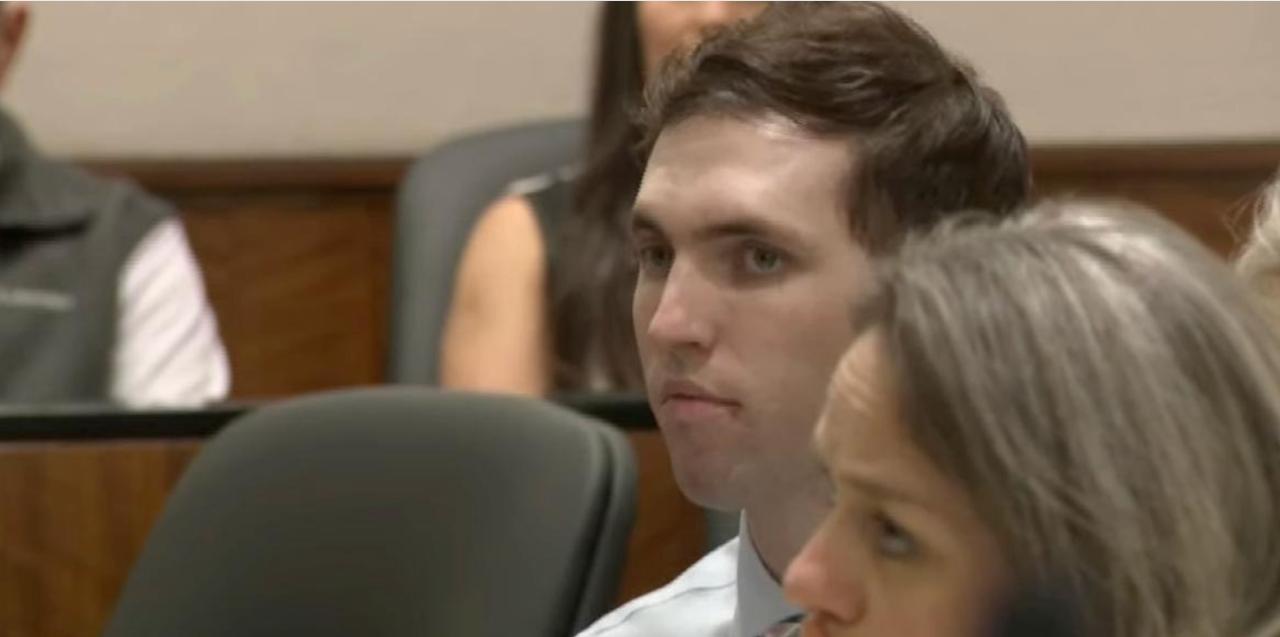
The defense said that the state had not offered any specific evidence that Robinson "presents a risk to anybody in the courtroom or to himself by being unshackled."

The transcript of a sealed hearing held in October in the Tyler Robinson case has been released, showing the parties discussing to what extent the suspect charged with assassinating Turning Point USA founder Charlie Kirk should wear shackles in the courtroom. Judge Tony Graf ordered that the transcript and audio be released with limited redactions. He ultimately ruled that Robinson could wear civilian clothing but must remain shackled.
Attorney Richard Novak, who is on Robinson’s defense team, argued that at least for the October 24 hearing, his client should be able to have a hand available "so he can take notes during the hearing." He said that after spending two hours with his client, "I can’t imagine any reason why he can’t take notes during this hearing, and there’s no reason why that would jeopardize his safety or the safety of anyone else." Ben Van Noy of the Utah County Attorney’s Office said that he objected, adding that "this is the heart of what we’re trying to decide."
Judge Graf asked if there was a way to unshackle one hand of Robinson’s "for him to be able to write that doesn’t compromise the rest of —" with the bailiff interrupting with a comment that was redacted. Graf continued, "all right, let’s go ahead and proceed with that."
The primary reason for the hearing was the defense’s motion for their client to appear "in civilian clothing and without restraints at all hearings." In his argument, Novak cited the 2005 Supreme Court case Deck v Missouri, which says "that a blanket policy of shackling a criminal defendant violates the defendant’s constitutional rights… Because what the constitution requires is an individualized assessment of whether shackling is necessary because of security risks emanating from the defendant." He said there was a "fundamental disagreement" between the parties as to whether this extends outside of a jury trial.
Novak said that being shackled in a courtroom "necessarily interferes with a defendant’s right to thoughtfully observe and participate in the proceedings because the shackling is inherently intrusive in his ability to do so," and that with the case being public, "for the public ... to see Mr. Robinson shackled at the feet, at the waist, at the hands, absent an individualized determination by the court, offends the dignity and decorum of the courtroom." He said that the state had not offered any specific evidence that Robinson "presents a risk to anybody in the courtroom or to himself by being unshackled."
On the topic of Robinson’s clothing for the courtroom, Novak said his client "should not be depicted as a jail inmate. He should be depicted as a citizen of the United States with a presumption of innocence. And that is why we believe he should be able to appear in street clothes that also are consistent with the Court's standards for what kinds of clothing individuals can wear ... unless we're going to shut down all the video and all the photography of what goes on in this courtroom, he shouldn't be wearing jail stripes."
"We do believe that in the absence of that individualized showing, the shackling should end right now," he added.
Christopher Ballard, an attorney for the state, said that the issue of shackling "raises two primary issues" of whether Robinson’s presence is necessary at a hearing, and what security measures are necessary if he is present at a hearing.
In regard to the first issue, Ballard said the court could hold noncritical hearings either virtually or in a hybrid format with Robinson appearing from jail, and that if Robinson is shown on the screen, "that it not show that he's appearing from the jail." He later added, "Holding those kinds of hearings virtually also gets rid of this question about shackling. And it avoids the significant costs and risks, especially the risks to Defendant of transporting him here to court."
In regard to the second issue, Ballard said, "Does he need to be in civilian clothes? Does he need to be shackled? And I want to make it clear that at this point, the state agrees that in any proceedings before a jury, the defendant has the right to be in civilian clothes and unrestrained unless those restraints are justified based on a showing that the state would need to make. But Defendant asks this Court to extend those principles to nonjury proceedings. And there's no basis and there's no reason to do that." He said that the defense’s arguments were based on "tenuous grounds," and that the defense did not cite "any controlling Utah case law."
Ballard noted the dissent in the Deck Supreme Court case from Justices Scalia and Thomas, "where they talk about and criticize those rationales, especially in non-jury, non-guilt-phase proceedings, which is — again, I think all that we're talking about now," and points out "that that case is based on a very ancient common law rule that no longer exists, or at least the rationale for that rule no longer exists." The rationale, he said, came from when the rule was first developed and "prisoners actually appeared in irons, heavy ponderous irons. They were painful."
He said that Utah courts have issued a rule that "leaves the ultimate decision about courtroom security up to this Court, but it creates a presumption that all in-custody defendants should be ... restrained or supervised at all times."
"And, again, I think it's important for this Court to consider that the court's security administrator and the sheriff, who's responsible to provide security here, in their opinion, restraints are — should be required for all pretrial detainees."
October 24 Tyler Robinson Hearing Transcript by Hannah Nightingale
Powered by The Post Millennial CMS™ Comments
Join and support independent free thinkers!
We’re independent and can’t be cancelled. The establishment media is increasingly dedicated to divisive cancel culture, corporate wokeism, and political correctness, all while covering up corruption from the corridors of power. The need for fact-based journalism and thoughtful analysis has never been greater. When you support The Post Millennial, you support freedom of the press at a time when it's under direct attack. Join the ranks of independent, free thinkers by supporting us today for as little as $1.
Remind me next month
To find out what personal data we collect and how we use it, please visit our Privacy Policy



Comments
2025-12-30T15:50-0500 | Comment by: Andrew
The presumption of innocence is key in American jurisprudence. I have no problem with the suspect being in civilian clothes, but I believe that a bailiff can shackle the suspect to a chair or table to prevent the potential danger to everyone else in the courtroom.