
SVPs are designated Level 3 sex offenders, the highest risk category under state and federal law, and most likely to re-offend.

SVPs are individuals who have been convicted of serious sexual offenses and later determined by the courts to suffer from a mental abnormality or personality disorder that makes them likely to reoffend if not confined. They are designated Level 3 sex offenders, the highest risk category under state and federal law. Under current law, supported by Democrats, the Department of Social and Health Services (DSHS) and the courts have discretion to place civilly committed SVPs in community-based housing after they are deemed eligible for conditional release.
Many SVPs in Washington are housed at the Special Commitment Center on McNeil Island, a remote island facility in Pierce County. The center was created to confine individuals described by federal authorities as the “worst of the worst,” including serial rapists and convicted pedophiles, after they have completed their prison sentences. Over time, Democrats have shifted state policy toward releasing these individuals into less restrictive alternatives (LRA), including supervised housing in residential neighborhoods, to de-populate the Island.
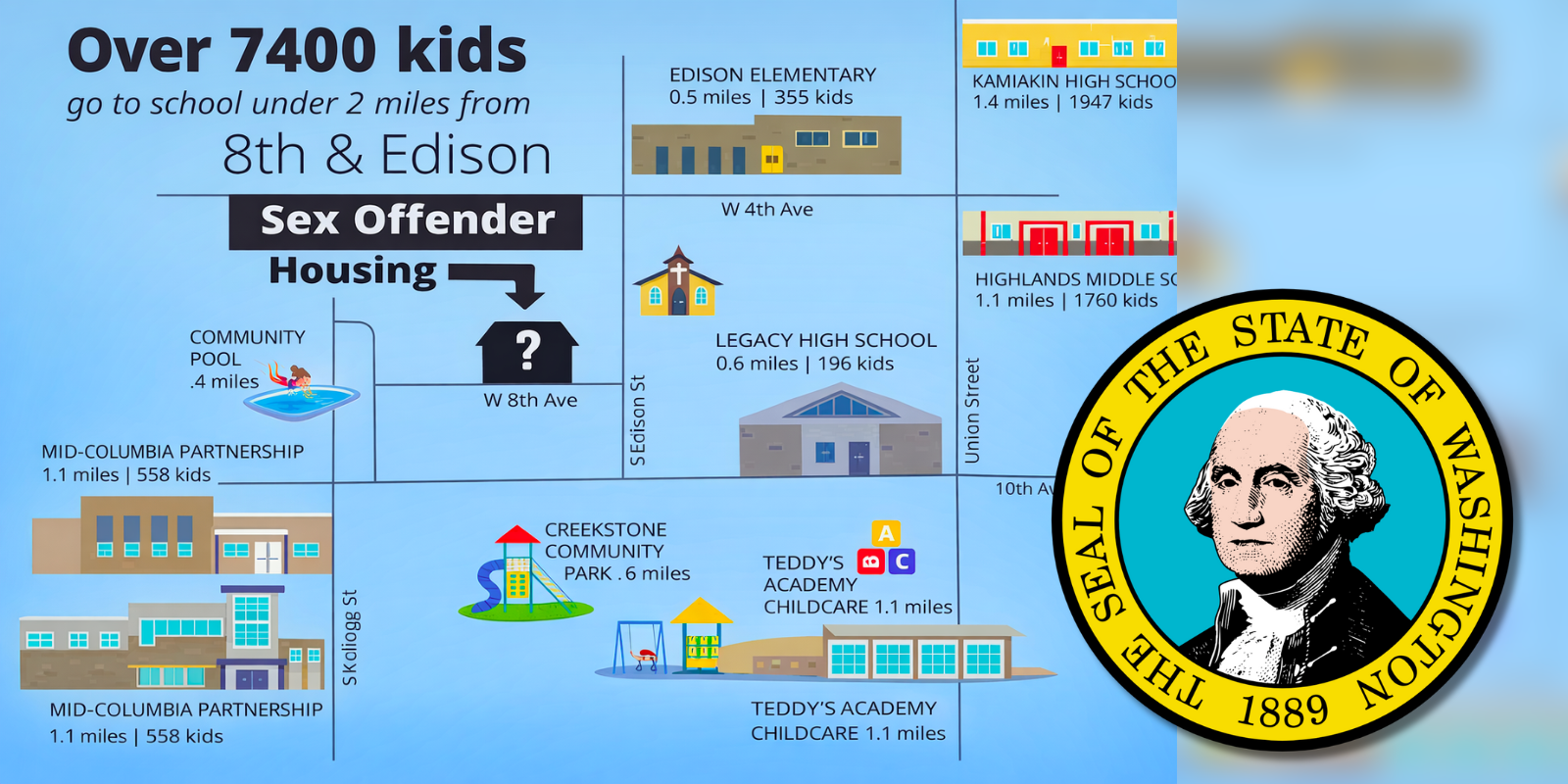
That shift is now under renewed scrutiny as a home near the intersection of 8th Avenue and Edison Street in Kennewick is being reviewed for use as an LRA for up to five SVPs. Within a two-mile radius of the proposed site, more than 7,400 children attend nearby schools and child care facilities, including Tri-Tech Skills Center, Kamiakin High School, Edison Elementary School, Highlands Middle School, Bright Beginnings Learning Center, Legacy High School, The Children’s Academy, Teddy’s Academy Childcare, Lincoln Elementary School, Taty’s Daycare, Little Miracles Childcare, Ridge View Elementary School, Mid-Columbia Partnership, and Fuerza Elementary School.
The proposed placement has ignited community backlash and revived long-standing concerns over the state’s SVP release process. Critics argue that communities are often notified only after key decisions have been made, leaving residents with little meaningful input.
Reps. April Connors (R-Kennewick) and Stephanie Barnard (R-Pasco), joined by Sen. Matt Boehnke (R-Kennewick), say existing statutes allow DSHS and contracted housing providers to prioritize administrative efficiency over public safety. Connors has introduced four bills aimed at increasing oversight, transparency, and physical separation between SVPs and vulnerable populations. Her proposals would require local supervision of offenders, expand buffer zones around schools and child care facilities, mandate early notification when properties are purchased for LRA use, and ensure that treatment providers are directly accountable for housing operations.
Barnard’s companion bills would prohibit LRA placements next to homes with minors, bar placements in family-dense neighborhoods, establish line-of-sight restrictions near schools and child care facilities, and require courts to consider recommendations from county prosecutors before approving any site.
In recent years, the Sex Offender Policy Board and the Washington State Sentencing Guidelines Commission have advocated reduced restrictions and expanded community placements for SVPs, arguing that such policies improve rehabilitation outcomes and reduce costs. Critics argue that the state has placed high-risk offenders from McNeil Island into residential neighborhoods without adequate transparency or local consent. Former Gov. Jay Inslee previously vetoed a measure that would have required notifying communities before placing Level 3 offenders nearby.
All eight bills have been referred to the House Community Safety Committee, though none are currently scheduled for public hearings.
Powered by The Post Millennial CMS™ Comments
Join and support independent free thinkers!
We’re independent and can’t be cancelled. The establishment media is increasingly dedicated to divisive cancel culture, corporate wokeism, and political correctness, all while covering up corruption from the corridors of power. The need for fact-based journalism and thoughtful analysis has never been greater. When you support The Post Millennial, you support freedom of the press at a time when it's under direct attack. Join the ranks of independent, free thinkers by supporting us today for as little as $1.
Remind me next month
To find out what personal data we collect and how we use it, please visit our Privacy Policy



Comments