
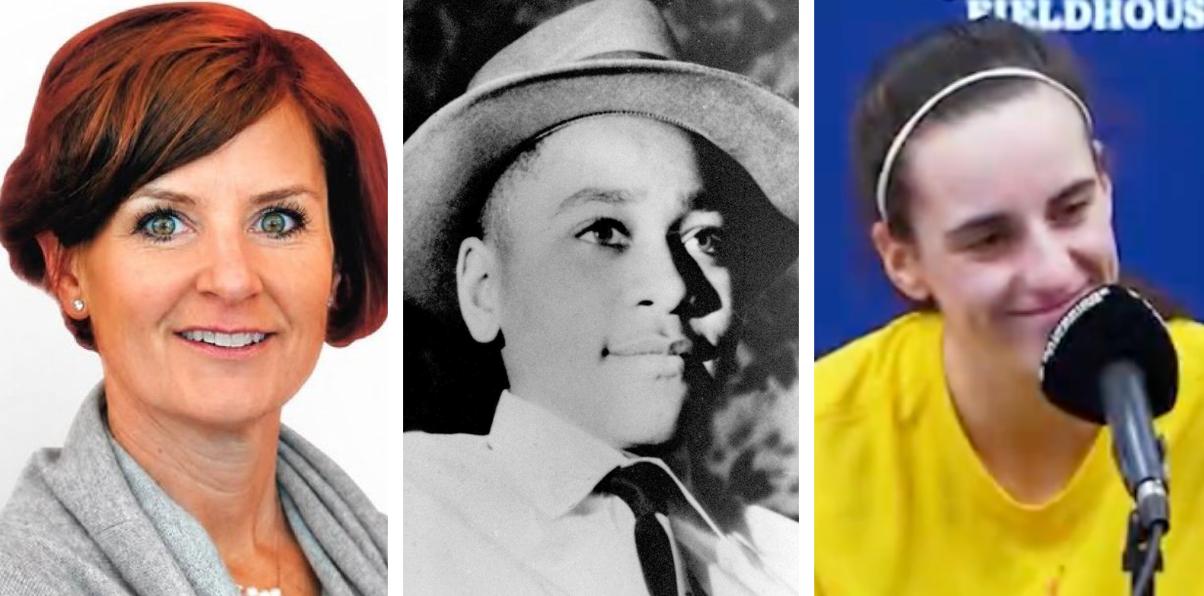
"This point stands: There is a history in this country of perceived threats to white women being weaponized against African-Americans, and the danger that poses to [b]lack players in the league."

USA Today's Nancy Armour compared WNBA player Caitlin Clark's comments about how fouls are called in the league to the murder of Emmett Till. When she was called out on the insane juxtaposition, she doubled down.
"In my recent column," Armour said, "I made an inartful comparison with the murder of Emmett Till. I intended to connect the issues the WNBA is currently facing with its All-Star Game being hosted in Till's hometown of Chicago.
"I obviously did not provide enough context for that," she continued.
"However," she went on, "this point stands: There is a history in this country of perceived threats to white women being weaponized against African-Americans, and the danger that poses to [b]lack players in the league.
"Players have been abused online and have reported receiving death threats. That has to be taken more seriously.
"I sincerely regret that my lack of appropriate context is overshadowing that important conversation and the action that needs to be taken by the WNBA to address it directly—for the benefit of ALL players."
So what did Armour write in the first place? In an article titled "Caitlin Clark's flopping isn't just annoying—it's becoming dangerous," Armour claimed that the Indiana Fever star was claiming fouls where none existed and that injuries she said she got at the hands of other players were non-existent. A recent on-the-court incident saw a competitor with her hand to Clark's throat. Clark's coach has also commented on how Clark is said to be "always initiating the contact."
But then Armour took the game and put it in what she would call a "historical context." She took aim at Clark and fans of women's basketball and put a whole racial component on it. "It seems there is a white nationalist element to Clark's fandom that is deeply, deeply problematic, made even more so because the WNBA is made up predominantly of [b]lack women, many of them queer," she wrote.
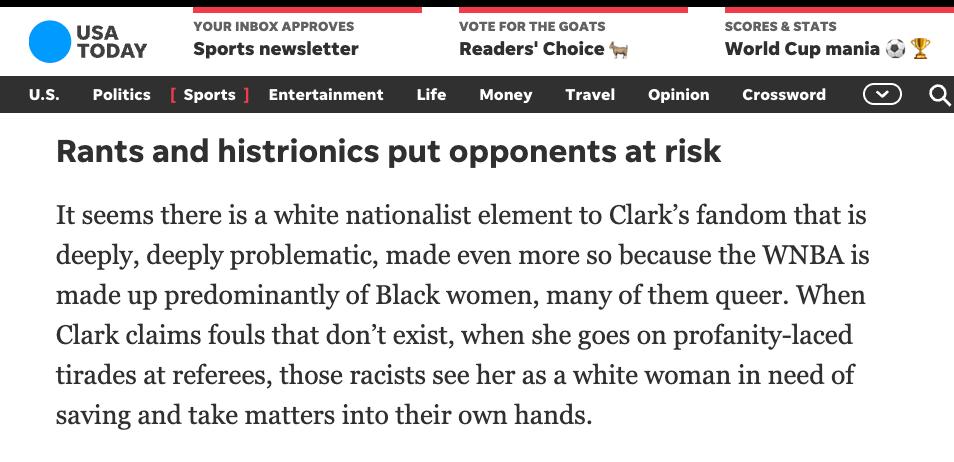
"When Clark claims fouls that don’t exist, when she goes on profanity-laced tirades at referees, those racists see her as a white woman in need of saving and take matters into their own hands," Amour said. She then said that a player who Clark said had fouled her, Chelsea Gray, had received mean messages online, including a racial slur from a man who got fired from his job at Hilton for doing so. Gray said the firing, and people coming out in support of her, was "really cool."
But for Armour, the whole thing is all about America's racist past and how culpable white people still are, in her view, for the sins of past white people. "It shouldn't need reminding," she wrote, "that this country has an awful history of [b]lack people being harmed, even killed, in the name of 'defending' white women.
"The WNBA's All-Star Game this weekend is in Chicago, Emmett Till's hometown, and a local art gallery is currently hosting an exhibit imagining his life if he hadn't been lynched. While it’s incumbent on the WNBA to do more to protect its players, there also should be an expectation on Clark to recognize the broader implications of her actions being weaponized," she wrote, with the words "being weaponized" added in the revised copy.
She also revised the paragraph to say that the All-Star Game being in Chicago is a case of "irony" and noted that Till "became an icon of the civil rights movement after his tragic murder." Is this enough context to justify the comparison of the unlawful murder of a young man to a player saying she's being fouled more than referees are calling?
An editor's note later appeared on the top of the article at USA Today, noting that the "column has been updated to provide further context and clarity." That context was minimal and does not address the concerns.
This is what was added: "After Phoenix Mercury forward Alyssa Thomas was charged with a flagrant-2 foul on Clark on June 25, she said she received death threats and online abuse and called on WNBA commissioner Cathy Engelbert to act. For her part, in a July 3 interview, Clark condemned the 'harassment, the hate' that has followed her on-court altercations since she entered the league." Armour also noted that the league is meeting to talk about player safety.
But in what universe is the horrific murder of a 14-year-old boy for allegedly talking to a white woman even remotely similar to game-play in an interracial women's professional basketball league? The "added context" is that Armour thinks Clark should take the race of her competitors into account before playing the game as she has been her entire career, and that it's her fault that these players are allegedly getting called names and threatened online.
Clark's emergence as a star player has been a bitter pill for some players who feel that they do not get the recognition they deserve. Clark has drawn crowds, fans love her, and other players have had a bad case of sour grapes as Clark's playing, and not their own, has brought attention back to the league.
No one has ever said that about white basketball players who draw fouls in the NBA. The very notion that players who are on equal footing should consider the race of their opponents is, in fact, racist. Armour should just let the women play without racially badgering a star player for her whiteness.
Powered by The Post Millennial CMS™ Comments
Join and support independent free thinkers!
We’re independent and can’t be cancelled. The establishment media is increasingly dedicated to divisive cancel culture, corporate wokeism, and political correctness, all while covering up corruption from the corridors of power. The need for fact-based journalism and thoughtful analysis has never been greater. When you support The Post Millennial, you support freedom of the press at a time when it's under direct attack. Join the ranks of independent, free thinkers by supporting us today for as little as $1.
Remind me next month
To find out what personal data we collect and how we use it, please visit our Privacy Policy


Comments