
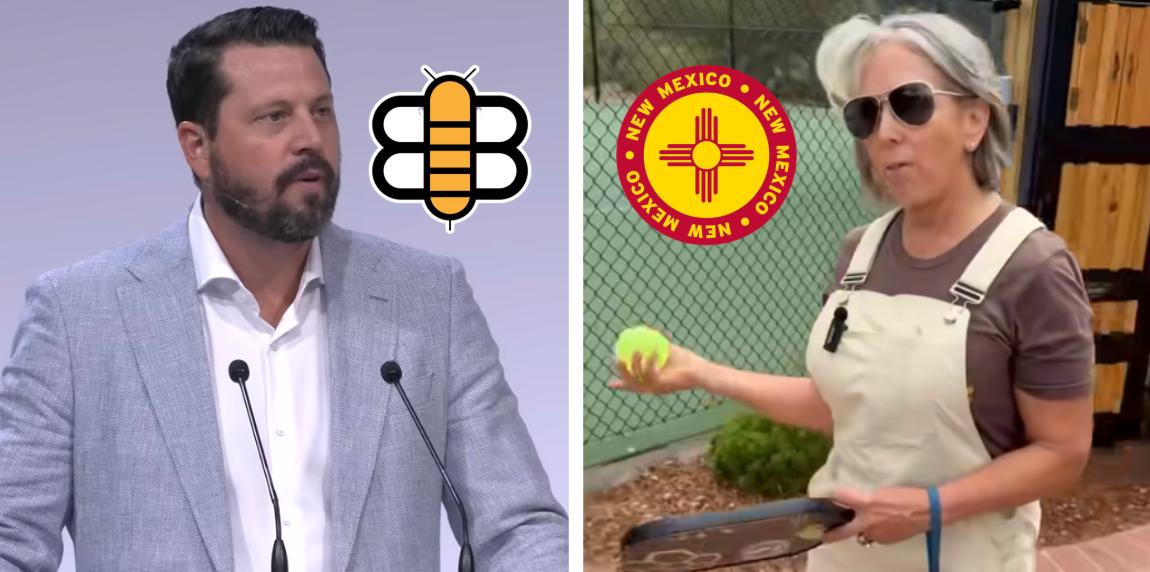
"Put simply, HB 182 spoils the joke as it begins, each and every time."

Alliance Defending Freedom (ADF) attorneys filed the lawsuit Tuesday in the US District Court for the District of New Mexico on behalf of the satire outlet, challenging provisions of HB 182, a 2024 law regulating what the state calls "materially deceptive media."
The law makes it a civil offense to create or produce political content containing AI-generated material without including a state-mandated disclaimer. Violations can carry penalties of up to $1,000 each, with total civil penalties reaching $20,000. The restrictions apply 365 days a year, including during non-election years.
The Bee argues the law directly targets constitutionally protected political satire and parody, which frequently rely on fictional statements, manipulated images, exaggeration, and absurd scenarios to make political points. "New Mexico has made it illegal to post AI-created satire of political candidates or issues without a state-mandated warning label," the complaint states, adding that the law covers material ranging from "flyers to tweets to memes" and can reach people who repost the content.
New Mexico's own officials raised constitutional concerns about the legislation before and after it became law. When Democrat Gov. Michelle Lujan Grisham signed HB 182 in March 2024, she acknowledged that members of the State Ethics Commission had raised concerns about its enforceability. Grisham added that she was "concerned that portions of this legislation are ambiguous and may pose legal issues" and requested an opinion from the state attorney general.
New Mexico Attorney General Raúl Torrez subsequently issued an advisory opinion in July 2025 agreeing that HB 182 does not actually exempt satire or parody from its disclaimer requirements.
"Given the importance of satire and parody to the marketplace of ideas, this part of the statute is likely unconstitutional on its face," Torrez concluded, according to the complaint. His opinion is not binding on the State Ethics Commission, which the Bee says has not disavowed enforcement of the challenged provisions.
The law defines "materially deceptive media" as an image, video, or audio depicting someone engaging in conduct or speech that did not actually occur, published without that person's consent and produced in whole or in part using artificial intelligence.
The Bee argues the definition could sweep far beyond conventional "deepfakes." The statute does not specify whether AI must have been used to create the allegedly deceptive portion of the material, meaning AI used for another purpose, such as "creating a border or editing accompanying text," could potentially trigger the law. The complaint also argues that the law leaves unclear whether sharing covered content through text messages, emails, direct messages, or social media reposts constitutes regulated distribution.
The disclaimer requirements are extensive. Images must display an easily readable warning, while videos must display the disclaimer for their entire duration. For audio, the warning must be spoken at the beginning and end and, for recordings longer than two minutes, repeated at intervals of no more than two minutes. HB 182 specifically addresses satire and parody but does not exempt them from those requirements. Instead, the complaint notes, satire and parody are permitted only if they include the mandated disclaimer.
The Bee argues that requirement fundamentally undermines how satire works. "Put simply, HB 182 spoils the joke as it begins, each and every time," the complaint states, arguing that announcing the artificial nature of a parody before the audience encounters the joke deprives it of its "rhetorical force."
The lawsuit centers in part on a recent Bee video titled "Visit New Mexico: A Democrat Untopia," a satirical tourism advertisement inviting viewers to "dream what it would be like not having the Bill of Rights" before telling them, "Our governor and supreme court have you covered."
The video displays a real image of New Mexico Supreme Court Justice David K. Thomson, who is scheduled to appear on the state's November 2026 ballot, followed by an AI-generated version of Thomson appearing to announce: "The New Mexico Supreme Court hereby rules against the Second Amendment, the First Amendment, or any other amendment that lets people do things."
The complaint includes an example of what the video would look like under the state's requirements, showing the image covered by a large warning stating that the video was manipulated or generated by artificial intelligence. The Bee says it will not add the disclaimer because doing so would alter its message.
The Bee also alleges the statute gives preferential treatment to traditional news outlets. The law excludes communications appearing in a "news story or editorial" from its definition of an advertisement, while satire, parody, political cartoons, and memes do not receive the same blanket exclusion.
"New Mexico is censoring political speech it dislikes. We should not trust the government to decide what is true in our political debates," ADF Legal Counsel Logan Spena said in announcing the lawsuit. "The Babylon Bee is seeking to uphold its fundamental right to speak freely and ensure that our political system remains one of self-government."
"We're used to getting pulled over by the joke police, but comedy isn't a crime," Babylon Bee CEO Seth Dillon added. "The First Amendment protects our right to create AI satire poking fun at political candidates. We'll never stop fighting to defend that freedom."
The lawsuit seeks a declaration that the challenged provisions violate the First and Fourteenth Amendments as well as preliminary and permanent injunctions preventing the State Ethics Commission from enforcing them.
Powered by The Post Millennial CMS™ Comments
Join and support independent free thinkers!
We’re independent and can’t be cancelled. The establishment media is increasingly dedicated to divisive cancel culture, corporate wokeism, and political correctness, all while covering up corruption from the corridors of power. The need for fact-based journalism and thoughtful analysis has never been greater. When you support The Post Millennial, you support freedom of the press at a time when it's under direct attack. Join the ranks of independent, free thinkers by supporting us today for as little as $1.
Remind me next month
To find out what personal data we collect and how we use it, please visit our Privacy Policy

Comments