
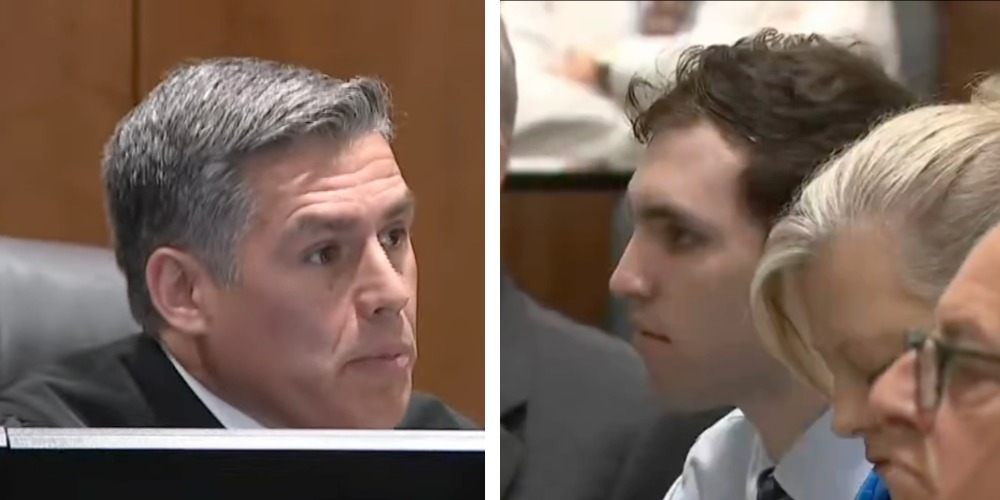
Tyler Robinson entered a plea of not guilty on all counts.

Following Tuesday's closing arguments for the July preliminary hearing, Judge Tony Graf ruled that the case against Tyler Robinson in the murder of Charlie Kirk can go forward. Graf determined that the prosecution had established probable cause for count one, capital murder.
"Viewed in the light most favorable to the prosecution, this evidence is sufficient at this stage to support a reasonable belief that defendant is the individual who shot and killed Charlie Kirk. Accordingly, the state has demonstrated probable cause as to the identity and homicide elements of count one," Graf said. Count one is aggravated murder and brings with it a death penalty if convicted.
As to count two, felony discharge of a firearm causing serious bodily injury, Graf ruled that probable cause had been established. On counts one, two, three, four, five, six, and seven, were all boundover for trial. Following the reading of the counts, Robinson pleaded not guilty to all counts.
Utah prosecutors asked that Robinson be tried for "count one, aggravated murder, a capital offense, together with the state's victim targeting notice. Count two, felony discharge of a firearm causing serious bodily injury, a first degree felony. Counts three and four obstruction of justice, second degree felonies. Counts five and six tampering with a witness, third degree felonies. And count seven violent offense committed in the presence of a child," Graf said.
Robinson was boundover for trial for each and every one of those counts.
Graf read out the events of September 10, 2025 on the Utah Valley University campus where Kirk was speaking with students during a TPUSA event. He tracked through the movements of Robinson on campus, which had been well-documented. In addition to that timeline, Graf walked through the electronic communications between Robinson and Lancy Twiggs, his roommate and boyfriend.
Prosecutor Ryan McBride delivered the closing arguments for the state. “Your honor, on September 10 of 2025, the defendant, this man, Tyler Robinson, shot and killed Charlie Kirk because he disagreed with him, and he did it by firing a high-powered rifle into a crowd of over 3,000 people, which created a great risk of death.”
He said there is a “mountain of evidence” that proves Robinson is the shooter, specifically four categories of evidence. He said these four categories “would provide evidence, certainly probable cause, and possibly proof beyond a reasonable doubt that the defendant is the man who shot Charlie Kirk.”
He said that the state knows Robinson first because of video evidence. He recounted surveillance video shown during the hearing that showed the person believed to be Robinson’s movements throughout campus leading up to, during, and after the shooting. He noted that Robinson was seen in some of the footage wearing the same clothing he later was seen wearing when he turned himself in.
He said the second category establishing Robinson as the shooter is DNA evidence. He said Robinson’s DNA was found “all over that gun,” on the scope, grips, stock, and trigger. “This was the rifle that killed Charlie Kirk. We know that because it was found in the woods,” in the area “where that shooter ran after taking the shot and dropping off of the Losee Center.” He said only one of the four rounds had been fired. He said that ballistic evidence showed that the round that was recovered from Kirk’s body “was consistent with having been fired from that gun.”
“The third reason we know that the defendant is the shooter is because he admitted to it,” McBride said. “That morning, before he left, he left a note for his boyfriend, stating that he left on a mission. He had the opportunity to take out Charlie Kirk, and then after he had shot and killed Charlie Kirk,the defendant texted that same boyfriend … and admitted to doing this.” He said that Robinson admitted to killing Kirk in text messages with Lance Twiggs, and also in a Discord group he was in.
The fourth factor establishing that Robinson was the killer is circumstantial evidence, “we have in this case the classic circumstantial evidence of motive, means, and opportunity, and then some.” Regarding motive, McBride said that Kirk “was an outspoken critic of homosexuality and transgenderism,” and that Robinson “was living in a homosexual relationship with a man who was considering transgender or transitioning his gender, and who went by the name Luna. It’s not difficult to understand the motive here.”
“The evidence is overwhelming. Any one of these four categories I’ve talked about is adequate, certainly for probable cause, and likely for proof beyond a reasonable doubt. There can be no doubt that the defendant is the man who shot and killed Charlie Kirk, and the evidence clearly surpasses the hurdle of probable cause at this stage of the proceeding.”
Moving to aggravating factors in the case, McBride said, “you can’t shoot a rifle into a crowd of 3,000 people without knowing that you create a great risk of death to all those around your target.” Through the aggravating factor of great risk of death, the prosecution is seeking the death penalty.
He said that testimony showed the shot was around 400 feet, “at that distance, a variance of simply one degree, if the defendant is one degree off, that’s a matter of millimeters for the barrel of his gun. That bullet would have struck seven feet away from his target.” He said Robinson could not only clearly see Kirk, but also the people surrounding his tent. “As he approached that rooftop on the Losee Center roof, as he approaches the edge of that rooftop, he would have seen this mass of thousands of people.”
He said that moments before the shot, a woman had passed behind Kirk in the line of fire, and noted the questioner that had been just feet away from Kirk at the front of the tent. He said that Robinson had also planned for the possibility of missing, bringing additional bullets with him.
McBride cited the example of the attempted assassination of President Trump in Butler, Pennsylvania, noting that Trump was able to escape being killed. One person was killed and others were injured in the assassination attempt. “You shoot at someone in a public assassination attempt, you have a great risk of killing someone else.” He later added, “what are the consequences of missing? Death.”
The defense spent a portion of its closing arguments making the case against the great risk of death aggravating factor. Attorney Staci Visser argued that “there’s nothing in this evidence showing that there was a great risk that someone else was going to be killed, let alone that the shooter would have knowledge of that risk. It’s not just the shot fired, it’s what happened around it.”
She said that factors establishing such an aggravating factor have not been established by the state. “There is no temporal relationship for this court to evaluate because there is one act, there is one shot, there is one bullet, there is one victim. There is no temporal relationship for this court to evaluate, this factor is not met. There were no actual threats by the assailant to the third party. There was no evidence that would suggest that anyone else was threatened.”
She argued that established case law has said that there must be a “knowing or puposeful state of mind” and that there “be a likelihood or high probability of great risk of death created, not just a mere possibility, and that there be at least one person within the zone of danger created by the defendant’s conduct.”
She said that if the court adopts the state’s idea that “presence alone is enough,” the court is “unconstitutionally expanding the aggravator.”
She also argued that the “four bullets in the gun” point from the state “ultimately cuts against the state’s position,” saying that the rifle was a bolt-action one, meaning the spent cartridge needs to be removed before its reloaded, “and it wasn’t.” She added, “So it actually cuts against this idea that maybe other people were endangered, that there was an intent or knowledge that other people might be killed. There is zero evidence that there was any action taken towards other people. Zero evidence.”
Attorney Michael Burt argued against the state’s depiction of DNA evidence in the case. He said that the DNA experts in the case testified that Robinson was merely a “possible contributor” on items tested, and that the state was “overreading the DNA evidence in this case when it asserts to the court that Mr. Robinson’s DNA was found all over the weapon.”
He also spoke on testing done on a bullet, saying that experts had testified that there were other guns that could have fired the bullet, not just the one conencted to the killing. “So again, the state is overreading that evidence when they say to the court that the ballistics evidence in this case shows that the bullet was fired from the rifle that they want to connect to Mr. Robinson.”
Attorney Richard Novak spoke on enhancements the prosecution is seeking, saying the enhancements “lack sufficient evidence to proceed in this prosecution.”
Novak noted the witness tampering enhancement regarding Robinson’s comments to Twiggs directing him to “stay silent if police questioned the roommate.” He argued that Robinson was not trying to protect himself in that instance, but instead protect Twiggs, his lover.
“Case law which we present basically requires this court to determine whether Mr. Robinson's statements to Mr. Twiggs were intended to obstruct justice or were altruistic. What is more clear in terms of altruism than having already decided to surrender and saying ‘you are all I worry about, love? If any police ask you questions, ask for a lawyer, and stay silent.’ That is actually a demonstration of altruism. That is a demonstration of caring for another person.”
He also questioned the charge of committing a violent act in the presence of a child. He said the evidence presented was such that the court could not “reasonably interfere that Mr. Robinson knew that” children wer present in the crowd, citing witness statements and a photo that McBride analyzed.
“The evidence presented at the preliminary hearing, was that the shooter was on the edge of that roof from 30 to 43 seconds. So one cannot take Mr. McBride's careful analysis of photographs after the fact and import that into what somebody on the edge of the roof saw. The fact that somebody saw Mr. Robinson wandering around the campus before the rally occurred doesn't mean that Mr. Robinson knew that there were children present at the time of what the state says he did.”
He also pushed back on the state’s position that Kirk was targeted because of his political stances. “There’s no evidence as to really what was in Mr. Robinson’s mind—if in fact he was the shooter—about Charlie Kirk, because we have no testimony that Mr. Robinson had ever spoken about Charlie Kirk, that he’d ever heard anything he’d said, that he’d ever discussed anything.”
He cited the interview with Twiggs, in which Twiggs said he had never discussed Kirk with Robinson. “There is no evidence of Mr. Robinson having heard or seen anything specific from Mr. Kirk, or having expressed anything about Mr. Kirk until the statement, which basically says some hatred can’t be negotiated out.”
In final statements from the state, prosecutor Chad Grunander stressed the margin of error that existed in the shooting. He said that “firing a gun into a crowd creates a zone of danger beyond that of a single intended target. Tyler Robinson doesn’t get to hide behind the fact that on September 10, 2025, he was true to his aim.”
“Firing at someone in a crowd at a distance of approximately at a distance of 415 feet is rife with peril. Not only for the target, which it obviously was, because Mr. Kirk was assassinated, but others as well in the immediate area surrounding him. At that distance, a micro movement of the barrel, a fraction of an inch, caused by maybe a gust of wind, a nervous breath, or a flinch, translates into a difference of potentially several feet at the target point.”
He said there was a risk of a ricocheting bullet from the perch where the bullet was fired, including another rooftop and a light pole. “If the bullet fired from the defendant's gun had struck a hard surface, it's reasonable to infer that it would have changed directions, and/or broken into unpredictable fragments of dangerous, even lethal shrapnel.”
Grunander pushed back on the defense’s assertion that Kirk “spoke hatefully of certain groups of people,” saying that Kirk “had an opinion that he would express on politics and religion. That doesn't make it hate, but the fact that Mr. Novak even considered it as hate makes the case for the state.” Grunander noted writings engraved on the bullets, including “Hey fascist, catch.” He said, “the reasonable inference, clearly from these facts, given his own words, was that he hated him because of his political expression.”
He spoke on the admissions made by Robinson, including the letter left for Twiggs and messages he sent. “All of those are admissions; some amount to straight-up confessions to what he did. And then the defendant turned himself in to the police judge for shooting Charlie Kirk. Actions speak louder than words. He actually turned himself in. Why? Because he did it.”
Grunander also spoke on the defense’s claims about DNA evidence, reading directly from reports that it was magnitudes “more likely” that Robinson was a contributor to the sample than a different, random person. “Reasonable inference: the defendant's DNA was found all over that rifle, that towel, those cartridges, the screwdriver.”
“The evidence presented at the preliminary hearing not only establishes probable cause that he committed the offenses, that he killed Charlie Kirk in cold blood, that he put others at great risk of death and committed the other offenses, it also satisfies proof beyond a reasonable doubt. The state would take this case to trial tomorrow if we could, judge.”
Powered by The Post Millennial CMS™ Comments
Join and support independent free thinkers!
We’re independent and can’t be cancelled. The establishment media is increasingly dedicated to divisive cancel culture, corporate wokeism, and political correctness, all while covering up corruption from the corridors of power. The need for fact-based journalism and thoughtful analysis has never been greater. When you support The Post Millennial, you support freedom of the press at a time when it's under direct attack. Join the ranks of independent, free thinkers by supporting us today for as little as $1.
Remind me next month
To find out what personal data we collect and how we use it, please visit our Privacy Policy

Comments