
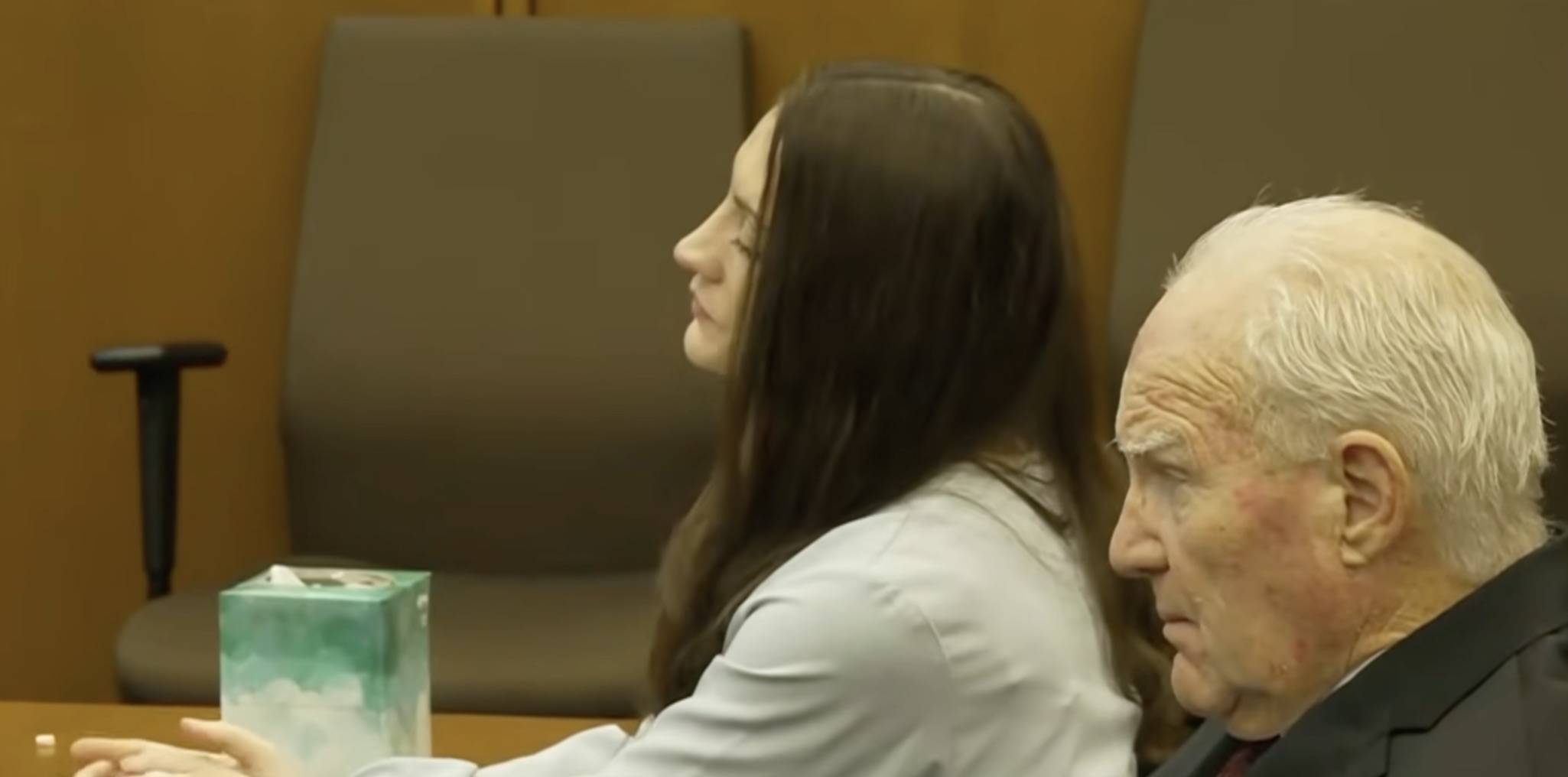
"This wasn't a woman suffering from a lack of care, a lack of resources. She had an abundance of help, an abundance of care."

After around three weeks of testimony, the jury in the Massachusetts trial of Lindsay Clancy has begun deliberating. Clancy has been charged with the strangulation deaths of her three young children, actions that she has admitted to. After several hours of deliberations through Thursday afternoon, the judge dismissed the jury for the day. Deliberations will resume on Friday morning.
Defense attorney Kevin Reddington said during closing arguments Thursday morning that Clancy’s three young children “are the victims of the horrible, horrific act that has been laid at your feet as yours to decide whether or not Lindsay is guilty.”
He accused the prosecution of “ripp[ing] the soul out of this girl,” saying that his client “did nothing wrong in her life.” He said that the case was built on “manipulation,” and that the prosecution had argued that Clancy had faked her suicide attempt.
He accused authorities of conducting a “lousy investigation,” noting evidence “that the police didn’t even see in their thorough investigation,” such as a bunch of empty prescription pill bottles. He noted a book that was taken into custody by authorities, titled “Good Moms Have Scary Thoughts.” He said, speaking from the perspective of the prosecution, “Put that in the guilty pile. We're going to put this in a plastic bag. We're going to show it to a jury so they know that this young lady had scary thoughts.”
Reddington emphasized the testimony of Dr. Phillip Resnick, saying, “He indicates clearly, in his opinion, that she was in a state of psychosis at the time of this death, times three.” He claimed that prosecution witnesses could not rebut Resnick’s testimony, citing the testimony of forensic psychologist Kirk Heilbrun, who said “it’s possible either way.” Reddington said, “That's not proof beyond a reasonable doubt.”
He spoke on the journals that Clancy kept leading up to the killings, which detailed the drugs she was prescribed and how she was feeling. He noted that she wrote about having “horrible thoughts” and “no motivation” just before she sought help at the Women and Infants Hospital, and that entries in January were "nothing other than little chicken scratches, because her mind was gone." He compared those journals to the fictional ones in Stephen King's The Shining to emphasize the unhinged nature of her writings.
He said that Clancy kept reaching out for help, “and she was not getting it.”
Prosecutor Jennifer Sprague began by saying, “There's no dispute that Lindsey Clancy was suffering from mental illness and that she tried to kill herself. There's no dispute about that.” She said, however, that that was not the issue at trial, but instead whether at the time she killed her kids, “she knew the difference between right and wrong, and whether she could conform her behavior to the requirements of the law.”
“This case is not about our mental health system or how it treats women or what's in the DSM-5 and what's not. That's a distraction to get you angry and passionate about an important issue, but an issue that's not on trial here.”
She said that Clancy “had more access to treatment and care and support than a lot of people do," citing health insurance that covered care, specialty treatment, and medications, she had support at home, an extended maternity leave, two kids that went to pre-school part time, support from family, as well as a nanny. “This wasn't a woman suffering from a lack of care, a lack of resources. She had an abundance of help, an abundance of care.”
“So why did she specifically do it? She was depressed. She was exhausted. She was done. She didn't want to try anymore. She felt damaged. But those kids, those kids were her protective factor. Those kids were keeping her from ending her misery, and so she had to remove the protective factor. I'm not saying she was happy about it. I'm saying that it was what she had to do to end her misery, but it was a choice.”
“She knew what she did was wrong. She could conform her behavior to the law, and chose not to. And she didn't expect to have any consequences because she expected to die with her children.”
She said the murders were premeditated, citing the order in which the children were killed, oldest to youngest, because the oldest “would have known this is bad, and they would have tried to intervene or run and hide, and she had a very limited time.”
Thursday’s hearing began with Superior Court Judge William Sullivan reading a portion of his instructions for the jury to abide by in their deliberations. He told the jury that both portions of his instructions “are to be taken and considered in while,” and that both portions of the instructions “are equally important.”
He said that for the jury to find Clancy guilty in the case, prosecutors must have proved “beyond a reasonable doubt that the defendant committed the crime with which she is charged, and also that the defendant is criminally responsible for her conduct.”
He explained that a person could be found not criminally liable “if she has a mental disease or defect, and as a result of that mental disease or defect, she lacks a substantial capacity either to appreciate the criminality or wrongfulness of her conduct, or to conform her conduct to the requirements of the law.” The phrase “mental disease or defect” is a legal term, he explained, and not a formal medical diagnosis.
He told the jury that the Commonwealth must prove “beyond a reasonable doubt” that Clancy “was not suffering from a mental disease or defect at the time of the killing,” and that she understood the severity of her actions at the time of the killings for prosecutors to have “satisfied its burden of proving that the defendant was criminally responsible.”
He said that if she is found not criminally responsible, authorities may petition for Clancy to be committed to a mental heath facility, adding that there is no limit to the number of renewed orders of commitment, and that Clancy could “remain committed for the duration of her life” if necessary. If she is ever found to no longer be mentally ill and dangerous, a hearing may be held regarding her release.
Moving to the specific charges against her, Sullivan said that Clancy has been charged with three counts of first-degree murder, one for each child. He told the jury that if they find her guilty of murder, they must determine the degree. He said that if the jury is unable to come to a unanimous decision on charges of first-degree murder, meaning she committed murder with deliberate premeditation and with “extreme atrocity or cruelty,” they must consider charges of second-degree murder. For second-degree murder, the jury must decide if Clancy killed her three kids, intended or cause them grievous bodily harm, or that she intended to do an act that a reasonable person would have known would create the strong likelihood of death.
Sullivan said the jury could also weigh the lesser charge of manslaughter, telling the jury, “ If you find that the Commonwealth has not proven the charges of first degree or second degree murder, you shall consider the lesser offense of manslaughter.” He explained that manslaughter “is an unlawful killing unintentionally caused by wanton or reckless conduct.”
He later stressed that the “presumption of innocence” means that the jury must find Clancy not guilty if the evidence has not proven beyond a reasonable doubt that she is guilty. He told the jury, “You are to be completely fair and impartial, and you are not to be swayed by prejudice, by personal likes or dislikes towards either side, or by any personal view you may have the nature of the claims or the defenses in the case.”
Powered by The Post Millennial CMS™ Comments
Join and support independent free thinkers!
We’re independent and can’t be cancelled. The establishment media is increasingly dedicated to divisive cancel culture, corporate wokeism, and political correctness, all while covering up corruption from the corridors of power. The need for fact-based journalism and thoughtful analysis has never been greater. When you support The Post Millennial, you support freedom of the press at a time when it's under direct attack. Join the ranks of independent, free thinkers by supporting us today for as little as $1.
Remind me next month
To find out what personal data we collect and how we use it, please visit our Privacy Policy






Comments