
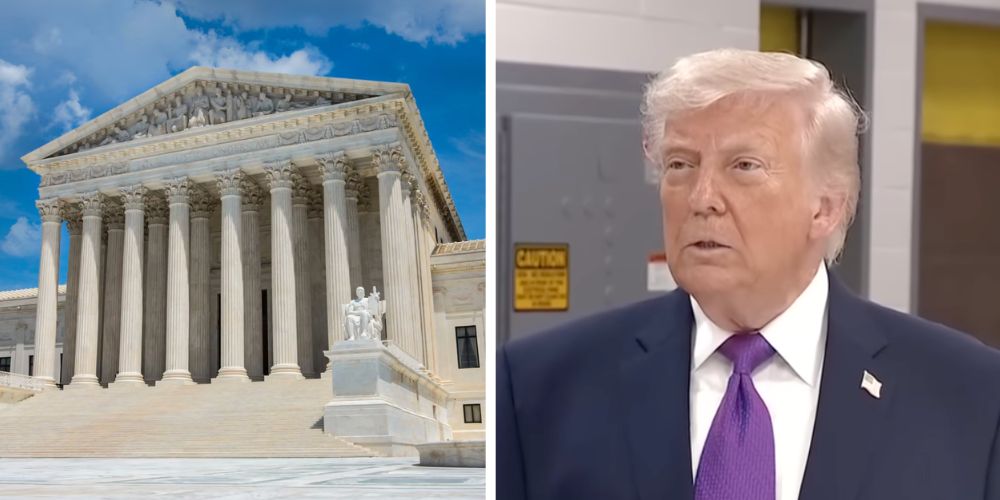
Justices Barrett, Sotomayor, Kagan, and Jackson joined Chief Justice Roberts in his opinion against Trump's EO.

The Supreme Court on Tuesday issued its ruling in what has been one of the most closely-watched cases before the Supreme Court this term, striking down Trump's executive order that ended birthright citizenship for children born to illegal immigrant parents on American soil.
The court ruled, "Children born in the United States to parents unlawfully or temporarily present are 'subject to the jurisdiction' of the United States and are citizens at birth under the Fourteenth Amendment’s Citizenship Clause." Justices Amy Coney Barrett, Sonia Sotomayor, Elena Kagan, and Ketanji Brown Jackson joined Chief Justice John Roberts in his opinion against Trump's EO.
"Citizenship, then and now, was the right to have rights— to freely participate in our political community. The Framers of the Fourteenth Amendment extended that promise to 'every free-born person in this land.’ We keep that promise today."
Roberts wrote that if Congress "intended to hinge citizenship on each individual’s domicile—a question that 'is sometimes a matter of great difficulty to decide,’ it is reasonable to expect there would have been at least some discussion of the topic. Yet the word “domicile” appears just twice in the discussion of the relevant provision of the Civil Rights Act. nd it appears in only one speech from the Citizenship Clause debates—as part of an explanation of why State citizenship is distinct from national citizenship under the Constitution."
"In any case, postenactment history cannot override the text. If Congress intended to limit American citizenship to the children of those domiciled in the United States, nothing in the succinct language of the Citizenship Clause conveyed that design. Words appearing frequently in the Executive Order—'mother,' 'father,' 'lawful,' 'temporary'— are absent from the Clause. For a simple reason: they did not matter."
On his first day back in office in 2025, President Trump issued an executive order to end birthright citizenship for children born to illegal immigrant parents, something even those few countries that have birthright citizenship do. The case made its way up to the Supreme Court, with arguments taking place on April 1.
US Solicitor General John Sauer argued for the Trump administration that the Citizenship Clause was adopted in the wake of the Civil War with the purpose of giving citizenship to newly freed slaves and their children, "whose allegiance to the United States had been established by generations of domicile here."
"It did not grant citizenship to the children of temporary visitors or illegal aliens who have no such allegiance. This conclusion reflects the original public meaning of the clause," Sauer added. A lucrative birth tourism business has sprung up where expctant mothers can come to the US, reside here until having her baby, and then take her newly minted US citizen back home.
Cecillia Wang, the ACLU National Legal Director, said that the rule that everyone born on American soil gets American citizenship was "enshrined in the 14th Amendment to put it out of the reach of any government official to destroy. When the government tried to strip Mr. Wong Kim Ark's citizenship on largely the same grounds they raised today, this court said no."
US v Wong Kim Ark was an 1897 case before the Supreme Court that upheld the 14th Amendment as it related to Wong Kim Ark, a man born in California to Chinese immigrant parents a few years after the 14th Amendment was ratified.
Trump had urged the Supreme Court to "do what’s right" and uphold his executive order, telling reporters in May that birthright citizenship "was not meant for Chinese billionaires who have their children become citizens of our country, … this was meant for the babies of slaves.
"This was signed during right after the Civil War. You look at the dates, the dates alone, immediately after. This was having to do with the babies of slaves, and people have used it—and if this is allowed to stand, it will be a disaster economically for our country, and you'll have 25 people of the people coming into our country coming in through birthright citizenship, and we won't have any control."
"This decision by the Supreme Court is a very big one. They'll probably rule against me because they seem to like doing that, you know. Frankly, I'm not happy with some of the decisions," he added.
Supreme Court strikes down Trump's EO banning birthright citizenship by The Post Millennial
Powered by The Post Millennial CMS™ Comments
Join and support independent free thinkers!
We’re independent and can’t be cancelled. The establishment media is increasingly dedicated to divisive cancel culture, corporate wokeism, and political correctness, all while covering up corruption from the corridors of power. The need for fact-based journalism and thoughtful analysis has never been greater. When you support The Post Millennial, you support freedom of the press at a time when it's under direct attack. Join the ranks of independent, free thinkers by supporting us today for as little as $1.
Remind me next month
To find out what personal data we collect and how we use it, please visit our Privacy Policy


Comments