
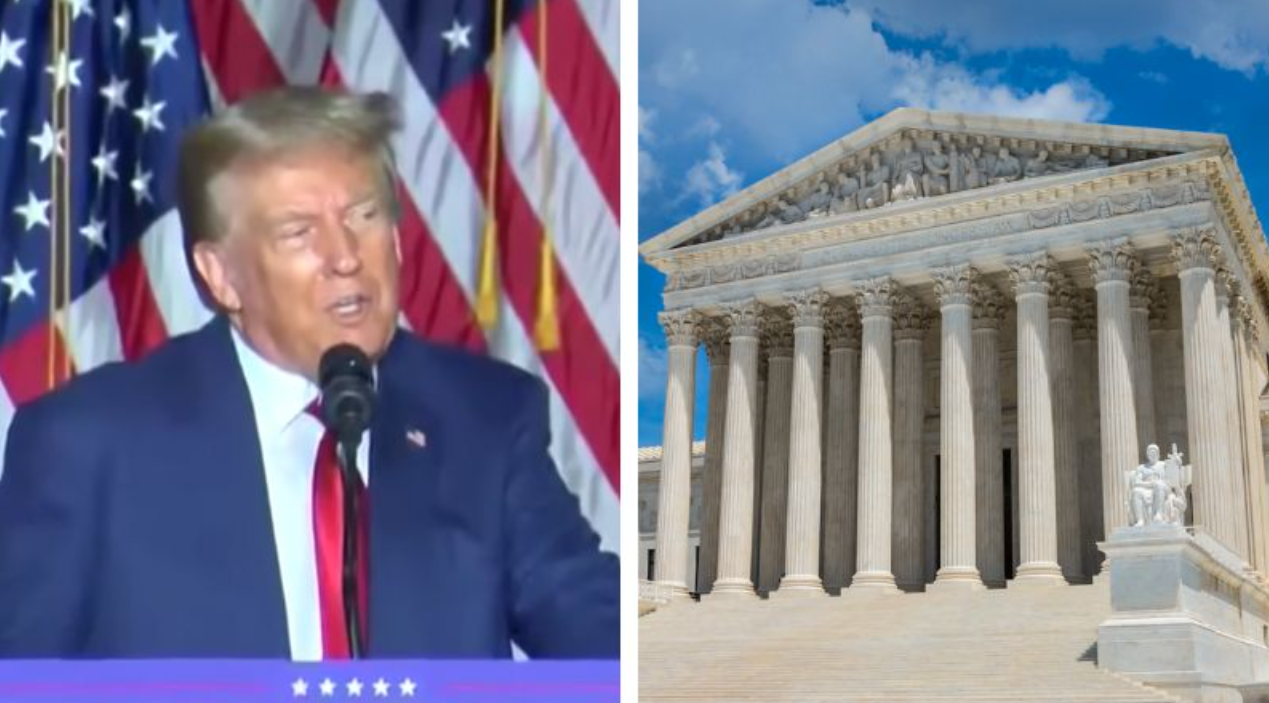
"You're using some pretty obscure sources to get to this concept," Justice Kagan told John Sauer.

The Supreme Court heard oral arguments on Wednesday in the case Trump v Barbara, which was brought forth regarding Trump’s day-one executive order ending birthright citizenship for the children of illegal immigrants and others who are not lawful permanent residents. During the arguments, the justices appeared skeptical of the Trump administration’s case.
In his opening arguments, US Solicitor General John Sauer said that the Citizenship Clause was adopted in the wake of the Civil War with the purpose of giving citizenship to newly freed slaves and their children, "whose allegiance to the United States had been established by generations of domicile here."
"It did not grant citizenship to the children of temporary visitors or illegal aliens who have no such allegiance. This conclusion reflects the original public meaning of the clause," Sauer added.
Sauer’s arguments centered around the term "not subject to any foreign power," which was used by Congress in the Civil Rights Act of 1866 and codified the Citizenship Clause of the 14th Amendment. Sauer argued that the Congress at the time had "rejected the British conception of allegiance. Senator Trumbull explained that subject to the jurisdiction thereof in the clause means not owing allegiance to anybody else. And in 1884, this court recognized that subject to the jurisdiction means owing direct and immediate allegiance."
"The clause thus does not extend citizenship to the children of temporary visa holders or illegal aliens. Unlike the newly freed slaves, those visitors lack direct and immediate allegiance to the United States," he said, adding that illegal immigrants lack the "legal capacity to establish domicile here."
"Unrestricted birthright citizenship contradicts the practice of the overwhelming majority of modern nations. It demeans the priceless and profound gift of American citizenship. It operates as a powerful pull factor for illegal immigration and rewards illegal aliens who not only violate the immigration laws, but also jump in front of those who follow the rules. It has spawned a sprawling industry of birth tourism as uncounted 1000s of foreigners from potentially hostile nations have flocked to give birth in the United States in recent decades, creating a whole generation of American citizens abroad with no meaningful ties to the United States."
Chief Justice John Roberts questioned the examples Sauer gives for those who should not be covered under the Citizenship Clause, saying, "you obviously put a lot of weight on 'subject to the jurisdiction thereof,' but the examples you give to support that strike me as very quirky. You know, children of ambassadors, children of enemies during a hostile invasion, children on warships. And then you expand it to the whole class of illegal aliens are here in the country. I'm not quite sure how you can get to that big group from such tiny and sort of idiosyncratic examples."
Sauer told the court to look back at the enactment of the Civil Rights Act of 1866, in which the phrase "subject to the jurisdiction thereof" was not used, but rather the phrase, "not subject to any foreign power."
Justice Samuel Alito questioned Sauer about the subject of general rules being enacted by lawmakers and being applied to future applications for concepts that were "basically unknown" at the time that a law, such as the 14th Amendment, was adopted. Alito said that illegal immigration was such an issue. "So how do we deal with that situation when we have a general rule?"
Sauer said that "illegal immigration did not exist then. Now, the problem of temporary visitors did exist." He noted the brief filed with the court in which the Trump administration said that commentators between 1881 and 1922 "are uniformly saying the children of temporary visitors are not included. Now, that logic we say it naturally extends … if you have someone who enters illegally, by the 1880s there are restrictions on immigration if you’ve entered illegally. It's kind of, you know, a well-established principle of law going back to the Code of Justinian, that says you're not allowed to be there, you cannot, you don't have the legal capacity to create domicile."
Justice Elena Kagan said that "most" of the Trump administration’s brief spoke not of illegal immigrants, but "people who are just temporarily in the country where there was quite clearly an experience of an understanding of that there were going to be temporary inhabitants. And your whole theory of the case is built on that group. You don't get to talking about undocumented persons until quite later, and at much lesser, you know, I think it's like 10 pages to three pages or something like that."
She later questioned where the principle "allegiance" comes from, saying that the Trump administration pointed to the Lincoln funeral speech as the "primary example of where this principle comes from." She said, "It's certainly not what we think of when we think of the word jurisdiction." Kagan said that the text of the clause "does not support you," and that Sauer was "looking for some more technical, esoteric meaning."
"And then the question comes, okay, if the text doesn't support you, if there's a real history of people using it that way. But as far as I can tell, you know, at the time of the 14th, you're, you're, you're using some pretty obscure sources to get to this concept," she said.
Cecillia Wang, the ACLU National Legal Director, said that the rule that everyone born on American soil gets American citizenship was "enshrined in the 14th Amendment to put it out of the reach of any government official to destroy. When the government tried to strip Mr. Wong Kim Ark's citizenship on largely the same grounds they raised today, this court said no." US v Wong Kim Ark was a 1897 case before the Supreme Court that upheld the 14th Amendment as it related to Wong Kim Ark, a man born in California to Chinese immigrant parents a few years after the 14th Amendment was ratified.
She claimed during her opening statement that thousands of "American babies will immediately lose their citizenship," and that "the citizenship of millions of Americans, past, present, and future, could be called into question" if Trump’s executive order is allowed to stand.
During questioning, Justice Alito posed the hypothetical of a child born to a foreign national in the US from a country that requires military service. "A boy is born here to an Iranian father who has entered the country illegally. That boy is automatically an Iranian national at birth, and he has a duty to provide military service to the Iranian government. Is he not subject to any foreign power?" He noted that this case was true for other countries as well.
Wang said that this was not the case within the meaning of the 1866 act. "What the framers meant by the phrase not subject to any foreign power, was referring to the ambassador exception. If it meant what the government contends, basically not subject of any foreign power, that another country considers you a Jus sanguinis citizen, then lawful permanent residents, all foreign nationals, would be excluded." Jus sanguinis citizenship is acquired through the parents and what country they are a citizen of, rather than the country of birth.
While questioning Wang, Justice Ketanji Brown Jackson used the example of a US citizen visiting Japan and stealing a wallet for the idea of local allegiance vs permanent allegiance. "You obviously have permanent allegiance based on being born in whatever country you're from. That's what everybody recognizes. But you also have local allegiance when you are on the soil of this other, other sovereign."
"And I was thinking, you know, I’m, I, US citizen, am visiting Japan. And what it means is that, you know, if I steal someone's wallet in Japan, the Japanese authorities can arrest me and prosecute me. It's allegiance meaning can they control as a matter of law. I can also rely on them if my wallet is stolen to you know, under Japanese law, go and prosecute the person who has stolen it. So there's this relationship based on even though I'm a temporary traveler, I'm just on vacation in Japan, I'm still locally, owing allegiance."
Powered by The Post Millennial CMS™ Comments
Join and support independent free thinkers!
We’re independent and can’t be cancelled. The establishment media is increasingly dedicated to divisive cancel culture, corporate wokeism, and political correctness, all while covering up corruption from the corridors of power. The need for fact-based journalism and thoughtful analysis has never been greater. When you support The Post Millennial, you support freedom of the press at a time when it's under direct attack. Join the ranks of independent, free thinkers by supporting us today for as little as $1.
Remind me next month
To find out what personal data we collect and how we use it, please visit our Privacy Policy

Comments