
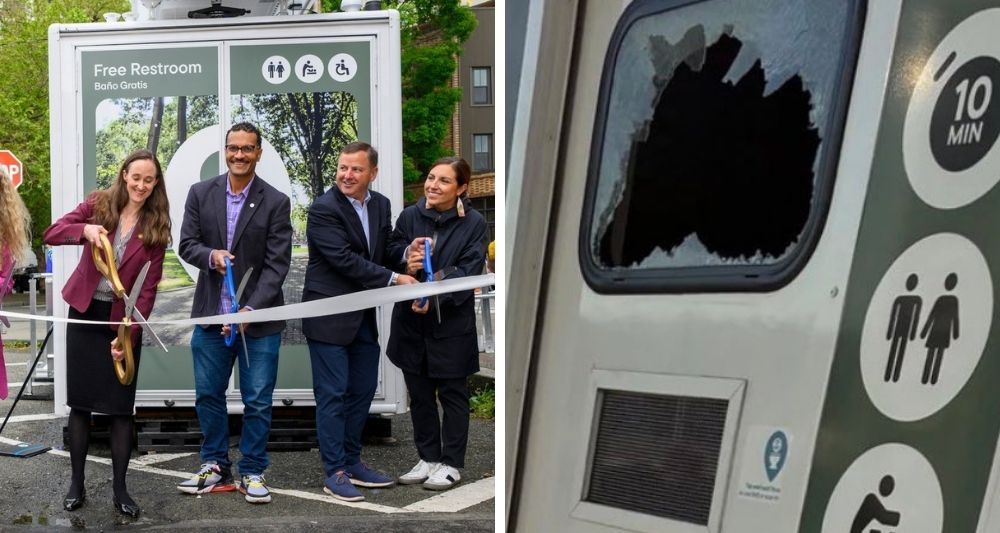
The incident comes less than a month after city officials celebrated the launch of the restrooms as part of Seattle’s preparations for the 2026 FIFA World Cup and broader efforts to revitalize downtown.

The incident comes less than a month after city officials celebrated the launch of the Throne Labs restrooms as part of Seattle’s preparations for the 2026 FIFA World Cup and broader efforts to revitalize downtown. The city is spending approximately $465,000 on the one-year pilot program.
Photos of the damaged restroom circulated on social media after being shared by Seattle Submissions. The Seattle Department of Transportation (SDOT) told local media that the damage was repaired in less than a day by Throne Labs, the company operating the facilities.
The vandalism is likely to raise questions about whether Seattle’s latest public restroom experiment will fare better than a similar effort nearly two decades ago. In the mid-2000s, Seattle spent millions on automated public toilets equipped with self-cleaning systems and multilingual instructions. The futuristic bathrooms quickly became targets for vandalism and were plagued by reports of criminal activity and drug use. The city ultimately abandoned the program and sold the units on eBay for a fraction of their original cost.
City officials have argued that the new generation of public restrooms is different. The solar-powered units operate without permanent plumbing hookups and can be unlocked through a smartphone app, QR code, or text message. Sensors monitor water and waste levels, while users can report maintenance issues directly to operators. The bathrooms also feature touchless fixtures, baby-changing stations, accessibility accommodations, and a 10-minute usage limit.
When announcing the pilot in May, Socialist Seattle Mayor Katie Wilson described the project as a response to one of the city's most basic infrastructure needs. “Today is a first step to delivering on Seattle’s number 1 and number 2 priority: creating clean, accessible, and safe public bathrooms,” Wilson said. “This is a simple solution to address one of our most basic human needs, and a step towards creating a more livable and welcoming city for everyone.”
SDOT has emphasized that the program is intended as a one-year trial and will be evaluated based on technology performance, cleanliness, maintenance needs, and public feedback. The city has suggested additional units could be deployed elsewhere if the pilot proves successful.
Powered by The Post Millennial CMS™ Comments
Join and support independent free thinkers!
We’re independent and can’t be cancelled. The establishment media is increasingly dedicated to divisive cancel culture, corporate wokeism, and political correctness, all while covering up corruption from the corridors of power. The need for fact-based journalism and thoughtful analysis has never been greater. When you support The Post Millennial, you support freedom of the press at a time when it's under direct attack. Join the ranks of independent, free thinkers by supporting us today for as little as $1.
Remind me next month
To find out what personal data we collect and how we use it, please visit our Privacy Policy






Comments