
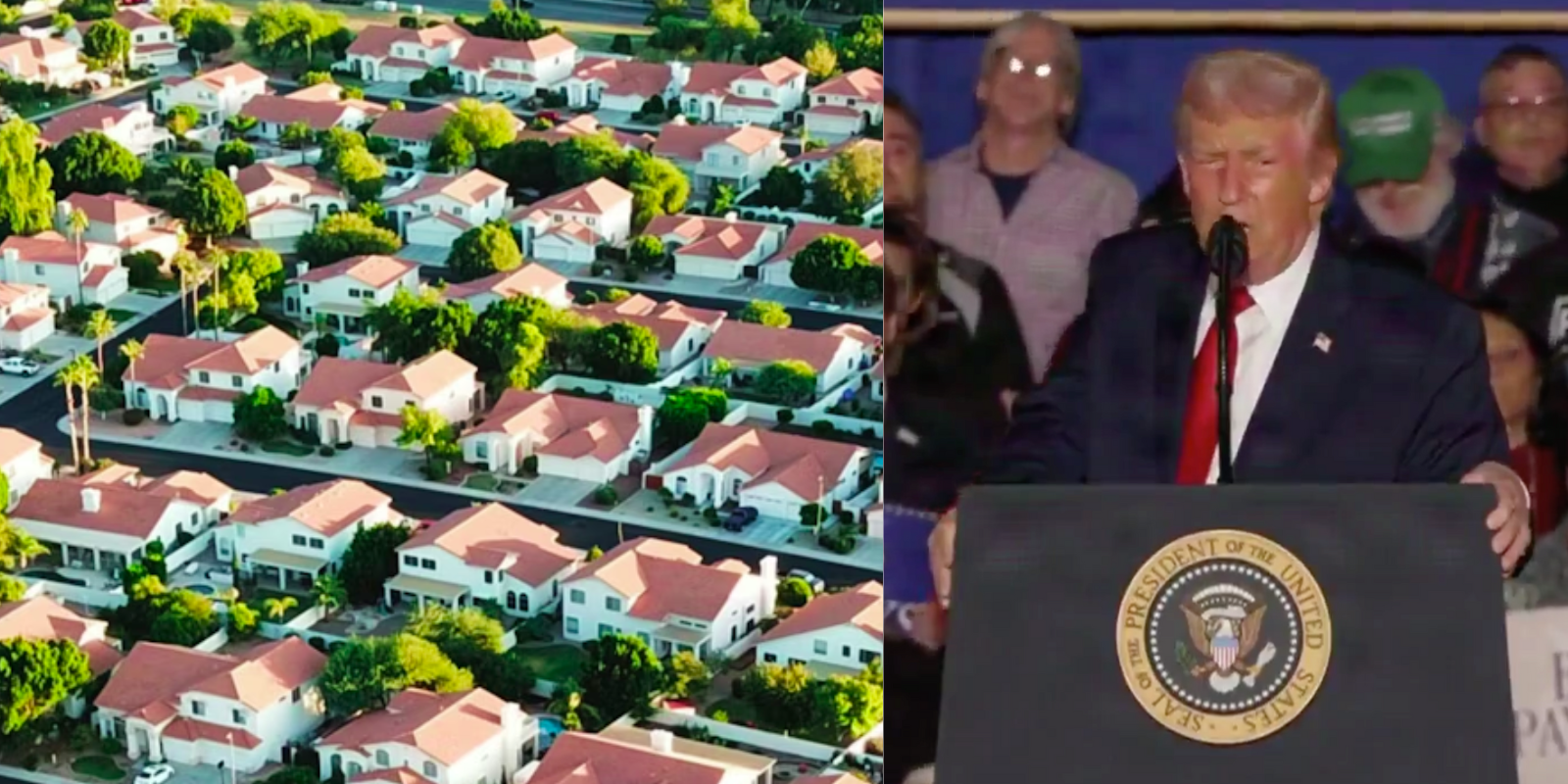
Trump said that he would discuss the announcement further at his speech in Davos, Switzerland, in two weeks.

In a post shared Tuesday afternoon, Trump said buying and owning a home was long considered “the pinnacle of the American Dream,” but claimed that record-high inflation under the Biden administration and congressional Democrats has made that goal increasingly unattainable, particularly for younger Americans.
“For a very long time, buying and owning a home was considered the pinnacle of the American Dream,” Trump wrote. “But now, because of the Record High Inflation caused by Joe Biden and the Democrats in Congress, that American Dream is increasingly out of reach for far too many people.”
Trump said he would move to prohibit large institutional investors from buying more single-family homes and urged Congress to codify the policy into law.
“People live in homes, not corporations,” he wrote. Trump also noted that he would discuss the announcement at his speech in Davos, Switzerland, in two weeks.
Large institutional investors now control a meaningful share of America’s single-family housing stock, a trend that has accelerated over the past decade.
Research compiled from Zillow, Redfin, CoreLogic, and the American Enterprise Institute shows that institutional investors own roughly 3–4 percent of all US single-family homes, translating to more than 500,000 houses nationwide. While that may appear modest at the national level, the concentration is far higher in certain metro areas, particularly in fast-growing Sun Belt cities such as Atlanta, Phoenix, Tampa, and Charlotte.
Investor activity surged following the 2008 financial crisis and spiked again during the pandemic-era housing boom. According to Federal Housing Finance Agency and Redfin data, investors accounted for 25–30 percent of home purchases in some markets during peak periods in 2021 and 2022. A significant portion of those purchases came from large corporate buyers, including private equity firms and real estate investment trusts, many of which targeted lower-priced and entry-level homes suitable for conversion into single-family rentals.
Housing analysts note that institutional ownership is disproportionately focused on the rental market, where growth has been strongest. CoreLogic estimates that the institutional single-family rental sector nearly tripled in size between 2012 and 2024. Studies from the Urban Institute and AEI have linked heavy investor activity to reduced housing supply for first-time buyers, faster price appreciation, and rising rents in markets with high corporate concentration.
This is a breaking news article. Refresh for updates.
Powered by The Post Millennial CMS™ Comments
Join and support independent free thinkers!
We’re independent and can’t be cancelled. The establishment media is increasingly dedicated to divisive cancel culture, corporate wokeism, and political correctness, all while covering up corruption from the corridors of power. The need for fact-based journalism and thoughtful analysis has never been greater. When you support The Post Millennial, you support freedom of the press at a time when it's under direct attack. Join the ranks of independent, free thinkers by supporting us today for as little as $1.
Remind me next month
To find out what personal data we collect and how we use it, please visit our Privacy Policy







Comments