
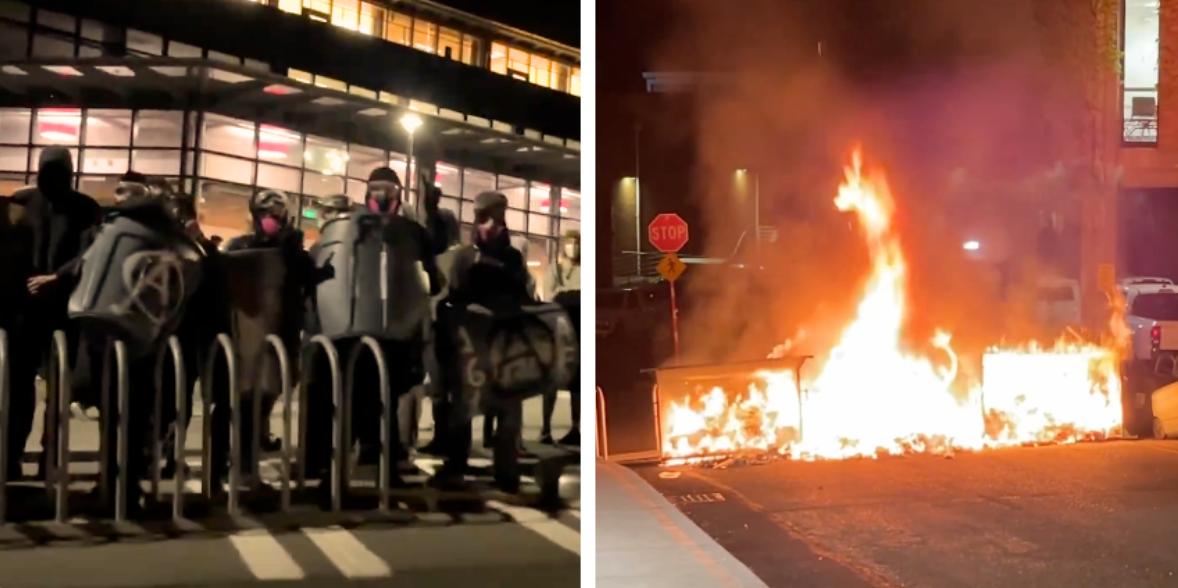
The 33 defendants can have their misdemeanor charges dismissed if they comply with stipulated orders of continuance reached with King County prosecutors.

The defendants were charged in March with first-degree criminal trespass, a gross misdemeanor, nearly 10 months after the May 2025 occupation of UW’s newly opened Interdisciplinary Engineering Building. None were charged with felonies over the more than $1 million in damage after a months-long police investigation was unable to establish which activists were responsible for the destruction.
The 33 defendants charged with first-degree criminal trespass are Tayler Hart, Max Rulff, Zachary Wallaced-Wells, Jade Wu, Jessica Schutz, Luisa Ortega Subdiaz, Ginger Newberry, Kimaya Mahajan, Gina Liu, Lea Keating, Akira Junyaprusert, Anna Hattle, Julia Fraczek, Cade Jackson, Jonas Piper, Ty Park, Lucy Zern, Tasbeet Iman, Ricardo Colon-Galvez, Roberta Collison, Ella Tunduwani, Zainab Chattha, Riley Centerwall, Catherine Brown, Brett Anton, Claire Berger, Yasmin Ahmed, Yafate Yared, Geneveve Konijisky, Finn Brown, Bailey Keen, Lucas Nichols-Mcauslan, and Sam Sueoka.
The misdemeanor cases are now being resolved through stipulated orders of continuance, or SOCs, an alternative resolution that allows defendants to avoid convictions and ultimately have their charges dismissed if they satisfy the requirements of their agreements. According to the King County Prosecuting Attorney’s Office, there is no guilty plea under an SOC. However, each defendant must stipulate to the accuracy of the police reports as part of the agreement with prosecutors.
If a defendant fulfills the requirements and the SOC is not revoked, the charge is dismissed at the end of the agreement. If the terms are violated, prosecutors said the court can revoke the SOC following a hearing and proceed to a stipulated bench trial, where a judge would review the police reports submitted by prosecutors and determine whether the defendant is guilty.
Prosecutors said that even if the cases were to proceed to trial, it is highly unlikely that the Court would sentence a defendant to the maximum of 364 days in custody for a gross misdemeanor - even if prosecutors made that recommendation to the Court.
The cases stem from the May 5, 2025 takeover of UW’s newly opened Interdisciplinary Engineering Building by dozens of masked agitators dressed in black. The occupation targeted the university’s relationship with Boeing, which contributed $10 million toward construction of the approximately $100 million facility.
Police records previously obtained by The Ari Hoffman Show on Talk Radio 570 KVI detailed a coordinated operation in which activists entered the building shortly after it closed, barricaded entrances and exits with furniture, and sealed at least one door shut. A university employee was temporarily trapped inside. Outside the building, activists set dumpsters on fire as police prepared to clear the facility.
The occupation was connected to Students United for Palestinian Equality and Return (SUPER UW), a student organization that had already been suspended by the university following a previous occupation of the Husky Union Building that caused more than $50,000 in damage. The activists targeted the engineering building over UW’s relationship with Boeing and the aerospace company’s business with Israel.
Police arrested dozens of people while clearing the building. UW subsequently suspended 21 students arrested during the occupation and banned them from campus. Those disciplinary suspensions were later lifted after completion of the university’s student conduct process.
UW Police initially referred 33 suspects to prosecutors for potential felony burglary and malicious mischief charges. But despite more than $1 million in damage, investigators were unable to determine which individual defendants were responsible for the destruction.
According to records, investigators found no eyewitnesses or surveillance footage showing specific suspects committing the vandalism. Search warrants and forensic examinations of seized electronic devices also failed to produce sufficient evidence tying individual defendants to felony-level property damage. The cases were ultimately resubmitted for misdemeanor prosecution.
“This is the reality prosecutors face with the insufficient evidence to prove felony cases after the lengthy police investigation (including search warrants),” the prosecutor’s office told The Ari Hoffman Show. “Prosecutors want to be able to show the Court who caused the million dollars in damage. No one who loves the University of Washington thinks it’s acceptable for people to get away with damaging a building like that, and students should feel safe when they’re on campus.”
Prosecutors said Washington’s accomplice-liability requirements also prevented them from attributing the destruction collectively to those arrested inside the building.
“We agree that people should be accountable for causing $1 million in damages, but those were not the cases sent to prosecutors,” the office said. “There was never a case that showed a specific person who caused felony-level damage, or even accomplice liability under the requirements of state law.”
The office said the misdemeanor resolutions reflect the evidence produced by the investigation rather than a determination that the destruction itself was insignificant. “These misdemeanor cases and the resolutions – and knowing that a judge in a misdemeanor case is highly unlikely to impose a more significant sentence even if prosecutors were successful at trial – is the reality we face with the information that the months-long police investigation uncovered,” prosecutors said.
The possibility of felony prosecution has not completely disappeared. Prosecutors said that if police uncover additional evidence within the statute of limitations identifying who caused the damage, the office would review it.
Powered by The Post Millennial CMS™ Comments
Join and support independent free thinkers!
We’re independent and can’t be cancelled. The establishment media is increasingly dedicated to divisive cancel culture, corporate wokeism, and political correctness, all while covering up corruption from the corridors of power. The need for fact-based journalism and thoughtful analysis has never been greater. When you support The Post Millennial, you support freedom of the press at a time when it's under direct attack. Join the ranks of independent, free thinkers by supporting us today for as little as $1.
Remind me next month
To find out what personal data we collect and how we use it, please visit our Privacy Policy


Comments
2026-09-16T16:39-0400 | Comment by: Jeffrey
It's entirely inappropriate for the UW to have any relationship with the war industry. Students are correct to protest the involvement of their university with the war industry that profits off the massacre of Palestinians. Go conduct a poll at UW & you will find most students oppose Israeli war crimes & genocide, & support Palestinian resistance. Bravo to the students for having the courage to take the moral stand.