
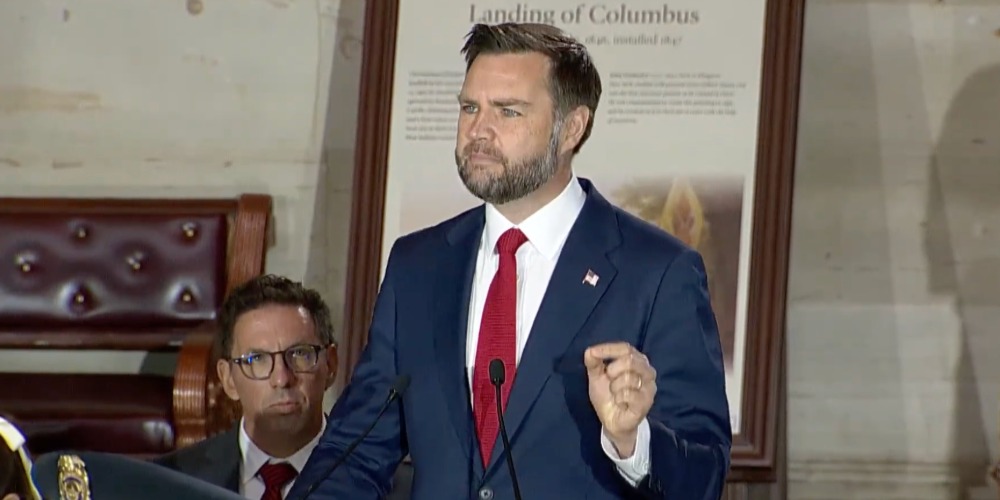
"The root of anti-semitism, the core of antisemitism to me, is the idea of blood libel. The idea that because of your genetics, because of your blood, because of your ancestry, you are guilty of a crime that you never committed."

Vice President JD Vance's highly anticipated appearance at the Republican Jewish Coalition's annual leadership summit at the Venetian Resort was closed to reporters, with RJC CEO Matt Brooks telling the Associated Press beforehand that the arrangement was intended to allow for a candid discussion. “We want to be able to have an opportunity to have a conversation that’s open and honest,” Brooks told the AP ahead of the Monday night appearance.
Vance argued there is “a very deep connection” between antisemitism and left-wing identity politics. “The root of anti-semitism, the core of antisemitism to me, is the idea of blood libel,” Vance said. “The idea that because of your genetics, because of your blood, because of your ancestry, you are guilty of a crime that you never committed.”
The vice president also argued that immigration must be part of the discussion about rising antisemitism. “Some of the antisemitism that we see rising in the United States of America is actually coming from people who are bringing ancient ethnic hatreds into the United States,” Vance said. “If you want to bring your ethnic hatreds anywhere, don’t come to the United States of America; you’re not welcome.”
During that closed-door conversation, Vance was directly confronted about his relationship with controversial commentator Tucker Carlson and refused to break ties with him. Vance also strongly defended the US-Israel alliance and told Jewish Republicans that Israel remains America's most important regional ally.
The Daily Wire later obtained a full recording of the conversation between Vance and RJC National Chairman Norm Coleman and published a transcript. The outlet reported that the event had been held off the record and closed to the press.
The closed-door format drew additional attention because Vance arrived at the summit facing questions from some Jewish Republicans about his views on Israel and his continued relationship with Carlson, especially given that the vice president is widely considered a potential frontrunner to succeed Trump in 2028.
“You mentioned Fuentes, podcasters. A few names: Tucker Carlson, Megyn Kelly, Joe Rogan, Nick Fuentes. They have platformed anti-semites,” Coleman told Vance before asking how he determines which influential personalities and platforms he will engage with.
"Yeah. I mean, look, and I recognize that not everyone in this room is going to agree with me on this, but I I take two basic approaches to it," Vance said. "One area where I really do draw the line is on people who engage in what I call this blood libel attitude. And like I recognize a lot of people in this room might disagree with things that Tucker Carlson or Megyn Kelly or Joe Rogan has said, but I I think just to hone in on Fuentes and Rogan, I think these are two very, very different categories of people, both with their within their reach, but also within the ideas that are in their in their actual head."
Vance acknowledged that members of the audience may disagree with statements Carlson, Kelly, or Rogan have made and said he draws a line at people who embrace what he called a “blood libel attitude.”
“I’m biased, I like Joe Rogan, and and but I think it’s a mistake to sort of say we’re going to write Joe Rogan off because he said something that we don’t like. I think the best approach is to actually go in there, and talk to him, and make the arguments as best as you can,” Vance said, arguing that Republicans make a mistake when they write off influential personalities because of something they have said.
“Talk to as many people as possible,” Vance said, while explaining there are limits. “Obviously I’m not going to go talk to a guy who’s attacked my wife or who’s said that Hitler was a good guy,” Vance said. “But outside of some pretty bright lines, I try to talk to as many people as I can.”
Carlson's relationship with Vance has become a significant issue among Jewish and pro-Israel Republicans in part because Carlson interviewed Fuentes, but also amid a broader pattern of increasingly hostile rhetoric toward Israel and his decision to give massive platforms to people accused of antisemitism and Holocaust revisionism.
The issue was addressed from the RJC stage even before Vance's appearance. “We have taken Tucker Carlson on by name,” Coleman told attendees. “Because platforming Holocaust deniers, smearing Jews who stand with Israel and dressing up old hatred as ‘just asking questions’ is not MAGA, and it’s not conservatism,” Coleman said. “And we have said so, and we will keep saying so.”
“This is what a serious organization does. We do not demand purity from the other side, the other party, and then excuse our own.”
Carlson hosted Fuentes for a friendly conversation in which the Fuentes, accused of being a white nationalist by the Anti-Defamation League, attacked “organized Jewry in America” and targeted “these Zionist Jews” inside the conservative movement.
The Fuentes interview followed Carlson's controversial 2024 interview with Darryl Cooper, whom Carlson introduced as “the most important popular historian working in the United States today.” Cooper argued that Winston Churchill, rather than Adolf Hitler, was the “chief villain” of World War II and offered an account of deaths in Nazi camps that critics said minimized the deliberate nature of the Holocaust. Jewish members of Congress subsequently denounced Cooper as a “Holocaust denier” and “Nazi apologist.”
Carlson has also increasingly challenged the longstanding conservative consensus on Israel and the US-Israel alliance, becoming one of the most prominent voices attempting to move the America First movement away from traditional Republican support for the Jewish state.
The Washington Post previously described Carlson as at odds with supporters of the US-Israel relationship and noted that prominent Republicans, including Sen. Ted Cruz, have accused him of antisemitism. President Donald Trump has distanced himself from Carlson.
Fleischer told the Washington Post that Carlson had become a defining test for Vance. “Tucker has earned his place in a unique spot of ‘Do you stand with him or against him?’” Fleischer said. “And I think that’s going to be a delicate matter for JD.”
Coleman also challenged Vance about his sometimes critical posture toward Israel and asked whether the US-Israel relationship was important to American national security.
“Certainly it’s extremely important to America’s national security,” Vance said. “I would say one of our most important alliances in the world and certainly our most important regional alliance.”
Vance described himself as a foreign policy realist and maintained that allies do not always have identical interests, but said the relationship with Israel goes deeper than a purely transactional alliance.
He compared America's relationship with Israel to its relationship with the United Kingdom, saying there is “a much deeper cultural symbiosis and harmony” with the two countries than with most other American allies.
Vance also directly confronted growing skepticism toward Israel among younger Americans on the right.
“There is a growing suspicion among, I would call it under-40s, of the US-Israel relationship,” Vance said.
Vance said Republicans need to demonstrate why the alliance with Israel benefits the United States. As one example, the vice president revealed that the US and Israel are cooperating on what he described as “extremely top-secret technology” connected to the North American Missile Defense Shield.
“It doesn’t make sense to shoot a $5 million missile interceptor at a $10,000 rocket,” Vance said. “We are working in an incredibly productive way with the Israelis to try to find the kinds of missile defense technology that can change both the economics and also the industrial side of that,” he added.
Immediately before Vance spoke, Israel’s Ambassador to the United States Yechiel Leiter said that the RJC Leadership Summit "is blessed with the participation of the Vice President of the United States, JD Vance."
Vance also delivered a direct message to Jewish Americans worried about rising antisemitism. Coleman described young Jews afraid to wear a Star of David or kippah on college campuses and asked Vance what could be done. Vance recalled meeting an attendee whose family feared publicly displaying their Jewish identity and who told him that although they loved America, sometimes “it don’t always feel like the country loves us back.”
“Of course America loves our Jewish citizens and respects the contributions of our Jewish citizens,” Vance responded. “We love you guys, we appreciate you guys, and you will very much always be on the team so long as I have any say in it.”
Vance also tore into Michigan Democratic Senate nominee Abdul El-Sayed, calling him “one of the worst disgraces running in the history of the American political process” over his reaction to the attempted antisemitic terrorist attack on a Michigan synagogue. Vance said El-Sayed had empathized with the would-be attacker rather than the Jewish children he allegedly intended to murder, arguing, “You don’t see a bunch of innocent Jewish kids who almost lose their lives and empathize with the killer unless you see those people as less than human.”
Vance called that worldview “a very, very ugly and nasty thing,” also blasting El-Sayed for campaigning with Hasan Piker, who previously said America “deserved 9/11.” Vance urged RJC attendees to back Republican Mike Rogers, saying his victory would send Democrats a message to “stop sending crazy people to the ballot box,” before adding of El-Sayed, “Thank God we have a guy who’s going to send him packing.”
Vance acknowledged antisemitism among some voices on the political right, but argued that controversial podcasters should not automatically be placed in the same category as white supremacists and said engagement with their large audiences was more effective than isolation.
“You got to meet people where they are and make the arguments as best as you can,” Vance said. “It’s not by shunning people, and that’s the approach that I try to take.”
Powered by The Post Millennial CMS™ Comments
Join and support independent free thinkers!
We’re independent and can’t be cancelled. The establishment media is increasingly dedicated to divisive cancel culture, corporate wokeism, and political correctness, all while covering up corruption from the corridors of power. The need for fact-based journalism and thoughtful analysis has never been greater. When you support The Post Millennial, you support freedom of the press at a time when it's under direct attack. Join the ranks of independent, free thinkers by supporting us today for as little as $1.
Remind me next month
To find out what personal data we collect and how we use it, please visit our Privacy Policy



Comments