
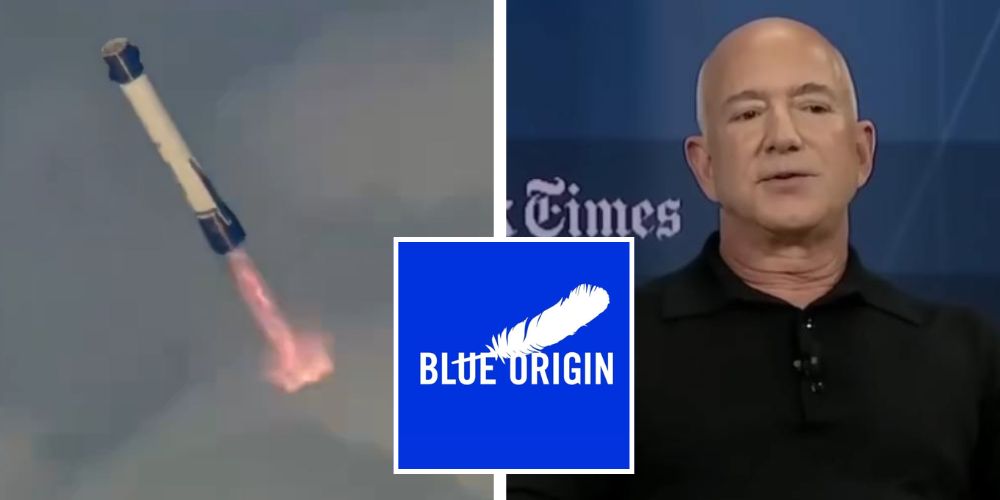
“Congratulations to Blue Origin, Rocket Lab, UC Berkeley, and all our partners on the successful launch of ESCAPADE."

Additionally, the company was able to land the rocket booster back on the launch pad, making an effort to match Elon Musk's SpaceX, which would make the booster cheaper, as it would be reusable. The mission, in coordination with NASA with the nickname ESCAPADE (Escape and Plasma Acceleration and Dynamics Explorers), may prepare for future human exploration of Mars as the satellites study the weather conditions of the planet.
Bezos shared a video on X of the booster landing back on the ground after the rocket launch, showing how the massive booster was able to decelerate back to the Earth's surface. Musk congratulated Bezos on the accomplishment.
“Congratulations to Blue Origin, Rocket Lab, UC Berkeley, and all our partners on the successful launch of ESCAPADE. This heliophysics mission will help reveal how Mars became a desert planet, and how solar eruptions affect the Martian surface,” said acting NASA Administrator Sean Duffy.
“Every launch of New Glenn provides data that will be essential when we launch MK-1 through Artemis. All this information will be critical to protect future NASA explorers and invaluable as we evaluate how to deliver on President Trump’s vision of planting the Stars and Stripes on Mars," he added.
The spacecraft will explore how solar winds have gradually been able to strip away Mars' atmosphere, which has caused the surface of the planet to cool as well as evaporate water on its surface. The mission is being led by the University of California at Berkeley.
“The ESCAPADE mission is part of our strategy to understand Mars’ past and present so we can send the first astronauts there safely,” said Nicky Fox, the associate administrator, Science Mission Directorate at NASA's DC headquarters. “Understanding Martian space weather is a top priority for future missions because it helps us protect systems, robots, and most importantly, humans, in extreme environments.”
Powered by The Post Millennial CMS™ Comments
Join and support independent free thinkers!
We’re independent and can’t be cancelled. The establishment media is increasingly dedicated to divisive cancel culture, corporate wokeism, and political correctness, all while covering up corruption from the corridors of power. The need for fact-based journalism and thoughtful analysis has never been greater. When you support The Post Millennial, you support freedom of the press at a time when it's under direct attack. Join the ranks of independent, free thinkers by supporting us today for as little as $1.
Remind me next month
To find out what personal data we collect and how we use it, please visit our Privacy Policy






Comments