45% of Americans believe bullied kids grow up to seek revenge as adults ‘by bossing other people around’: poll
59 percent said that “getting bullied in school is a traumatic experience for children.”
59 percent said that “getting bullied in school is a traumatic experience for children.”

A new poll out from Rasmussen asks Americans what they really think of those who were bullied as kids now that they're all grown up. The answer was surprising, with 45 percent of Americans believing that once they became adults, those once-bullied children "spend the rest of their lives trying to get revenge by bossing other people around." College-educated adults are less likely to agree with that statement, Rasmussen reports.
They also said, at 59 percent, that "getting bullied in school is a traumatic experience for children, compared to only 31% who think getting bullied in school is just a normal part of growing up." Ten percent of those surveyed are "not sure."
This comes as the efforts to create "anti-bullying" campaigns in school have been going on for decades, leading to situations where what is likely normal, kid behavior, has been villainized. The "tolerance" movement, where every whim under the sun is held up and glorified, has also been part of the anti-bullying craze.
The Biden administration has recently put even more cash behind anti-bullying initiatives, saying that by funding the STOP School Violence Program, they will "promote a positive and healthy school climate including, anti-bullying training, enhancing access to school-based behavioral health services, implementing appropriate social and emotional learning programs, and hiring personnel to help create a welcoming school climate, all of which have been proven to increase student attendance and engagement."
The national survey, conducted from June 10-12 by Rasmussen, asked if respondents agree with the statement "Some people who got bullied in school spend the rest of their lives trying to get revenge by bossing other people around." Of those 1,232 Americans surveyed (+/- 3 percent sampling error), 45 percent said they agree, including 15 percent who said that they strongly agree. While 39 percent said they disagree, with 12 percent who strongly disagree, 15 percent said they are not sure.
When disgruntled Harvard donor Bill Ackman posted about his concern that "higher education is failing us," Rasmussen touted their poll, saying "Wait till you see our new Ivy League results later this week. They’ve sunk themselves in American public opinion." America's top tier schools have for sure lost much of their trust as they are the site of frequent, violent protests, and have been turning American kids into far-left activists—by design.
Loading this lets X set cookies and collect data.
View on XThe survey asked about Americans' perceptions of those who attend Ivy League schools. "Generally speaking," the question asked, "are people who go to Ivy League schools like Harvard and Yale better workers than people who went to other colleges?" The answer, across sex, age and race demographics, was a resounding "No." When asked if the value of an Ivy league degree has increased or decreased in recent years, an astounding number said that it has decreased.
Loading this lets X set cookies and collect data.
View on X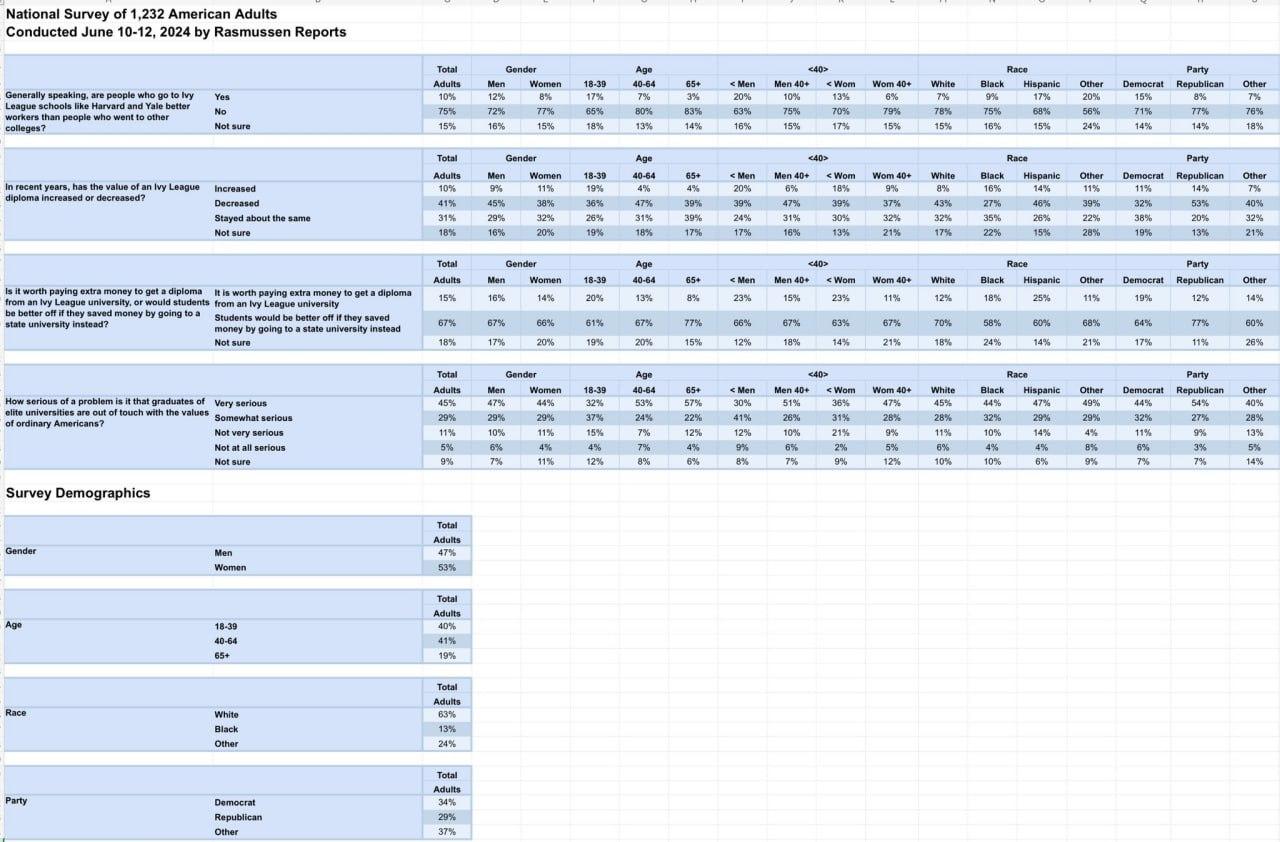
Americans surveyed also say that it's not "worth paying extra money to get a diploma from an Ivy League university," and that "students would be better off if they saved money by going to a state university instead." Most said that they'd stick with state schools if they wanted the most bang for their buck. When asked "How serious of a problem is it that graduates of elite universties are out of touch with the values of ordinary Americans," a majority said it was a "very serious" problem.
Libby’s Desk
Commentary and must-reads from Libby’s desk, straight to your inbox.
TPM Newsletter
The Post Millennial’s top stories, delivered to your inbox.


