BREAKING: SCOTUS strikes down Trump’s tariffs
“IEEPA does not authorize the President to impose tariffs.”
“IEEPA does not authorize the President to impose tariffs.”
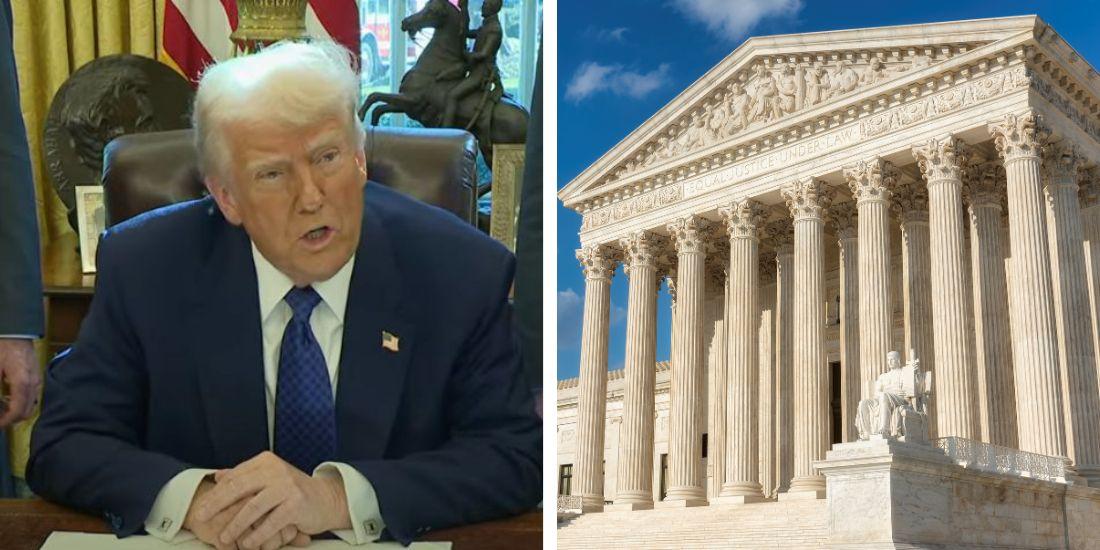
The Supreme Court ruled on Friday that the International Emergency Economic Powers Act (IEEPA) does not authorize President Donald Trump to impose tariffs. The court ruled 6-3 on the matter.
"IEEPA does not authorize the President to impose tariffs," the ruling stated. "The judgment in No. 24-1287 is vacated, and the case is remanded with instructions to dismiss for lack of jurisdiction; the judgment in No. 25-250 is affirmed."
Chief Justice John Roberts wrote for the court, "the Government reads IEEPA to give the President power to unilaterally impose unbounded tariffs and change them at will. That view would represent a transformative expansion of the President’s authority over tariff policy. It is also telling that in IEEPA’s half century of existence, no President has invoked the statute to impose any tariffs, let alone tariffs of this magnitude and scope."
"That '"lack of historical precedent," coupled with the breadth of authority' that the President now claims, suggests that the tariffs extend beyond the President’s 'legitimate reach.'" He wrote that Trump relied on the words "regulate" and "importation" to assert that he has "the independent power to impose tariffs on imports from any country, of any product, at any rate, for any amount of time. Those words cannot bear such weight."
Roberts wrote that "the Framers gave" the power to issue tariffs during peacetime "to ‘Congress alone’ — notwithstanding the obvious foreign affairs implications of tariffs," Roberts wrote. "And whatever may be said of other powers that implicate foreign affairs, we would not expect Congress to relinquish its tariff power through vague language, or without careful limits."
Roberts later added, "IEEPA contains no reference to tariffs or duties. The Government points to no statute in which Congress used the word 'regulate' to authorize taxation. And until now no President has read IEEPA to confer such power."
In his dissenting opinion, Justice Brett Kavanah wrote that the court’s decision "is likely to generate other serious practical consequences in the near term. One issue will be refunds. Refunds of billions of dollars would have significant consequences for the U. S. Treasury. The Court says nothing today about whether, and if so how, the Government should go about returning the billions of dollars that it has collected from importers. But that process is likely to be a 'mess,' as was acknowledged at oral argument."
Kavanaugh wrote that "like quotas and embargoes, tariffs are a traditional and common tool to regulate importation." He wrote that Nixon levied tariffs under IEEPA’s predecessor, the Trading with the Enemy Act, "which similarly authorized the President to 'regulate … importation.' The Nixon tariffs were upheld in court." He added, "Moreover, in 1976, a year before IEEPA was enacted, this Court unanimously ruled that a similarly worded statute authorizing the President to 'adjust the imports' permitted President Ford to impose monetary exactions on foreign oil imports."
Libby’s Desk
Commentary and must-reads from Libby’s desk, straight to your inbox.
TPM Newsletter
The Post Millennial’s top stories, delivered to your inbox.


