Iran fans defy FIFA ban, fly pre-revolutionary flags during LA World Cup match
Outside the stadium, hundreds of demonstrators gathered to protest the Iranian regime.
Outside the stadium, hundreds of demonstrators gathered to protest the Iranian regime.
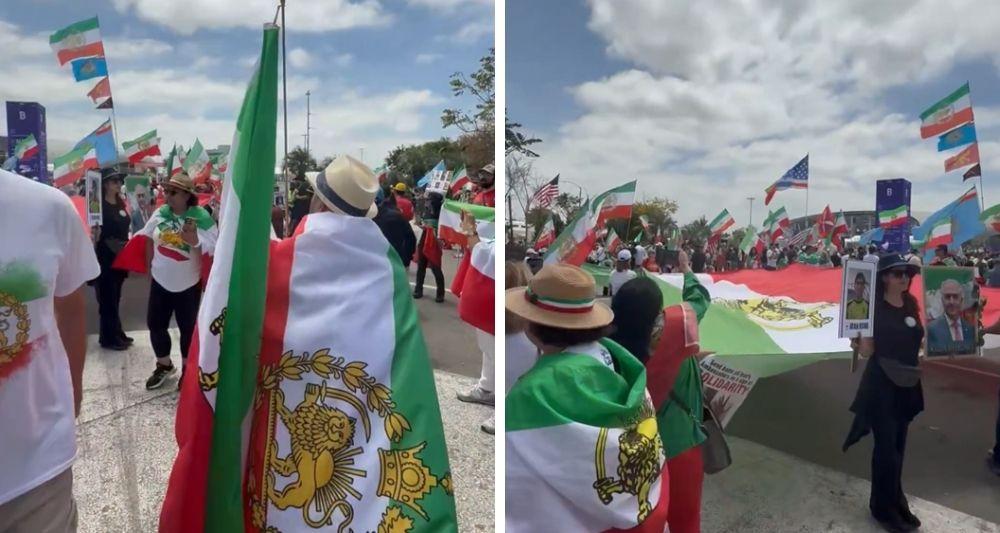
Anti-regime protesters attending Sunday's World Cup match between Iran and Belgium in Los Angeles displayed the pre-revolutionary Iranian flag despite FIFA's ban on the symbol inside tournament venues. The flag, which was used before the 1979 Islamic Revolution and is widely embraced by opponents of Iran's current regime, appeared throughout the grounds surrounding SoFi Stadium—temporarily renamed Los Angeles Stadium for the 2026 FIFA World Cup—and later inside the venue itself.
The California Post reported that many supporters carried the banned flags openly before kickoff, while others folded them into pockets or bags before passing through security checkpoints. Once inside the stadium, numerous fans unfurled the flags from their seats, wore them on clothing, or draped them over their shoulders.
Outside the stadium, hundreds of demonstrators gathered to protest the Iranian regime, chanting for freedom and political change. The demonstrations reflected deep divisions within the Iranian-American community over whether Iran's national team represents the Iranian people or the Islamic Republic government.
Sports Illustrated reported that anti-regime protesters outside the stadium described the national team as representing the Islamic Revolutionary Guard Corps terrorist group rather than the Iranian people. One protester told the outlet, "They are IRGC team, not Iran team."
The display marked the second consecutive World Cup match in Los Angeles where anti-regime protesters attempted to circumvent FIFA's restrictions on the symbol. Similar scenes unfolded during Iran's tournament opener against New Zealand last week, when large demonstrations erupted outside the stadium over FIFA's ban on the flag and broader opposition to the Iranian regime.
FIFA's tournament regulations prohibit political symbols, including banners, flags, clothing, and other materials deemed political, offensive, or discriminatory. Tournament organizers classified the pre-revolutionary Lion and Sun flag as a prohibited political symbol before the World Cup began. Court challenges to the ban have thus far failed.
According to the Post, enforcement of the ban has proven difficult, particularly in Southern California, home to one of the largest Iranian diaspora communities in the world. An estimated 600,000 Persian Americans live in the region. Iranian-American activists have organized protests throughout the World Cup, with some calling on FIFA to remove Iran from the competition over the Tehran regime's human rights record.
https://twitter.com/Tarikh_Eran/status/2068789573593784480?s=20
During the playing of Iran's national anthem on Sunday, numerous supporters reportedly booed the anthem of the Islamic Republic, underscoring the political divisions that have followed Team Melli throughout the tournament. Similar scenes played out during Iran's opening match against New Zealand, where anti-regime demonstrators vowed to bring the banned flags into stadiums and protest the government on the world stage. In Seattle, an IRGC flag, part of the World Cup display on the city’s monorail, has been regularly vandalized. The match between Iran and Belgium ended in a scoreless draw.
Libby’s Desk
Commentary and must-reads from Libby’s desk, straight to your inbox.
TPM Newsletter
The Post Millennial’s top stories, delivered to your inbox.


