Socialist Seattle Mayor Katie Wilson doubles down on scandal-plagued homeless shelter provider
Wilson claimed, “We got contingency plans,” when asked about possible HUD reductions to funding.
Wilson claimed, “We got contingency plans,” when asked about possible HUD reductions to funding.

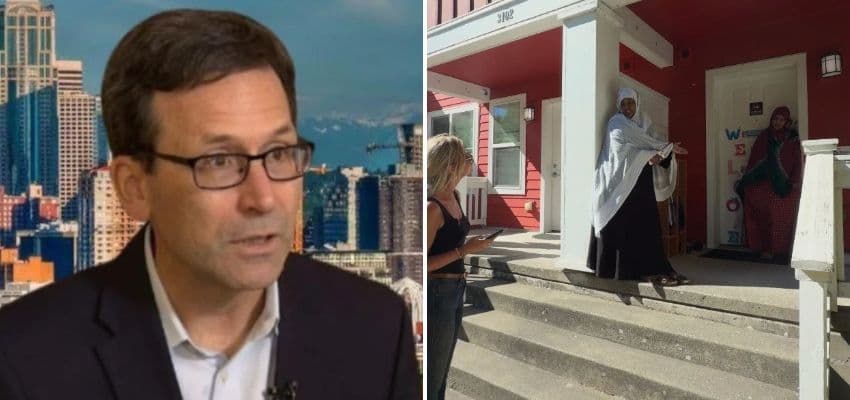
Seattle Mayor Katie Wilson is celebrating a nearly $2.8 million tiny house village operated by the Low Income Housing Institute (LIHI), despite the provider’s history of safety controversies and questions about whether her latest homelessness strategy meaningfully changes the city’s approach.
The opening follows Wilson’s retreat from her original shelter expansion promise and challenge to her reliance on the same organizations that have failed throughout Seattle’s homelessness crisis.
Loading this lets X set cookies and collect data.
View on XCloverleaf Tiny House Village in South Park contains 90 shelter units. According to the city, grants came through the Shelter Accelerator Fund, a public-private partnership involving Seattle and Challenge Seattle, with support from Seattle Foundation.
“Cloverleaf Village isn't just ninety tiny houses. It's ninety chances for someone to come inside and catch their breath,” Wilson said.
But LIHI’s promises of supervision and stability have fallen flat.
Earlier this year, in a video recorded by We Heart Seattle founder Andrea Suarez at LIHI’s Interbay Tiny House Village, a resident showed her a structure the resident said was used for consuming drugs, including fentanyl.
LIHI defended it as a “multi-use room,” describing staff monitoring people experiencing behavioral health problems and intervening during overdoses. Suarez said she was subsequently barred from returning.
In August, US Marshals arrested convicted child rapist Timothy Martin at Interbay.
As The Post Millennial reported, Martin had an outstanding December 2021 warrant for allegedly violating lifetime supervision and a June 2026 warrant concerning an alleged failure to register as a sex offender.
It remains unclear when he entered Interbay, what screening he underwent, or whether staff knew about the warrants. His presence nevertheless raised questions about oversight at a facility advertising round-the-clock staffing and security.
Other controversies stretch back years.
Seattle announced in 2018 that it would close LIHI’s Licton Springs village after safety complaints and prolonged stays. Although intended as temporary shelter, 39 of 53 residents had remained longer than a year. LIHI added security measures, but the city declined to renew the permit.
At Tacoma’s Aspen Court, former employee Anita Letasi alleged inadequate security and inconsistent screening. LIHI rejected a broader employee complaint letter as containing misrepresentations.
This year, the regional homelessness authority also rescinded a $3 million LIHI grant for another village, citing missed site deadlines. LIHI appealed and blamed the authority’s contracting delays.
At Wilson’s October 21 presser, Journalist Jonathan Choe confronted the mayor about her continued faith in established providers.
“Mayor, you're holding this press conference to admit that the current plan is not working, yet for more than a decade some of these providers behind you, DESC, Plymouth, LIHI, PDA, REACH, have presided over this very homeless crisis the city is dealing with,” he asked. “Why do you still have faith in them and why are you sticking by them?”
Wilson claimed the challenge was “a problem really of coordination.”
Her shelter commitment has also shrunk: from 1,000 additional beds annually to 960 across 2026 and 2027—less than half the original two-year pace. Wilson blamed an inherited $175 million deficit.
Federal funding presents another question.
After the opening, Wilson told The Center Square, “We got contingency plans,” when asked about possible HUD reductions. She did not explain whether she would use roughly $20 million reserved for potential funding losses before her team closed the vehicle door.
HUD Secretary Scott Turner previously included Seattle in federal scrutiny during an August interview with The Ari Hoffman Show.
“The housing first model is a failure,” Turner said, advocating treatment, recovery and self-sufficiency. HUD’s funding summary prioritizes new transitional housing and supportive-service projects. Neither source establishes that Cloverleaf faces a cutoff.
Following last week’s presser announcing the plan, Downtown Seattle Association CEO Jon Scholes was slammed after dismissing the idea of a large service-resistant population as “a myth.”
Seattle’s 2024 Human Services Department report recorded 7,565 shelter offers and 1,884 acceptances—approximately 75 percent went unaccepted.
Loading this lets Rumble set cookies and collect data.
View on RumbleLibby’s Desk
Commentary and must-reads from Libby’s desk, straight to your inbox.
TPM Newsletter
The Post Millennial’s top stories, delivered to your inbox.