
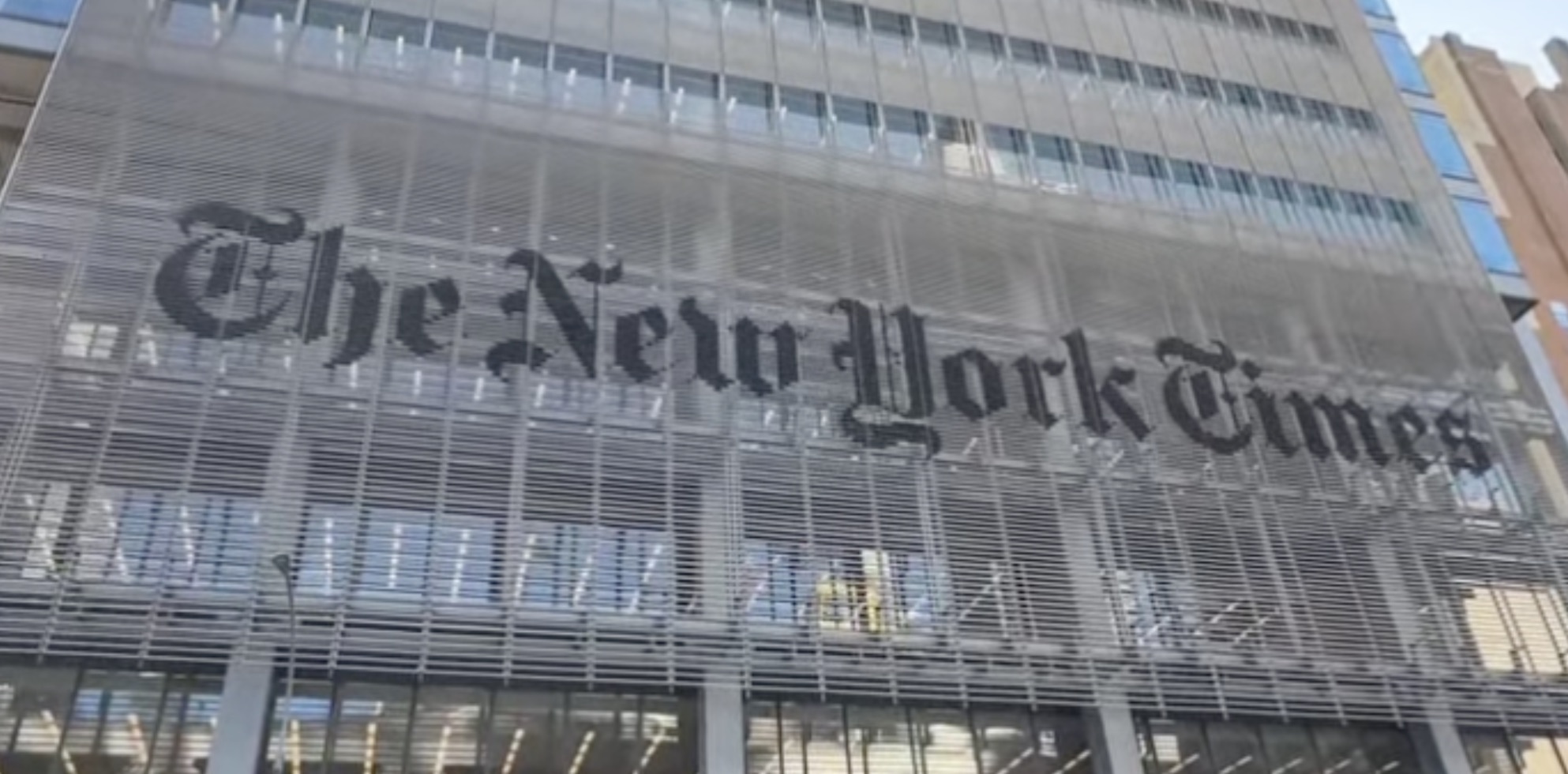
A peer-reviewed analysis of 1,559 New York Times articles found the paper’s Gaza war coverage increasingly portrayed Israel as the "sole aggressor."

Yale School of Management professor Edieal Pinker analyzed 1,559 Times articles published between Hamas's Oct. 7, 2023 terrorist attack and June 7, 2024, finding a persistent imbalance that increasingly portrayed Israel as the “sole aggressor” while Hamas's continuing role in the war largely disappeared from the narrative.
“Drawing on a corpus of 1,559 news articles, I document a dominant narrative consistent with a framing that assigns near-exclusive agency and responsibility to Israel while diminishing Hamas's role in sustaining the conflict,” Pinker wrote.
The study, “How the New York Times Framed the War Between Israel and Hamas,” was published Sept. 7 in the peer-reviewed journal Studies in Conflict & Terrorism.
Personal accounts of Palestinian suffering appeared approximately two out of every three days, Pinker found, while comparable accounts of Israeli suffering were rare. The overwhelming majority of the Times' coverage also made no mention of Israelis killed after Oct. 7 or Hamas terrorists killed during Israel's military campaign.
In an earlier version of the analysis, Pinker found that 1,423 of the articles examined mentioned neither subsequent Israeli casualties nor Hamas combatant deaths. Only about 10 percent of stories directly covering the fighting mentioned Hamas terrorists being killed, while just 18 percent referenced Palestinian violence committed after Oct. 7.
Israel, meanwhile, was mentioned more than three times as often as Hamas in articles focused on the war. The cumulative effect, Pinker found, was a narrative in which Israel continued inflicting casualties while Hamas's role in perpetuating the conflict faded from view.
The Times regularly reminded readers that Hamas murdered approximately 1,200 people during its Oct. 7 invasion of southern Israel, but the study found that Israeli suffering was largely frozen on that date.
Hundreds of Israeli soldiers were subsequently killed during the war. Israeli civilians and police were also killed in terrorist attacks; Hamas continued launching rockets at Israel, and terrorists continued holding hostages kidnapped during the Oct. 7 massacre. Yet those realities received dramatically less attention than Palestinian casualties and suffering.
Pinker found that the resulting narrative increasingly depicted Israel as the “sole aggressor” while Palestinians appeared overwhelmingly as “passive victims.”
Pinker examined the cumulative picture created by what readers were repeatedly told and what they were not. An individual article could therefore contain accurate facts while still contributing to a distorted overall narrative. If readers were continually shown Israeli military operations, Palestinian casualties, and personal accounts of Palestinian suffering, but were rarely reminded that Hamas continued fighting, Hamas terrorists were being killed, Israelis continued dying, and hostages remained captive, Israel increasingly appeared to be waging the war alone.
The coverage effectively transformed the conflict from a continuing war between Israel and Hamas into a narrative centered on Israel inflicting suffering on Palestinians.
Hamas terrorists invaded southern Israel on Oct. 7, 2023, murdering approximately 1,200 people and kidnapping 251 others. Israel subsequently launched its military campaign with the stated objectives of destroying Hamas and returning the hostages.
A Times spokesperson said the newspaper had covered the war “with more rigor than virtually any other US news organization” and had approached the conflict “from all angles.”
“Our editors make careful and deliberate choices about every story we publish to ensure our language, framing, prominence and tone remain true to our mission of independent journalism,” the spokesperson said.
“We remain open to good-faith disagreement but will not change our coverage to buttress entrenched perspectives. Our commitment is to independent reporting that our readers can trust.”
Pinker told the Times of Israel that the final study remained “mainly the same” as his earlier research but said publication provided the work with the “stamp of approval” that comes with peer review.
Studies in Conflict & Terrorism accepted the paper on July 19 and published it online Sept. 7.
The result, according to Pinker's study, was a narrative that assigned “near-exclusive agency and responsibility” to Israel while diminishing Hamas's role in continuing the war.
Powered by The Post Millennial CMS™ Comments
Join and support independent free thinkers!
We’re independent and can’t be cancelled. The establishment media is increasingly dedicated to divisive cancel culture, corporate wokeism, and political correctness, all while covering up corruption from the corridors of power. The need for fact-based journalism and thoughtful analysis has never been greater. When you support The Post Millennial, you support freedom of the press at a time when it's under direct attack. Join the ranks of independent, free thinkers by supporting us today for as little as $1.
Remind me next month
To find out what personal data we collect and how we use it, please visit our Privacy Policy







Comments