
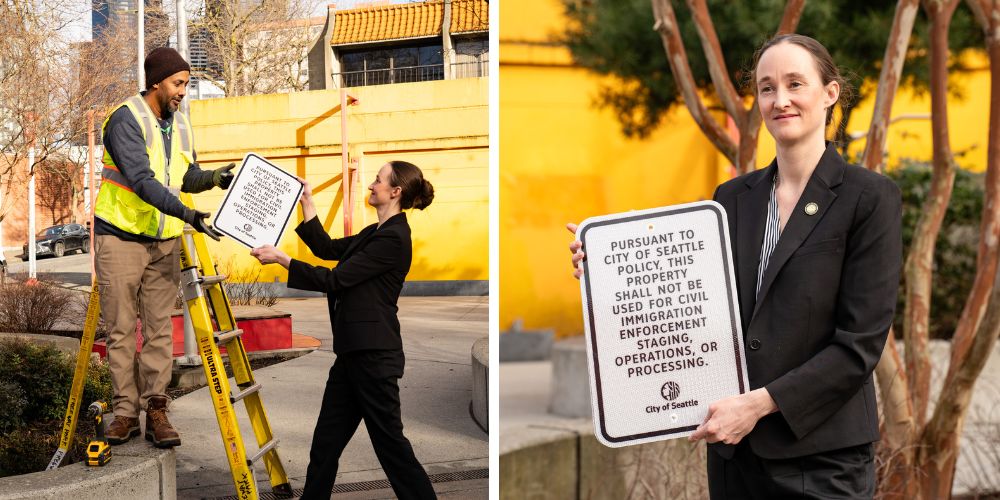
The cost comes out of Wilson's January 29 executive order, which bars federal immigration authorities from using city-owned or controlled property for immigration enforcement actions.

The cost comes out of a directive pushed by Seattle’s socialist Mayor Katie Wilson, whose January 29 executive order bars federal immigration authorities from using city-owned or controlled property for immigration enforcement actions.
The Center Square obtained a fiscal note prepared for Tuesday’s March 10 Public Safety Committee meeting, stating that the Seattle Department of Transportation may have to “delay or defer” projects or programs if it cannot find savings elsewhere to cover the signage costs. “To the extent that appropriations made in the 2026 Adopted Budget support other activities, and for which SDOT cannot find efficiencies/savings to otherwise support, SDOT may have to delay or defer projects or programs to free up funding for the signage costs that will be incurred pursuant to this legislation,” the fiscal note states.
The outlet reported that the city has not yet determined the full cost, because Seattle’s Finance and Administrative Services department has not completed a review of all properties covered by the legislation.
A February 24 city council research memo estimated that posting 656 signs on city property would cost SDOT at least $45,000 just to produce the signs, with installation costs still unknown. That means a city department responsible for maintaining streets, bridges, roadways, and Seattle’s two streetcar lines may have to divert resources away from core transportation needs in order to fund political signage tied to the mayor’s anti-ICE agenda.
Wilson framed the move as a matter of protecting Seattle residents. “Whoever you are, and wherever you come from: If Seattle is your home, then this is your city,” Wilson said. “And it’s our responsibility as city leaders to move quickly and get organized so we can keep people safe.”
In January, Wilson announced a sweeping set of measures directing the Seattle Police Department to investigate, verify, and document ICE activity, while also expanding legal and financial support for illegal immigrants and restricting federal immigration enforcement from using city property. She also allocated $4 million in taxpayer dollars for illegal immigrants’ legal fees and support services, despite city officials acknowledging there was no indication of any surge in ICE or Customs and Border Protection activity in Seattle.
Under the policy, SPD officers are expected to record ICE operations using body-worn and in-car cameras, verify the identities of federal agents, and document evidence of potentially unlawful acts for possible referral to prosecutors. Officers are also expected to coordinate with city departments and “trusted community organizations” to distribute what the city calls accurate information about ICE activity. Wilson did not identify those organizations, but during her campaign used Antifa militants as bodyguards.
Seattle Police Officers Guild President Mike Solan blasted the directive, warning that city leaders are trying to turn officers into political tools. “Toothless virtue signaling rhetoric like this has already cost two people their lives,” Solan said. “The concept of pitting two armed law enforcement agencies against each other is ludicrous and will not happen. I will not allow SPOG members to be used as political pawns.”
Seattle Police Chief Shon Barnes also made clear this week that officers who refuse to comply with the city’s policy could face disciplinary action. Speaking before the Seattle City Council’s Select Committee on Federal Administration and Policy, Barnes said officers who fail to document immigration enforcement actions as required would violate both policy and law. “This would be a violation of our policy, a violation of the law,” Barnes said.
Barnes added that officers could be placed on administrative leave under the Seattle Police Officers Guild collective bargaining agreement.
Powered by The Post Millennial CMS™ Comments
Join and support independent free thinkers!
We’re independent and can’t be cancelled. The establishment media is increasingly dedicated to divisive cancel culture, corporate wokeism, and political correctness, all while covering up corruption from the corridors of power. The need for fact-based journalism and thoughtful analysis has never been greater. When you support The Post Millennial, you support freedom of the press at a time when it's under direct attack. Join the ranks of independent, free thinkers by supporting us today for as little as $1.
Remind me next month
To find out what personal data we collect and how we use it, please visit our Privacy Policy




Comments