
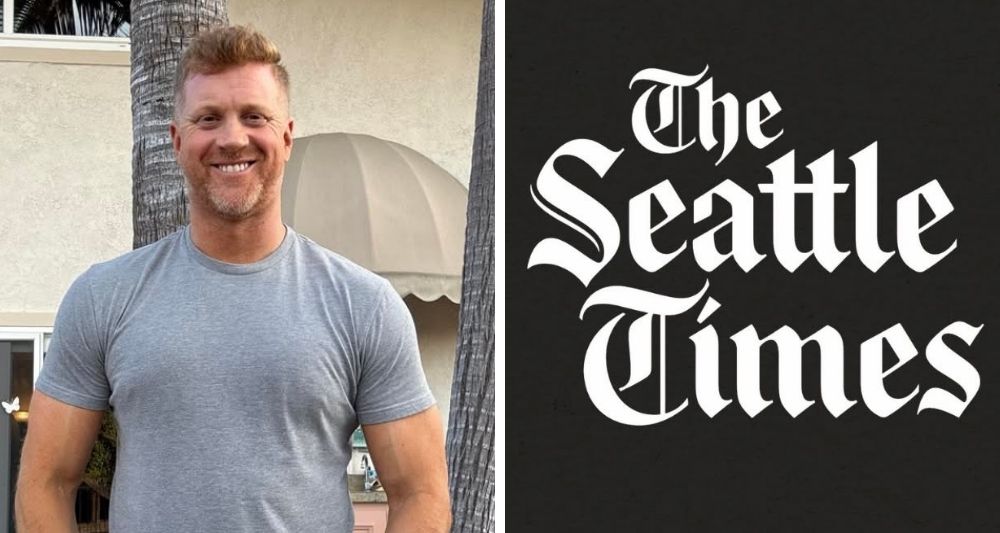
"The impetus was the Times declining to run a column I wrote from the perspective of two female student athletes who were opposed to competing against biological males."

Calkins, who spent 11 years at the paper, said the decision was entirely his own but came after he concluded he could no longer properly perform his job as a columnist there.
“The impetus was the Times declining to run a column I wrote from the perspective of two female student athletes who were opposed to competing against biological males,” Calkins announced on X. “It was one of several pieces of mine that had been spiked.”
The rejected column followed the July 28 Seattle Storm game against the Indiana Fever at Climate Pledge Arena. Before the game, supporters gathered to thank Fever guard Sophie Cunningham for speaking out in defense of female-only sports. Calkins interviewed 16-year-old student athlete Ahnaleigh Wilson, who carried a sign reading, “Thank You, Sophie for Speaking up for Girls!” Wilson and other supporters told him that opposing biological males in female athletic divisions did not mean they hated transgender people.
During the game, Seattle Storm co-owner Celeste Keaton allegedly confronted Wilson and another 16-year-old girl, called them “f*cking insane,” and accused them of being “un-Christian.” One of the teenagers was reduced to tears and put away her sign. Other Storm fans were filmed hurling insults at the girls. The Storm subsequently apologized, and the WNBA suspended Keaton for five home games and imposed an undisclosed fine. Cunningham praised the teenagers for standing by their beliefs and called Keaton’s conduct “truly embarrassing.”
Calkins said the thesis of his proposed column was that “supporting the separation of biological females and males doesn’t automatically make you transphobic, so let’s stop throwing those labels around.”
He submitted the piece after speaking with his editor on July 31, telling the editor there was no rush to publish it. His editor later told him that other newsroom leaders were reviewing the column but that it would not be ready for that Sunday’s newspaper.
Several days later, Calkins was informed that the column would not run because he allegedly had not provided sufficient advance notice that he was pursuing it.
Calkins rejected that explanation. He argued that if insufficient notice had been the real problem, the idea would have been killed immediately—not circulated among multiple editors and escalated to the newspaper’s top newsroom leadership over several days.
“My response? To resign on the spot,” he wrote.
The Storm column, however, was not the first time the newspaper had refused to publish his commentary.
Calkins revealed that the Times previously rejected a column questioning whether members of the US Women’s National Soccer Team were actually victims of sex-based pay discrimination. The highly publicized equal-pay dispute was routinely presented as an example of female athletes being paid less than their male counterparts, but the men’s and women’s teams operated under different collectively bargained compensation structures.
Calkins wanted to examine whether the facts justified the discrimination narrative. The Times declined to publish it. Another of his columns was rejected because it addressed cancel culture in sports. That piece also challenged the increasingly common practice of destroying careers or reputations over unpopular statements and controversial opinions. It likewise never reached readers.
The three rejected topics—women’s soccer compensation, cancel culture and biological males in female sports—were different controversies but, according to Calkins, shared the same editorial problem.
“The common theme?” he wrote in his Substack account. “All of these challenged prevailing newsroom narratives and likely would have triggered the outrage mob.”
The disclosures raise questions about the role of a columnist at the region’s largest newspaper. Unlike a beat reporter, a columnist is expected to advance arguments, scrutinize popular assumptions and generate debate—particularly when an issue is divisive.
Calkins said avoiding controversial subjects would leave readers “shortchanged,” adding that he ultimately no longer believed he was being allowed to do the job for which he had been hired.
“I’ve always thought that it was a columnist’s duty to generate discussion on the most hot-button issues,” he wrote. “I guess in the end, I just didn’t feel like I could do my job properly anymore.”
Despite the dispute, Calkins said he held no animosity toward his former colleagues.
“I enjoyed my time with the paper, find the talent there to be immense, and have no animosity toward anyone who works there,” he said. “It was just time for a change.”
Powered by The Post Millennial CMS™ Comments
Join and support independent free thinkers!
We’re independent and can’t be cancelled. The establishment media is increasingly dedicated to divisive cancel culture, corporate wokeism, and political correctness, all while covering up corruption from the corridors of power. The need for fact-based journalism and thoughtful analysis has never been greater. When you support The Post Millennial, you support freedom of the press at a time when it's under direct attack. Join the ranks of independent, free thinkers by supporting us today for as little as $1.
Remind me next month
To find out what personal data we collect and how we use it, please visit our Privacy Policy



Comments