
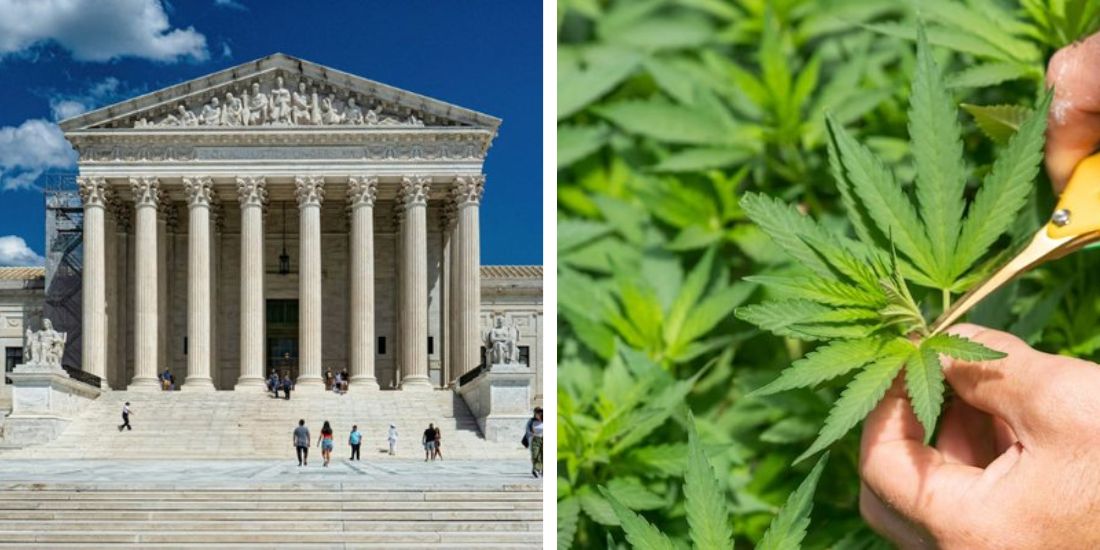
The court held that the government’s prosecution of Hemani under the unlawful user provision "is inconsistent with the Second Amendment."

Ali Hemani, a dual citizen of the US and Pakistan who was born in the US, had been charged by the federal government with possessing a firearm in his home while being an unlawful user of a controlled substance.
Under the suspicion that Hemani and his family had been involved in terrorism-related activities, the family’s home was searched. Hemani "proved cooperative" during the search, the ruling stated, surrendering his gun over and pointing agents to marijuana that was on the property, and consenting to an interview. During the interview, "he told law enforcement agents that he used marijuana about every other day." Over six months later, Hemani was indicted on the gun charge, with prosecutors "relying solely of Mr. Hemani’s admitted use of marijuana."
The court held that the government’s prosecution of Hemani under the unlawful user provision "is inconsistent with the Second Amendment."
Gorsuch’s opinion stated, "We appreciate that drugs and guns can sometimes make for a dangerous mix. We appreciate, too, that the government’s effort to analogize a modern statute addressing drug use to historical laws must be approached with a sensitivity to the fact that many drugs well known today were unknown in early America. As we have put it, the Second Amendment 'can, and must, apply to circumstances beyond those the Founders specifically anticipated.’"
He wrote that the "habitual drunkard laws" on which the government relied in their arguments before the court "differ dramatically" from the unlawful user provision "on every single metric the government invites us to consider: They targeted different kinds of people, did so for different purposes, and operated in different ways."
The habitual drunkard laws applied to those who drank in extreme excess, and Gorsuch wrote that had those laws "applied to those who simply drank regularly, many notable early Americans could have faced trouble. John Adams took 'a tankard of hard cider' with his 'daily breakfast.’ Some say James Madison 'consumed a pint of whiskey daily.' George Washington often drank three glasses of madeira in the evening—'not enough to be considered a heavy drinker in his day.' Thomas Jefferson enjoyed '3 or 4 glasses [of wine] at dinner.'"
"There was, in short, a 'culture of copious drinking' in early America … Given all this, it seems the government’s historical laws targeted habitual drunkards not merely because they regularly used intoxicants, or even sometimes used them to excess. Instead, those laws focused on habitual drunkards because their drinking rendered them practically incapacitated and incapable of managing their affairs. And that hardly compares to whom §922(g)(3)’s unlawful user provision targets on the government’s account," he wrote.
Gorsuch wrote that the case "is a narrow one," adding, "All that is before us is one, if surely ambitious, theory. The government maintains that it may automatically strip Mr. Hemani of his Second Amendment right to possess a firearm because he uses marijuana a few times a week. More than that, because he possessed a gun despite this prohibition, the government insists it may imprison him for up to 15 years and disarm him for life. According to the government, none of this turns on how much marijuana Mr. Hemani uses or what effect it has on him."
"It makes no difference either if he keeps a firearm only in his home for self-defense, never misuses a gun while intoxicated, and never poses a danger to himself or others as a result of his marijuana use. The only thing the government must show, it says, is that an individual like Mr. Hemani regularly uses any amount of any controlled substance."
Powered by The Post Millennial CMS™ Comments
Join and support independent free thinkers!
We’re independent and can’t be cancelled. The establishment media is increasingly dedicated to divisive cancel culture, corporate wokeism, and political correctness, all while covering up corruption from the corridors of power. The need for fact-based journalism and thoughtful analysis has never been greater. When you support The Post Millennial, you support freedom of the press at a time when it's under direct attack. Join the ranks of independent, free thinkers by supporting us today for as little as $1.
Remind me next month
To find out what personal data we collect and how we use it, please visit our Privacy Policy





Comments