
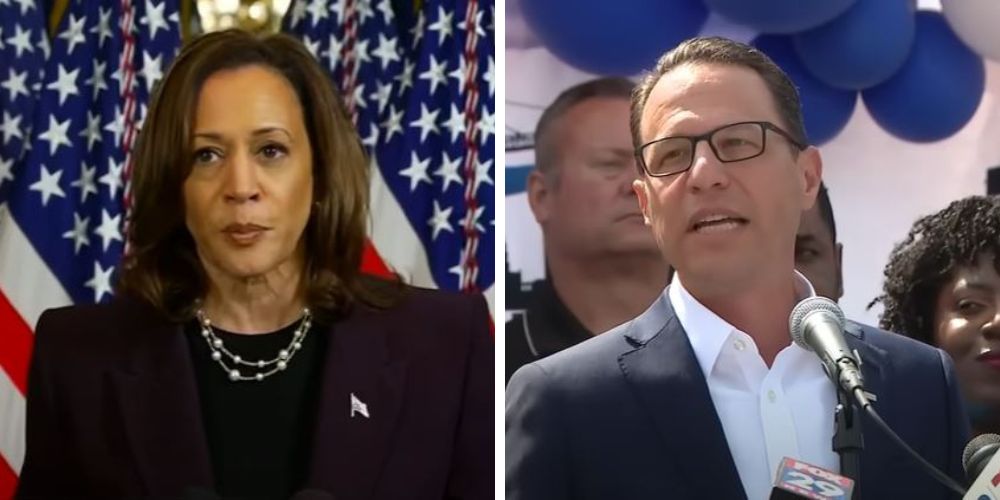
He wrote that he said that the question was offensive and was told, “Well, we have to ask.”

In his upcoming memoir, Where We Keep the Light, Shapiro, who is Jewish, writes that though Harris herself remained professional in their direct interactions, her team was intensely focused on his views about Israel. According to the New York Times, Shapiro wrote that late in the vetting process, he was asked, “Had I been a double agent for Israel?” He wrote that he said that the question was offensive and was told, “Well, we have to ask.”
Shapiro added that the questioner was “just doing her job,” but says the fact that such a question was posed “said a lot about some of the people around the VP.” He also recalls being pressed repeatedly on Israel-related issues and wondering whether the scrutiny was uniquely his. “I wondered whether these questions were being posed to just me — the only Jewish guy in the running — or if everyone who had not held a federal office was being grilled about Israel in the same way.”
The governor, who has been an outspoken critic of antisemitism on college campuses during the Israel–Hamas war, wrote, “These sessions were completely professional and businesslike. But I just had a knot in my stomach through all of it.”
In her book, 107 Days, Harris described Shapiro as “poised, polished, and personable,” but also suggests that his ambition raised red flags that he might struggle to accept the limitations of being second in command. Harris wrote that Shapiro wanted a seat at the table for “each and every decision,” a level of involvement she believed was too ambitious, despite claiming that she was part of major decisions in the Biden administration and was the “last person in the room” when they were made.
She referenced what she saw as political vulnerabilities he carried as well, referencing “the attacks he’d confronted on Gaza and what effect it might have on the enthusiasm we were trying to build.” Harris emphasized that her central worry was personal and structural, writing of “a nagging concern that he would be unable to settle for a role as number two and that it would wear on our partnership.”
Shapiro wrote in his book that the two had different views of what the vice presidency should look like. He said he wanted a partnership which had an open debate followed by loyalty. “If we had door A and door B as options, and she was for door A and I was for door B, I just wanted to make sure that I could make the case for door B. And if I didn’t convince her, then I’d run right through a brick wall to support her decision.” He added that Harris said, “That was not what she was looking for.”
Where We Keep the Light is scheduled to be released on Jan. 27.
The Biden-Harris administration's former Deputy Special Envoy to Monitor and Combat Antisemitism, Aaron Keyak, called Team Harris' actions an “antisemitic inquiry.” He said in a statement that Shapiro’s experience was similar to those of “too many” who had been asked similar questions. Keyak said he was asked “questions in a classified setting that my fellow non-Jewish political appointees did not.”
He added, “These sorts of antisemitic questions are anti-American and do not represent the best that the Democratic Party offers. Now and especially during the next Presidential campaign, we must demand better.”
Powered by The Post Millennial CMS™ Comments
Join and support independent free thinkers!
We’re independent and can’t be cancelled. The establishment media is increasingly dedicated to divisive cancel culture, corporate wokeism, and political correctness, all while covering up corruption from the corridors of power. The need for fact-based journalism and thoughtful analysis has never been greater. When you support The Post Millennial, you support freedom of the press at a time when it's under direct attack. Join the ranks of independent, free thinkers by supporting us today for as little as $1.
Remind me next month
To find out what personal data we collect and how we use it, please visit our Privacy Policy



Comments