

minute read
US and Chinese officials met in Geneva on Saturday, beginning negotiations to resolve the escalating trade war between the two countries.
Treasury Secretary Scott Bessent and Chinese Vice Premier He Lifeng are leading the talks, which are set to continue on Sunday. Both countries confirmed the discussions, though the precise location in Geneva has not been disclosed, according to the New York Post.
The talks mark the first since President Donald Trump announced a steep increase in tariffs on Chinese imports, raising them to 145 percent. In response, China imposed a retaliatory 125 percent tariff on American goods, and the heightened tension has raised concerns regarding supply chains and trade. Similar tariffs on other countries were paused earlier in April for 90 days as the US has been moving to make deals with other countries after the implementation of the reciprocal tariffs that were announced by the president.
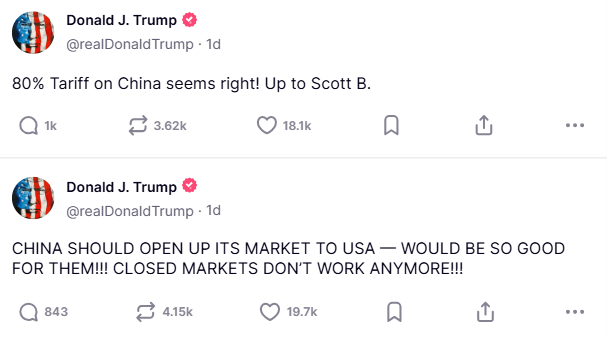
On Friday, Trump suggested via social media that he might be open to lowering the tariffs with China to 80 percent but left the decision up to Bessent.
“China should open up its market to USA — would be so good for them!!! Closed markets don’t work anymore!!!” Trump posted. “80% Tariff on China seems right! Up to Scott B.”
White House Press Secretary Karoline Leavitt later clarified that the 80 percent figure was not a finalized position, describing it as a “number the president threw out there.”
“The president still remains with his position that he is not going to unilaterally bring down tariffs on China,” Leavitt said.
Earlier this week, Bessent said the public should not expect a major trade deal to be the outcome of the talks, though he acknowledged that such conversations are a positive step in negotiations between the US and China. President Trump has frequently pointed to the US-China trade imbalance, which reached $263 billion last year, as justification for his aggressive tariff policies. He has also accused China of unfair trade practices that disadvantage American industries.
The Geneva meeting follows Trump’s broader global tariff push, which he launched in early April during what he dubbed “Liberation Day.” Since then, several countries have sought negotiations with the US to avoid harsher trade penalties.
Last week, Trump announced a trade agreement with the United Kingdom that leaves a 10 percent tariff in place but opens the British market to US agricultural exports. The deal also permits the country to import of 100,000 cars into the US at a 10 percent rate rather than 25 percent. Trump trade advisor Peter Navarro said the 10 percent tariff would serve as a “template” for future deals and warned that countries attempting to retaliate should expect higher rates.
Treasury Secretary Scott Bessent and Chinese Vice Premier He Lifeng are leading the talks, which are set to continue on Sunday. Both countries confirmed the discussions, though the precise location in Geneva has not been disclosed, according to the New York Post.
The talks mark the first since President Donald Trump announced a steep increase in tariffs on Chinese imports, raising them to 145 percent. In response, China imposed a retaliatory 125 percent tariff on American goods, and the heightened tension has raised concerns regarding supply chains and trade. Similar tariffs on other countries were paused earlier in April for 90 days as the US has been moving to make deals with other countries after the implementation of the reciprocal tariffs that were announced by the president.
On Friday, Trump suggested via social media that he might be open to lowering the tariffs with China to 80 percent but left the decision up to Bessent.
“China should open up its market to USA — would be so good for them!!! Closed markets don’t work anymore!!!” Trump posted. “80% Tariff on China seems right! Up to Scott B.”
White House Press Secretary Karoline Leavitt later clarified that the 80 percent figure was not a finalized position, describing it as a “number the president threw out there.”
“The president still remains with his position that he is not going to unilaterally bring down tariffs on China,” Leavitt said.
Earlier this week, Bessent said the public should not expect a major trade deal to be the outcome of the talks, though he acknowledged that such conversations are a positive step in negotiations between the US and China. President Trump has frequently pointed to the US-China trade imbalance, which reached $263 billion last year, as justification for his aggressive tariff policies. He has also accused China of unfair trade practices that disadvantage American industries.
The Geneva meeting follows Trump’s broader global tariff push, which he launched in early April during what he dubbed “Liberation Day.” Since then, several countries have sought negotiations with the US to avoid harsher trade penalties.
Last week, Trump announced a trade agreement with the United Kingdom that leaves a 10 percent tariff in place but opens the British market to US agricultural exports. The deal also permits the country to import of 100,000 cars into the US at a 10 percent rate rather than 25 percent. Trump trade advisor Peter Navarro said the 10 percent tariff would serve as a “template” for future deals and warned that countries attempting to retaliate should expect higher rates.
Sign in to comment
Powered by The Post Millennial CMS™ Comments
Join and support independent free thinkers!
We’re independent and can’t be cancelled. The establishment media is increasingly dedicated to divisive cancel culture, corporate wokeism, and political correctness, all while covering up corruption from the corridors of power. The need for fact-based journalism and thoughtful analysis has never been greater. When you support The Post Millennial, you support freedom of the press at a time when it's under direct attack. Join the ranks of independent, free thinkers by supporting us today for as little as $1.
Remind me next month
To find out what personal data we collect and how we use it, please visit our Privacy Policy


Comments