
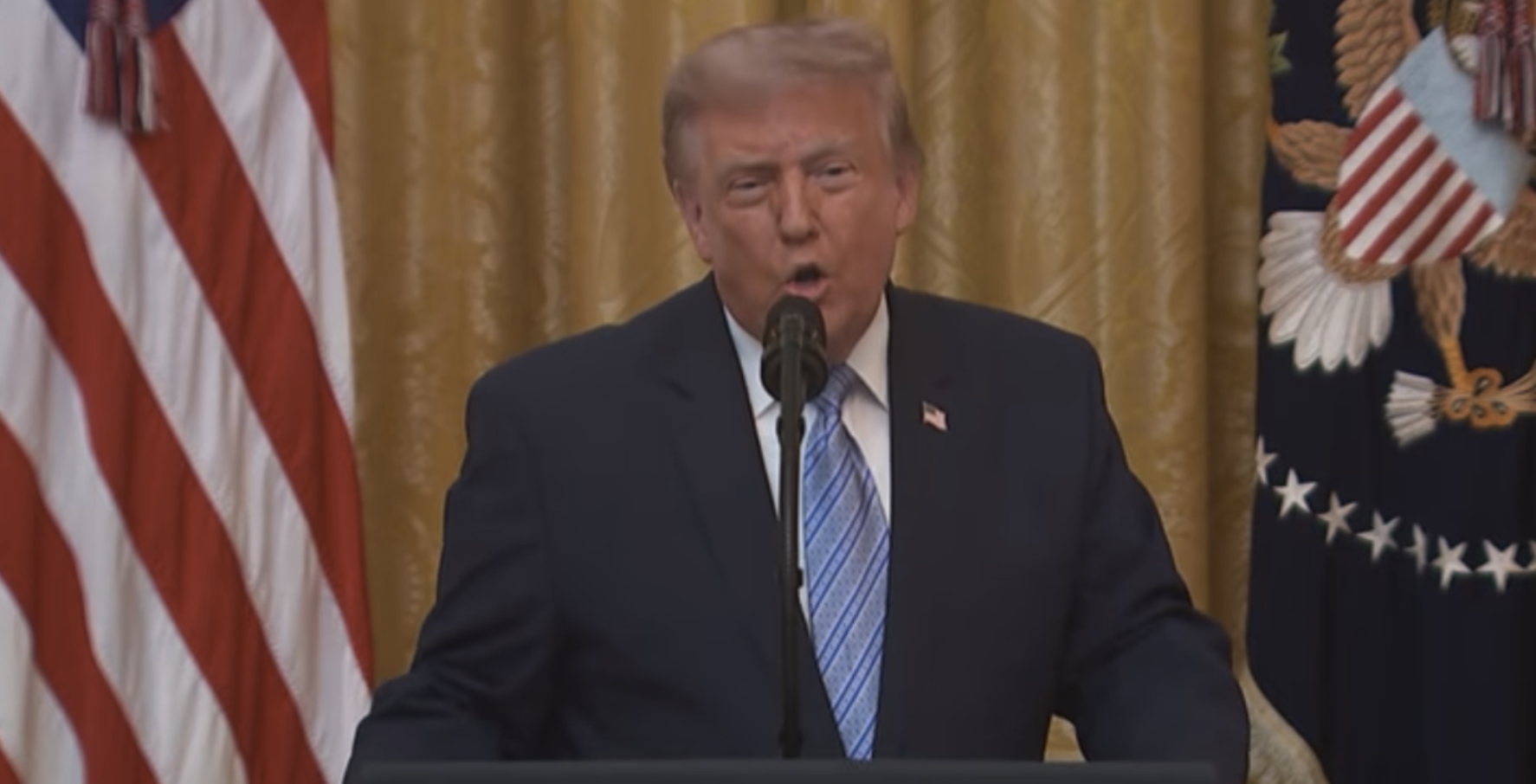
"The president wanted to make sure that while we have this data center boom and we win in the AI race, we are not passing on increased electricity bills to American families and businesses."

The announcement comes as electricity demand from AI development continues to surge nationwide, raising concerns that residential utility customers could be left paying for the infrastructure needed to power a new generation of data centers.
According to the White House, the expanded coalition now covers 80 percent of all electricity delivered to American homes and businesses, protecting roughly 263 million Americans when new data centers are built nearby. Under the initiative, companies constructing AI data centers agree to pay for the new electricity generation, transmission lines, substations, and other infrastructure needed to support their facilities, themselves.
"The president recognized that every part of American life runs through data centers—911 call centers, air traffic control, cell phone calls," White House Assistant Press Secretary Taylor Rogers told The Ari Hoffman Show on Talk Radio 570 KVI.
"But the president wanted to make sure that while we have this data center boom and we win in the AI race, we are not passing on increased electricity bills to American families and businesses."
Rogers said President Trump first announced the initiative during his address to Congress earlier this year, initially securing commitments from seven of the nation's largest technology companies. Following what the administration described as a successful rollout, the pledge has since expanded to include more than 200 organizations, including 23 governors.
The pledge outlines five core commitments. Participating companies agree to build, buy, or finance the additional electricity generation their facilities require rather than relying on existing capacity; pay the full cost of new transmission and grid upgrades; continue paying for that infrastructure whether they ultimately use the electricity or not; invest in local workforce development; and coordinate with grid operators to improve grid reliability during emergencies.
The White House says those commitments are already producing measurable benefits. In Michigan, DTE Energy's agreements with Google and Oracle are projected to generate billions of dollars in customer savings because the companies are covering their full energy and capacity costs.
In Indiana, NiSource's agreements with Amazon and Alphabet are expected to return at least $1.4 billion to customers over the next 15 years. In Georgia, Southern Company has agreed to freeze base electricity rates through 2029 while delivering more than $1.7 billion in savings—more than $100 annually for the typical residential customer.
Additional agreements include Mississippi, where Entergy says its partnership with Amazon will generate roughly $2 billion in customer benefits while covering new transmission costs; Wisconsin, where Alliant Energy says developers including QTS will pay the full cost of new infrastructure while supporting a five-year rate freeze; Louisiana, where Meta is funding the full cost of connecting its Richland Parish data center; and Texas, where Crusoe is powering a new 900-megawatt AI campus using its own on-site natural gas generation and battery storage.
Rogers argued the initiative is possible because the Trump administration reversed what she described as the Biden administration's "energy subtraction" policies. "Thanks to the president, who has reversed course on these Green New Scam policies and has unleashed affordable, reliable, and secure energy sources, we are able to power our grid," Rogers said. "The president's energy dominance agenda is more than just powering our homes, but it's also making sure that we're able to win in this AI race."
She contrasted the administration's approach with states that have experienced electricity shortages, pointing specifically to California. "It makes prices go sky high, and it also causes brownouts," Rogers said of the energy policies embraced by California Gov. Gavin Newsom and the Biden administration. "The president says frequently that you cannot have national security without energy security."
The White House also emphasized that while the pledge has attracted support from governors in 23 states, every governor who has signed on is a Republican. "We encourage Democrat governors to sign the pledge and have data centers pay their way so that ratepayers do not incur the cost of this data center boom," Rogers said. "Then we have a common-sense solution where American households and families win, and we also win this race for AI dominance."
The governors who have signed the pledge include those from Alabama, Alaska, Arkansas, Georgia, Idaho, Indiana, Iowa, Louisiana, Mississippi, Missouri, Montana, Nebraska, Nevada, North Dakota, Ohio, Oklahoma, South Carolina, South Dakota, Tennessee, Texas, Utah, West Virginia, and Wyoming. The addendum commits participating states to implement the pledge's principles "to the greatest extent possible."
Not every jurisdiction is embracing the administration's approach. Earlier this year, the Seattle City Council approved a one-year moratorium on new data centers while city officials study their impact on electricity demand, water consumption, land use, and greenhouse gas emissions.
Last week, the council approved two consecutive 9.5 percent Seattle City Light rate increases for 2027 and 2028, which will compound into roughly a 20 percent increase over the two-year period.
While Seattle has paused new data center development pending further study, the Trump administration argues the industry is essential to maintaining America's technological edge over China and should continue expanding, but only if developers, rather than utility customers, pay for the additional generation and transmission infrastructure their projects require.
The White House has pointed to agreements with companies including Google, Oracle, Amazon, Alphabet, and Meta as examples of how AI investment can strengthen the electric grid while protecting consumers from higher electricity bills, framing the initiative as both an affordability measure and a national security priority.
Powered by The Post Millennial CMS™ Comments
Join and support independent free thinkers!
We’re independent and can’t be cancelled. The establishment media is increasingly dedicated to divisive cancel culture, corporate wokeism, and political correctness, all while covering up corruption from the corridors of power. The need for fact-based journalism and thoughtful analysis has never been greater. When you support The Post Millennial, you support freedom of the press at a time when it's under direct attack. Join the ranks of independent, free thinkers by supporting us today for as little as $1.
Remind me next month
To find out what personal data we collect and how we use it, please visit our Privacy Policy




Comments