
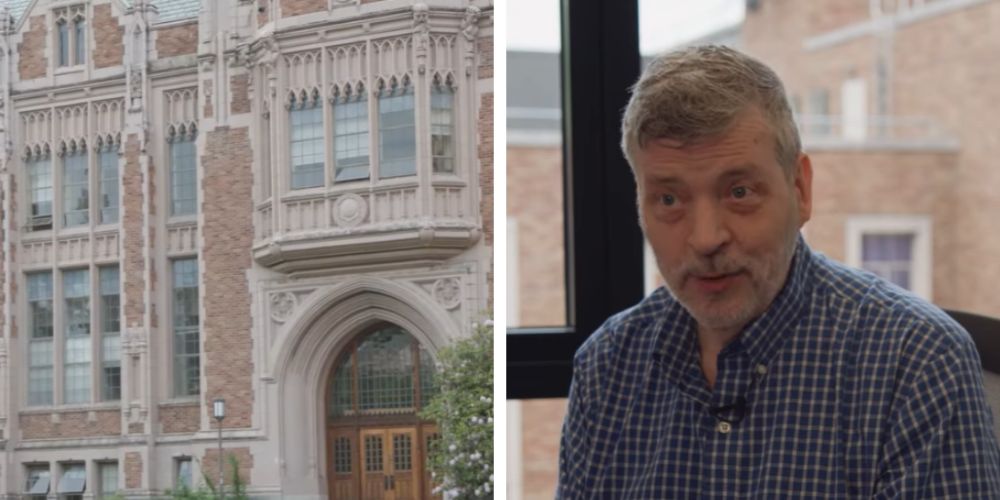
"I hope that my protest can help reverse a decade-long trend towards ideological conformity in academia and help to convince them that instead of ‘protecting’ students from controversial ideas, they should be helping them to learn how to cope with disagreement."

The settlement with Professor Stuart Reges follows a major victory at the US Court of Appeals for the Ninth Circuit, which ruled that UW officials violated Reges’ First Amendment rights through retaliation and viewpoint discrimination.
Under the settlement announced Thursday, UW will pay $600,000 for damages, attorneys’ fees and costs, and agreed that it will take no further adverse action against Reges over the conduct at issue. Reges will also be allowed to continue including his parody of land acknowledgment in future course materials.
The agreement concludes litigation that began when the Foundation for Individual Rights and Expression (FIRE) sued the university on Reges’ behalf in 2022. “I am deeply grateful to FIRE for this legal victory which will remind public universities that they are obligated to respect the First Amendment rights of their students, faculty, and staff,” Reges said. “More importantly, I hope that my protest can help reverse a decade-long trend towards ideological conformity in academia and help to convince them that instead of ‘protecting’ students from controversial ideas, they should be helping them to learn how to cope with disagreement. Only then can we heal the deep divisions that confront us today.”
The controversy began after UW’s Paul G. Allen School of Computer Science & Engineering encouraged professors to include an Indigenous land acknowledgment in their syllabi. Reges objected to what he viewed as the political nature of the practice and, in January 2022, placed his own version in the syllabus for his introductory programming course.
“I acknowledge that by the labor theory of property the Coast Salish people can claim historical ownership of almost none of the land currently occupied by the University of Washington,” Reges wrote.
The statement referenced philosopher John Locke’s labor theory of property and was intended to present a competing viewpoint on the premise of underlying land acknowledgments.
UW officials demanded Reges to remove the statement. When he refused, administrators replaced the publicly posted syllabus with a version that removed his statement. The school also publicly condemned Reges’ statement as “offensive,” apologized to students, and created a second section of his course taught by another instructor. Roughly 170 of approximately 500 students transferred into the alternate section.
UW then launched a lengthy disciplinary investigation under its anti-harassment and nondiscrimination policies. The investigation ultimately ended without formal sanctions in June 2023, but Reges was warned that repeating the statement in future syllabi could result in discipline if it caused further disruption.
Reges sued, and the case eventually reached the Ninth Circuit. A divided three-judge panel handed Reges a major victory in December 2025, finding his syllabus statement was protected speech on a matter of public concern and concluding that UW violated the First Amendment by taking action against him over his viewpoint.
“A public university investigated, reprimanded, and threatened to discipline a professor for contentious statements he made in a class syllabus,” Circuit Judge Daniel Bress wrote for the majority. “Yet debate and disagreement are hallmarks of higher education.”
The court rejected UW’s attempt to justify its actions based largely on students’ reactions to Reges’ views. “Student discomfort with a professor’s views can prompt discussion and disapproval. But this discomfort is not grounds for the university retaliating against the professor,” Bress wrote.
The Ninth Circuit directed the district court to enter summary judgment for Reges on his First Amendment retaliation claim and concluded that summary judgment was also warranted on his viewpoint discrimination claim. “The record is clear that the University took action against Reges as a result of the views he expressed in his mock land acknowledgment,” the court wrote. “That is viewpoint discrimination.”
The Ninth Circuit issued an amended opinion in May 2026 that left Reges’ central First Amendment victory intact and denied UW officials’ petition for panel rehearing and rehearing en banc. The appeals court also revived Reges’ challenge to Executive Order 31, UW’s nondiscrimination and affirmative action policy, which authorized discipline for conduct deemed “unacceptable or inappropriate” even when it did not rise to the level of unlawful discrimination, harassment or retaliation.
The Ninth Circuit did not itself rule that the policy was unconstitutional, instead sending that question back to the district court for consideration. UW rescinded and replaced the policy while the litigation was pending.
“Reasonable people can disagree about the value of land acknowledgments,” FIRE attorney Gabe Walters said following Thursday’s settlement. “What’s not up for debate is academic freedom.”
“UW learned the hard way: Ignoring the First Amendment can be costly,” Walters added. “The livelihoods of professors shouldn’t be at the mercy of student or administrator outrage, and this ruling will help protect other professors across the country.”
UW maintained Thursday that the settlement does not constitute an admission of wrongdoing. “The University of Washington maintains that we acted appropriately, and this settlement is in no way an admission of any wrongdoing,” UW said in a statement to GeekWire.
The university said that following the Ninth Circuit’s 2-1 ruling, settling was “the most reasonable option” because of the attorneys’ fees and costs that could result from continuing the litigation.
“Prof. Reges has retained his faculty position and continued teaching throughout this process, and his status with the UW remains unchanged,” the university said.
Powered by The Post Millennial CMS™ Comments
Join and support independent free thinkers!
We’re independent and can’t be cancelled. The establishment media is increasingly dedicated to divisive cancel culture, corporate wokeism, and political correctness, all while covering up corruption from the corridors of power. The need for fact-based journalism and thoughtful analysis has never been greater. When you support The Post Millennial, you support freedom of the press at a time when it's under direct attack. Join the ranks of independent, free thinkers by supporting us today for as little as $1.
Remind me next month
To find out what personal data we collect and how we use it, please visit our Privacy Policy



Comments