
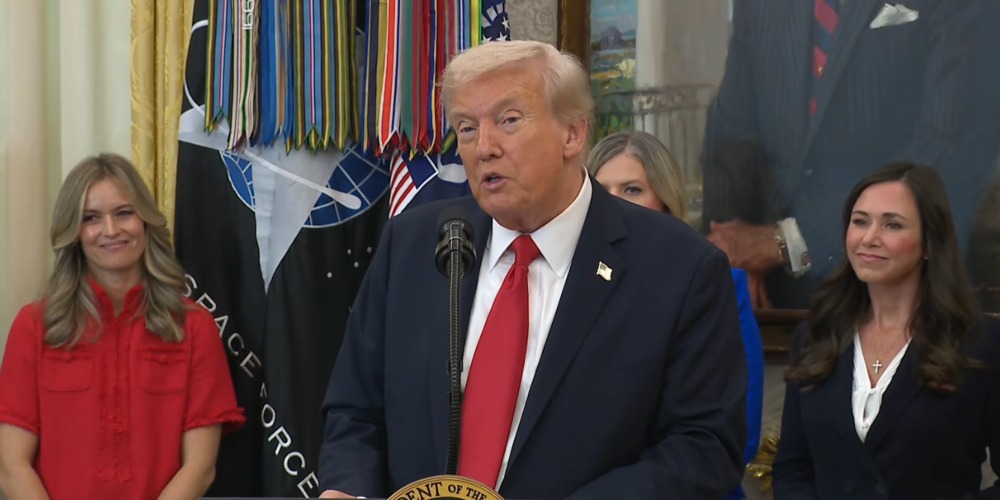
The Compact asks schools to protect academic freedom and to not punish students for ideological differences, such as having conservative ideas.

As of Monday, the University of Arizona, Brown University, Dartmouth College, MIT, UPenn, University of Southern California, and the University of Virginia all said no. The University of Texas said they might sign on and the decision of Nashville's Vanderbilt University is still unclear. Signing on to the compact would give those schools the potential for "greater funding," per The New York Times.
That compact asks schools to freeze tuition for five years, limit enrollment of international students, say outright that men are not women, and ensure that students are not punished for their political beliefs, specifically if those students are conservative. It also insists that students studying hard sciences be given free tuition at schools with massive endowments.
The Compact for Academic Excellence in Higher Education outlines 10 areas: equality in admissions, the marketplace of ideas & civil discourse, nondiscrimination in faculty and administrative hiring, institutional neutrality, student learning, student equality, financial responsibility, foreign entanglements, exceptions, and enforcement.
The Trump administration asks for schools to ban discriminatory admissions practices such as affirmative action. "Treating certain groups as categorically incapable of performing—and therefore in need of preferential treatment—perpetuates a dangerous badge of inferiority, destroys confidence, and does nothing to identify or solve the most pressing challenges for aspiring young people."
The ask for schools is: "no factor such as sex, ethnicity, race, nationality, political views, sexual orientation, gender identity, religious associations, or proxies for any of those factors shall be considered, explicitly or implicitly, in any decision related to undergraduate or graduate student admissions or financial support, with due exceptions for institutions that are solely or primarily comprised of students of a specific sex or religious denomination."
The Compact asks schools to protect academic freedom and to not punish students for ideological differences, such as having conservative ideas. "Given the importance of academic freedom to the marketplace of ideas, signatories shall adopt a policy protecting academic freedom in classrooms, teaching, research, and scholarship."
While many critics of the Compact buck against the statement in the document that says school policies should "recognize that academic freedom is not absolute," they do not cite the rest of the sentence—one they undoubtedly agree with when considering their own ideological bias. It reads that "universities shall adopt policies that prevent discriminatory, threatening, harassing, or other behaviors that abridge the rights of other members of the university community."
Schools that sign on would be prevented from considering "sex, ethnicity, race, national origin, disability, or religion" in hiring faculty and staff. It also asks for schools to rein in their staff and faculty to maintain institutional neutrality, saying that staffers who speak out politically should not do so on behalf of the university.
The Compact calls for fair, meritocratic grading and that all students "shall be treated as individuals and not on the basis of their immutable characteristics, with due exceptions for sex-based privacy, safety, and fairness." This addresses the false belief that many schools have engaged in, namely that people can switch sex. Schools have used this belief to dismantle women's rights on campus and in athletics, and somehow they've convinced themselves that this is a good thing.
Another point of the Compact is to help students deal with those horrific student loans that so many young people are saddled with, only it addresses it from the university side—the side that's been skyrocketing tuition for decades. "Universities have a duty to control their costs, including by eliminating unnecessary administrative staff, reducing tuition burdens, engaging in transparent accounting and regular auditing for misuse of funds, and cutting unnecessary costs."
Schools that sign on would be required to post statistics about average earnings for given majors to help students decide what they want to realistically pursue and will not charge students tuition for hard science programs, but instead cover it with their endowment. Universities would also be required to accept military service men and women's full transfer credits from the Joint Service Transcript.
Universities would be required to agree to maintain anti-money laundering and Know-Your-Customer foreign gift disclosures. "The program is reasonably designed to prevent university services from being used to facilitate money laundering and the financing of terrorist activities, and to ensure transparency and public accountability."
There are exceptions for religious-based, single-sex schools and the administration of these schools would be required to enforce it and ask for student input on their compliance with the Compact.
Vanderbilt's chancellor Daniel Diermeier said, "Our North Star has always been that academic freedom, free expression and independence are essential for universities to make their vital and singular contributions to society. We also believe that research awards should be made based on merit alone. This merit-based approach has enabled the scholarly and scientific excellence that has driven American health, security and prosperity for decades. It must be preserved."
University of Arizona’s president Suresh Garimella said "Principles like academic freedom, merit-based research funding and institutional independence are foundational and must be preserved," but went on to say that the ideas laid out in the Compact "deserve thoughtful consideration."
California Governor Gavin Newsom said any California school that signs on will "lose billions in state funding—immediately." A statement signed on to by higher education associations claims that the compact "offers nothing less than government control of a university's basic and necessary freedoms." The group claims that the Compact would "hinder, not safeguard, freedom of expression for all points of view, and it will not assist in expanding social and economic mobility for all of our students." However, that statement runs counter to the actual Compact.
Compact for Academic Excellence in Higher Education by The Post Millennial
Powered by The Post Millennial CMS™ Comments
Join and support independent free thinkers!
We’re independent and can’t be cancelled. The establishment media is increasingly dedicated to divisive cancel culture, corporate wokeism, and political correctness, all while covering up corruption from the corridors of power. The need for fact-based journalism and thoughtful analysis has never been greater. When you support The Post Millennial, you support freedom of the press at a time when it's under direct attack. Join the ranks of independent, free thinkers by supporting us today for as little as $1.
Remind me next month
To find out what personal data we collect and how we use it, please visit our Privacy Policy




Comments