
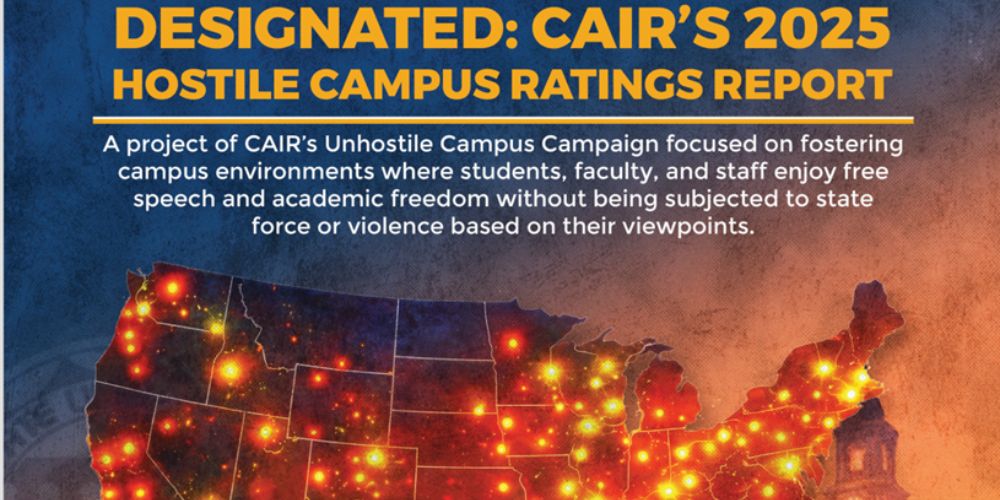
Universities automatically lose five points if they adopt the International Holocaust Remembrance Alliance (IHRA) definition of antisemitism or condemn violent activism on campus.

Schools can lose points for adopting mainstream antisemitism definitions, for issuing statements CAIR deems insufficiently “balanced,” and for enforcing rules against protests and occupations that result in arrests or discipline.
According to CAIR’s framework, each of the 51 universities begins at 100 points, an automatic “Unhostile Campus.” Points are then deducted across four categories: institutional policies; student experience and campus climate; civil-rights and legal action; and free speech and political expression. A score of 90 percent or above earns “Unhostile.” Scores between 70 and 89 percent are labeled “Under Watch.” Anything 69 percent or below is deemed a “Hostile Campus.”
No school in the report is qualified as “Unhostile” for CAIR. The average score hovered below 40 percent. Several high-profile universities received single-digit or low double-digit scores, including many that allowed their campus to be taken over by activists supporting radical Islamic terror groups. Under “Institutional Policies,” universities automatically lose five points if they adopt the International Holocaust Remembrance Alliance (IHRA) definition of antisemitism, or similar definitions. CAIR claims to oppose antisemitism, but according to the organization’s scorecard, adopting IHRA becomes a scoring offense. Under this framework, universities that implement a definition used by numerous governments and institutions to identify antisemitic conduct are penalized. A policy intended by many to protect Jewish students can, in CAIR’s grading system, lower a campus’s civil-rights score.
The report also deducts points for what it describes as “biased statements.” Universities can lose five points if leadership statements frame Palestine activism as harassment, characterize protests as dangerous disruptions, or condemn violence against Israelis without sufficiently condemning what CAIR describes falsely as genocide in Gaza. This means that a university president who issues a forceful condemnation of antisemitism following threats to Jewish students, or who condemns the October 7 Hamas massacre without pairing it with specific language about Gaza, risks being penalized.
The scoring system also evaluates whether institutional messaging aligns with CAIR’s expectations about political framing. The deductions continue under “Free Speech & Political Expression.” Arrests cost ten points. Sanctions or suspensions cost ten points. Surveillance costs five points. If a university shares certain student information with federal authorities beyond legal requirements, it can face an automatic 25-point deduction.
In the context of widespread violent campus encampments, building occupations, blocked access routes, and protest-related confrontations, these automatic penalties almost guarantee lower scores for institutions that enforced time, place, and manner restrictions or addressed trespass violations. The report notes that a significant majority of the investigated campuses called police during protest incidents and that most made policy changes without full student or faculty consultation. Those facts may reflect governance decisions in volatile situations. In CAIR’s framework, however, they are numerical liabilities.
The “Civil Rights & Legal Action” category deducts ten points when a Title VI complaint is filed and fifteen points when a lawsuit alleging discrimination is brought. A larger deduction applies if federal authorities formally find discrimination. But even before any finding, the filing itself counts against the institution. Under this structure, a university can lose points regardless of whether a complaint is substantiated.
As an example, the University of Washington, which allowed a violent Gaza encampment to take over the Quad, caved to radical organizers' demands, and took almost no consequential action against Antifa and pro-Hamas activists that caused over $1 million in damage, was rated a "Hostile Campus" for condemning the vandalism and having the culprits arrested.
Though CAIR claims to be a civil-rights advocacy organization, it has been linked to terror groups repeatedly over the last two decades. The group was identified by the Justice Department's Office of the Inspector General as an unindicted co-conspirator in the United States v. Holy Land Foundation terrorism financing case, the largest terrorism financing trial in US history, as part of the Muslim Brotherhood’s Palestine Committee, an entity formed to support Hamas in the US. According to the US government, the case “linked CAIR leaders to Hamas, a specially designated terrorist organization.”
In November 2023, CAIR’s national executive director and co-founder, Nihad Awad, said he was “happy to see” Palestinian terrorists “breaking the siege,” referring to Hamas’ October 7th massacre of Israeli civilians that left 1,200 dead and over 250 taken hostage. In response to the comments, the Biden administration removed CAIR from its White House task force on antisemitism.
Powered by The Post Millennial CMS™ Comments
Join and support independent free thinkers!
We’re independent and can’t be cancelled. The establishment media is increasingly dedicated to divisive cancel culture, corporate wokeism, and political correctness, all while covering up corruption from the corridors of power. The need for fact-based journalism and thoughtful analysis has never been greater. When you support The Post Millennial, you support freedom of the press at a time when it's under direct attack. Join the ranks of independent, free thinkers by supporting us today for as little as $1.
Remind me next month
To find out what personal data we collect and how we use it, please visit our Privacy Policy



Comments