
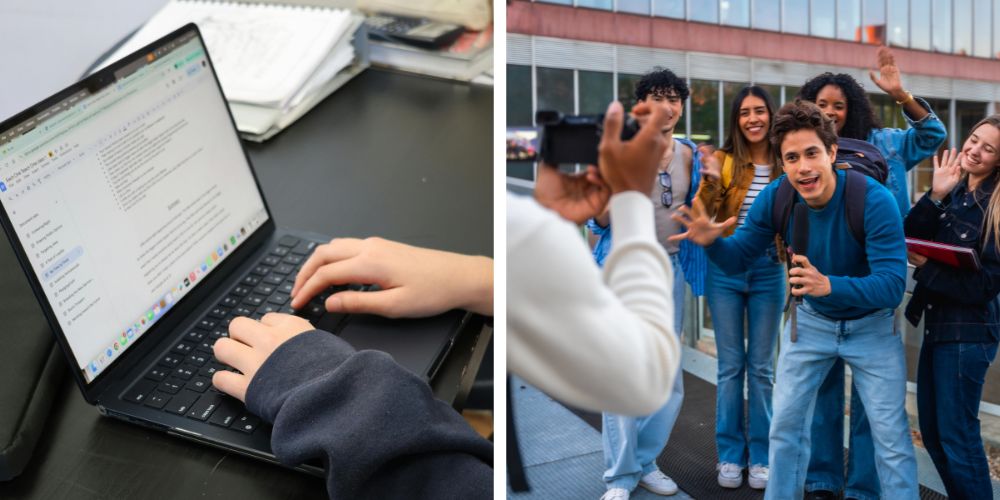
"Our responsibility is not to maximize screen exposure, but to maximize the cognitive capacity and long-term flourishing of the next generation."

Maine was one of the first states to implement a laptop program at some grade levels in 2002. Those programs grew throughout the country and by the time 2024 came around, the United States had spent $30 billion in order to distribute laptops and tablets to students in a variety of grades and schools.
However, over 20 years later, the psychologists have determined that Gen Z is the first generation that is less cognitively capable than the generation that came before them, per Fortune. Gen Z is the first generation to score lower on standardized tests than previous generations, according to neuroscientist Jared Cooney Horvath.
Horvah, who testified before the US Senate Committee on Commerce, Science, and Transportation earlier this year, cited data from the Program for International Student Assessment. He said in his testimony that the heavy use of technology is to blame.
“This is not a debate about rejecting technology,” Horvath wrote. “It is a question of aligning educational tools with how human learning actually works. Evidence indicates that indiscriminate digital expansion has weakened learning environments rather than strengthened them. Federal policy can restore balance by demanding evidence, protecting children’s developmental needs, and ensuring that innovation serves learning rather than attention capture."
"Our responsibility is not to maximize screen exposure, but to maximize the cognitive capacity and long-term flourishing of the next generation," he concluded.
Additionally, early data from Stanford University has found that AI in the workplace has a “significant and disproportionate impact on entry-level workers in the U.S. labor market.”
Horvah warned that as a result of this, humans may be facing challenges they may not be able to handle as well over the course of the next several decades. “We’re facing challenges more complex and far-reaching than any in human history—from overpopulation to evolving diseases to moral drift,” he told reporters. “Now, more than ever, we need a generation able to grapple with nuance, hold multiple truths in tension, and creatively tackle problems that are stumping the greatest adult minds of today.”
Powered by The Post Millennial CMS™ Comments
Join and support independent free thinkers!
We’re independent and can’t be cancelled. The establishment media is increasingly dedicated to divisive cancel culture, corporate wokeism, and political correctness, all while covering up corruption from the corridors of power. The need for fact-based journalism and thoughtful analysis has never been greater. When you support The Post Millennial, you support freedom of the press at a time when it's under direct attack. Join the ranks of independent, free thinkers by supporting us today for as little as $1.
Remind me next month
To find out what personal data we collect and how we use it, please visit our Privacy Policy






Comments